Some of the readers of this blog are aware that Brant, Michael, and I—along with Peter Kreeft—were all involved in a large Catholic Bible conference in New Orleans a few weekends ago, the Word of God conference sponsored by Catholic Productions.
The conference was focused on the sacraments of service—matrimony and orders. After an introductory lecture by Brant, I delivered a talk on the Catholic view of marriage, based on reason and revelation. My first major point was that Catholic teaching on marriage is in agreement with reason—social scientific data supports the view that the two-parent, heterosexual marriage is superior to all other arrangements for the raising of children. Since the state has a vested interest in the welfare of the next generation, the state justifiably identifies and protects the life-long mutual commitment of a man and woman—marriage.
After making this point, I went into a biblical narrative theology of marriage starting from Genesis 2 and moving through the Pentateuch and even into the Historical Books, pointing out how the narrative implicitly valorizes monogamy and critiques other arrangements—i.e. polygamy and homosexuality. My students will remember this as the “implicit critique of polygamy” in the Old Testament. Of course, this view is not original with me. It has deep roots in the Jewish interpretive tradition, and my eyes were opened to it by reading the superb Jewish biblical commentator Umberto Cassuto on Genesis.
I also mentioned the concept of marriage as the climax of the creation story (Genesis 1-2) and the iconic significance of marriage vis-à-vis the creation of mankind in the image of God. Marriage is two persons whose love becomes hypostasized (personified) in a third; inasmuch as this is true, it is iconic of the relations of the persons of the Trinity.
In any event, after the talk was over, an officer of the local secular humanist society, who happened to be in attendance, approached me cordially and shared with me that he disagreed with “everything” I had said, and invited me to debate the issue of marriage in a forum provided by his organization. I declined to debate, but offered to arrange someone else to do so. I contacted Brian Brown of the National Organization for Marriage, who has since accepted the offer to debate. We will see how that develops.
In any event, the encounter led to some self-reflection, and I began to wonder if I had overstated the case for the importance of the two-parent family, with biological father and mother present, for the raising of children. That led me to do some searching on the internet, which turned up a remarkable link to none other than that bastion of Catholic dogma, Time Magazine. Unbeknownst to me, since I, like many of my generation, no longer read the legacy (i.e. print) news media very much (internet is faster and cheaper), just last month Time ran a cover story on the importance of marriage to society. I’d like to call our readers’ attention to this Time Magazine article, which is worth the read.
This remarkable piece of reporting is notable for several acute insights that in fact support the case I was making for traditional marriage in New Orleans.
At one point, the Time article quotes Princeton sociologist, feminist and single mother Sara McLanahan: "Children who grow up in a household with only one biological parent," she found, "are worse off, on average, than children who grow up in a household with both of their biological parents, regardless of the parents' race or educational background." Of course, Princeton is a real center of Catholic bigotry, superstition, and fideism, right? McLanahan is making her point in the context of two-parent versus single parenting; but her observation also indicates why homosexual “marriages”, by their very nature, cannot provide an ideal context for raising children. Even if homosexual couples adopt a child, the child will necessarily be raised without at least one of her or his biological parents.
The Time article’s concluding questions are most poignant, and were, in fact, precisely the questions I raised, in different words, during my talk in New Orleans:
“The fundamental question we must ask ourselves at the beginning of the century is this: What is the purpose of marriage? Is it — given the game-changing realities of birth control [my emphasis], female equality and the fact that motherhood outside of marriage is no longer stigmatized — simply an institution that has the capacity to increase the pleasure of the adults who enter into it?”
Notice that the author recognizes the fundamental shift the wide-spread use of artificial birth control has had on the very notion of marriage in our society. By decoupling sex from procreation, children have become an optional rather than natural outcome of marriage. Children are OK if you’re “into that,” but have no intrinsic connection to marriage in the view of many. Hmmm, wasn’t there somebody, like maybe a Pope, who predicted that things would develop like that, way back in 1968?
Then the author proposes the alternative:
“Or is marriage an institution that still hews to its old intention and function — to raise the next generation, to protect and teach it, to instill in it the habits of conduct and character that will ensure the generation's own safe passage into adulthood?”
Precisely.
The Catholic model of marriage as the life-long commitment of a man and woman is confirmed by social sciences as the ideal for the happiness and well-being of children as well as the spouses (See this recent New York Times article).
There is not a conflict between faith and reason, Scripture and science on this issue.

Tuesday, August 25, 2009


Thursday, August 13, 2009
Maximal Synthetic and Synchronic Exegesis
Hello, y'all readers of Sacred Page!
I'm saying "y'all" because I've just spent a weekend in New Orleans and feel partially Cajunified already. "Y'all" is actually an extremely useful word, because it supplies modern English with a second-person plural pronoun that has been absent for quite some time. Seventeenth-century English, memorialized in the King James Bible, could make a distinction between second-person singular (thee, thou) and second-person plural (ye, you)--a distinction we cannot make in Standard English today without awkward circumlocutions. Therefore, regional dialects supply one: the South generally uses "y'all"; southwestern Pennsylvania uses "yinz" (a contraction of "you ones"). But I digress.
Trying to be a full time professor, husband, father of seven, a faithful Catholic, and actually get any scholarship done is a tall order for me, as it is for my colleagues on this blog (mutatis mutandis--Brant and Michael don't have seven kids [yet]). One of the things you learn to do is to try to squeeze all the time you can out of the day by "multi-tasking." Today I had to drive my youngest son to the Cleveland Clinic--a six-hour round trip from humble Steubenville. Not wanting to lose all the time, I brought along my second son to read to me out of a book I'm working on, Jean Corbon's The Wellspring of Worship (Ignatius Press).
Corbon, like a good modern Frenchman, doesn't actually argue for a position or tell you what he's doing--he just begins describing his vision in beautiful semi-poetic language, and any argument behind his thought--if there is one--is either aesthetic ("it's so beautiful it compels me!") or implicit. It made me wonder if the last Frenchman to write with logical clarity was Thomas Aquinas (if teaching in Paris makes you French), but not being familiar enough with French culture, I decided I wasn't in a position to affirm that definitively. My apologies to the French if my impression of their literary style is inaccurate.
In any event, Corbon writes beautifully. The book is about liturgy, and the early chapters are about the divine economy or salvation history, which Corbon views as the true object of the celebration of the sacred liturgy. What fascinated me at times was the maximalism of Corbon's interpretation as he re-told the biblical story line. His basic perspective is that the water motif--a common one throughout Scripture, from the river of Eden in Gen 2 to the river from the New Jerusalem in the final chapters of Revelation--really points to a metaphysical reality: the continually self-outpouring of the persons of the Trinity, one to another, and the self-gift of the Godhead to humanity by the outpouring of the Holy Spirit. Corbon's perspective leads him to make some striking statements. For example, he will affirm that the outpoured Holy Spirit is essentially what the patriarchs were digging for when they sunk wells during their sojourn in Canaan. Striking thought, no? It's the kind of thought one would expect from the Church Fathers but not from a twentieth-century theologian. So what do "y'all" think? It what sense can a Christian affirm that the patriarchs were really searching for the Holy Spirit as they dug wells in Canaan? What metaphysical presuppositions does such reflection on Scripture require? Or is this too "maximalist" for contemporary Christians to affirm? I may wade in with some more thoughts in a future post.
I'm saying "y'all" because I've just spent a weekend in New Orleans and feel partially Cajunified already. "Y'all" is actually an extremely useful word, because it supplies modern English with a second-person plural pronoun that has been absent for quite some time. Seventeenth-century English, memorialized in the King James Bible, could make a distinction between second-person singular (thee, thou) and second-person plural (ye, you)--a distinction we cannot make in Standard English today without awkward circumlocutions. Therefore, regional dialects supply one: the South generally uses "y'all"; southwestern Pennsylvania uses "yinz" (a contraction of "you ones"). But I digress.
Trying to be a full time professor, husband, father of seven, a faithful Catholic, and actually get any scholarship done is a tall order for me, as it is for my colleagues on this blog (mutatis mutandis--Brant and Michael don't have seven kids [yet]). One of the things you learn to do is to try to squeeze all the time you can out of the day by "multi-tasking." Today I had to drive my youngest son to the Cleveland Clinic--a six-hour round trip from humble Steubenville. Not wanting to lose all the time, I brought along my second son to read to me out of a book I'm working on, Jean Corbon's The Wellspring of Worship (Ignatius Press).
Corbon, like a good modern Frenchman, doesn't actually argue for a position or tell you what he's doing--he just begins describing his vision in beautiful semi-poetic language, and any argument behind his thought--if there is one--is either aesthetic ("it's so beautiful it compels me!") or implicit. It made me wonder if the last Frenchman to write with logical clarity was Thomas Aquinas (if teaching in Paris makes you French), but not being familiar enough with French culture, I decided I wasn't in a position to affirm that definitively. My apologies to the French if my impression of their literary style is inaccurate.
In any event, Corbon writes beautifully. The book is about liturgy, and the early chapters are about the divine economy or salvation history, which Corbon views as the true object of the celebration of the sacred liturgy. What fascinated me at times was the maximalism of Corbon's interpretation as he re-told the biblical story line. His basic perspective is that the water motif--a common one throughout Scripture, from the river of Eden in Gen 2 to the river from the New Jerusalem in the final chapters of Revelation--really points to a metaphysical reality: the continually self-outpouring of the persons of the Trinity, one to another, and the self-gift of the Godhead to humanity by the outpouring of the Holy Spirit. Corbon's perspective leads him to make some striking statements. For example, he will affirm that the outpoured Holy Spirit is essentially what the patriarchs were digging for when they sunk wells during their sojourn in Canaan. Striking thought, no? It's the kind of thought one would expect from the Church Fathers but not from a twentieth-century theologian. So what do "y'all" think? It what sense can a Christian affirm that the patriarchs were really searching for the Holy Spirit as they dug wells in Canaan? What metaphysical presuppositions does such reflection on Scripture require? Or is this too "maximalist" for contemporary Christians to affirm? I may wade in with some more thoughts in a future post.
Thursday, August 06, 2009
Are the Gospels Historical Biographies--Or Not?

Michael and I had a great time at the Catholic Biblical Association this past weekend.
Among the highlights of the weekend--the chief of which was meeting biblioblogger Jim West and being invited to a semi-liturgical ritual honoring Rudolf Bultmann, an invitation which we respectfully declined--was a lecture by John P. Meier summarizing the results of his fourth volume on the historical Jesus, A Marginal Jew: Volume 4, Law and Love (New York: Yale University Press, 2009).
Over the course of Meier's presentation, it became evident to me how fundamentally the question of the literary genre of the Gospels affects the way one deals with the historicity of various passages in the Gospels. If one, for example, takes the classical form-critical view that all four Gospels are the end-products of a long period of anonymous oral tradition, one will evaluate the historicity of episodes differently than if one thinks that they are historical biographies.
In that light, I recently found a rather revealing quote from Geza Vermes, at the beginning of his famous book, Jesus the Jew (Fortress, 1973). Vermes spends all of a paragraph on the important question of the genre of the Gospels (which is about one paragraph more than most books on the historical Jesus). In it, he says the following:
"It is generally agreed that, whilst maintaining a definite interest in time, space, and circumstance, the Synoptists did not aim to write history proper. Although they adopted the biographical literary form, their life of Jesus was intended principally as a vehicle for the preaching of the early Church. In consequence, however brilliantly analysed, the Gospels cannot be expected to provide more than a skeletal outline of Jesus of Nazareth as he really was." (Geza Vermes, Jesus the Jew, 42)
This is a fascinating quote. First , it reveal Vermes admitting that the literary genre of the Gospels is that of ancient biographies. Like biographies, they maintain a "definite interest in time, space, and circumstance," and they even adopted the biographical "literary form." Despite this, admission, Vermes goes on to claim that even though the Gospels 'look like' biographies, they aren't; rather, he claims the Gospels are a vehicle for "preaching." I don't know what ancient literary genre he has in mind here, but it seems to me like he's involved in a category mistake in which he is forcing the Gospels into the mold of say, the letter to the Hebrews, or James. But is that what they really are? Not biographies, but "preaching"? Really?
Second--and this is important--this quote shows that Vermes' skepticism about the Gospels ability to tell us anything more than a "skeletal outline" of Jesus' life derives principally from his decisions about their genre. Because they aren't biographies, they can't tell us very much about what biographies usually tell us about: what their subjects did and said.
Now, all this begs an important question: What if Vermes is wrong? What if the Gospels look like historical biographies because that's what they are? That is, after all, how genre usually works. What if, for example, when Luke says he intends to give an "accurate" account of what Jesus did and said, based on the testimony of "eyewitnesses" (Luke 1:1-4), he actually means it?
Monday, July 20, 2009
A Momentous New Publication

I just received a free copy in the mail (thanks Doubleday!) of what is truly a momentous publication: the new Catholic Bible Dictionary, edited by Scott Hahn (Doubleday, 2009), and running at almost 1000 double-columned pages. It's fantastic. From this day forward, I will be making this volume the first book that all of my students purchase. In addition to having everything you usually expect from a Bible dictionary (names, places, maps, definitions, etc.) here are just a few of the reasons everyone--both Catholic and Protestant Bible students--should consider this a must-own.
- It's Catholic. There are literally dozens of Protestant and ecumenical Bible dictionaries, but this is the first uniquely Catholic Bible dictionary to be published in almost 50 years! (In English, at least). The last was written by the Jesuit John L. McKenzie in 1965, compiled on 3-by-5 notecards! (I knew one of his students.) This one has Scott Hahn as its general editor, and Scott's unique mastery of Scripture and theology shows on every page. As such, it is a unique compendium of treatments of biblical topics from a distinctively Catholic perspective, in a concise format packed with data. If you're a Catholic or Protestant whose ever wondered about the biblical bases for distinctively Catholic beliefs, then this Bible Dictionary is a one-stop-shop that contains references and arguments you simply won't find in any other Bible dictionary in print (including McKenzie). See, e.g., the articles on "Mary," which goes through the biblical evidence for Mary as the Ark of the New Covenant, Queen Mother of the Davidic Kingdom, the New Eve, and a Type of the Church. Other examples are the articles on the biblical bases of "Papal Primacy," "The Eucharist," "Purgatory," the "Canon," etc.
- It's Packed with Information, including Long Articles on Major Subjects. This is no tiny pocket dictionary; again, it runs almost 1000 pages, double columns. One of the frustrations I have with many Bible dictionaries is that there's either too little information or more than you want (e.g., sometimes the ABD). This one's just right. It's meaty without being intimidating. I especially love the long articles on major subjects; they really are extremely well done and allow a person to dive in deep without being overwhelmed with data. This is a sign of a great editor--knowing when to keep short what needs to be kept short and when to give space to issues that need a fuller discussion. See, for example, the fantastic articles on "Biblical Criticism," "Inspiration", "Interpretation of the Bible," "Sacrifice," "Temple." The articles on "Covenant" and "Inspiration" are phenomenal, and worth the price of the whole book.
- It Successfully Integrates Scripture and Theology. In the biblical guild, there's a whole lot of talk about "bridging the great divide" between biblical studies and dogmatic/systematic theology. But we still tend to keep producing Bible dictionaries without much theology and Theological dictionaries without much Scripture. Not so with the Catholic Bible Dictionary: it integrates the two seamlessly and authentically, in a way that is both refreshing and (in my humble opinion) way ahead of its time. Again, check out the articles on "Inspiration," "Jesus Christ," "Temple," and "Typology" for a taste of this.
I could go on and on here, but I've got to go to bed. I hope this little bit whets your appetite for purchasing the Catholic Bible Dictionary. I haven't been this excited about a resource that I could both learn from myself and use with my students in years. God bless Scott Hahn for putting this thing together.
Oh, and one final plus: it's got a stinking gorgeous cover (kudos to the Doubleday cover art team!) and a great layout--it's 1 and 1/2 spaced, so no eye-headaches like most Bible dictionaries. It's actually pleasant to read this thing, which I can't say about most of my Bible dictionaries, which go right back on the shelf as soon as I'm done with them.
If you've ever wanted to understand what the Catholic Church really teaches about Sacred Scripture and what a truly Catholic biblical theology really looks like, then this is the Bible Dictionary for you.
Friday, June 05, 2009
Where Have You Been All My Life?

Yesterday I got my copy of A Reader's Hebrew Bible (Zondervan, 2008) in the mail and all I can say: Wow! Where have you been all my life?! (More to the point: Where were you when I first learned Hebrew ten years ago? I could'a used you then.)
This thing is fantastic. Essentially, it is what it says it is: a Hebrew Bible specifically designed for reading the Hebrew text. In order to facilitate this--for those who don't happen to have every word in the Hebrew Bible memorized--it provides footnotes for all Hebrew words that occur less than 100 times, excluding proper nouns. The definitions given in the footnotes are all taken from major lexicons like Brown-Driver-Briggs (lovingly or not-so-lovingly known by all Hebrew students as 'BDB') or Koehler-Baumgartner's massive Hebrew and Aramaic Dictionary of the Old Testament.
I can't say how helpful this is. Anyone who's done any reading of the Hebrew Old Testament knows that the one thing that really kills the joy of the whole endeavor is having to put down the text you're trying to read, pick up (an often-very-heavy) lexicon like BDB, track down the root of the Hebrew word, hope you got it right, then go back to your Hebrew Bible (usually the visually chaotic BHS), try to find your place, try to find your word, and start up the whole process of reading again...
Those days are over with the Reader's edition. Don't get me wrong--for detailed exegesis and study--there's no replacement for lexical work. Moreover, if you don't know how to recognize masculine and feminine forms, as well as the different lemmas (stems) of your words, then it's not going to be some kind of magic potion. You've still got to know your grammar and syntax (as well as all the words that do occur 100 times or more).
However, if you're just wanting to practice reading, this Bible helps cut out the wasted time (and effort) of switching from book to book while your vocabulary grows.
If you're a budding student of the Hebrew Bible, or if your Hebrew is getting rusty, or if you just (like me) hate reading the BHS because there's so much crammed onto one page, then this is the book for you.
Oh, and one last thing--it comes in a sweet leather binding with silver-leaf and a silver RIBBON!
How can you top that?
Saturday, May 30, 2009
The Longest Footnote in Human History?
 For those of you who don't already know, the long-awaited fourth volume of John Meier's multivolume work, A Marginal Jew, is finally out. All 735 pages of it.
While reading through the book this morning, I discovered what may well be the longest footnote/endnote in human history. At the beginning of his chapter on Jesus' teachings on divorce, Meier has an endnote that spans almost twelve single-spaced 10 point font pages! (See pp. 128-139).
I challenge any of our (obviously erudite) readers to find me a footnote or endnote longer than this! Go ahead, try! Someone needs to contact the Guinness book of world records and add a new section to it.
Now, don't get me wrong, for many a year, I have loved long footnotes. Meier was, after all, my teacher at Notre Dame, and I sought to emulate his footnote style in my own dissertation. However, this new record does raise a question. How long is too long? How many footnotes (or endnotes, as in Meier's volume) is too many?
Do you prefer works like Meier's, which are accompanied by exhaustive footnotes/end-notes and excursuses? Or works like N. T. Wright and Richard Bauckham, which keep the notes to a minimum, functioning as a selective group of references? Thoughts? Advice for future books?
Thursday, April 09, 2009
What Did Jesus Sing at the Last Supper?

Well, Holy Thursday is upon us and the Paschal Mystery right around the corner.
In honor of the feast, I thought I'd post a little something on Jesus and the Last Supper.
It is widely recognized that the Last Supper was a Passover meal and that the Jewish Passover liturgy included special hymns drawn from the book of Psalms. These hymns were known as the Hallel Psalms (meaning "Praise" psalms), and consisted of Psalms 113-118. We find a fleeting reference to them in Gospel accounts of the Last Supper. After identifying the bread as his "body" and the wine as his "blood," the Gospel reads:
"And when they had sung a hymn, they went out to the Mount of Olives." (Matthew 26:30; Mark 14:26).
Now, this is interesting to highlight, for at least three reasons.
First, on a totally subjective level, it is just cool to think about Jesus singing at the Last Supper. Like any other Jew in the first century, he would have known how to chant the Psalms in Hebrew, especially the famous Hallel psalms. This is an aspect of the Last Supper which is often overlooked.
Second, on the level of Jesus' self-understanding, the fact that he sang the Hallel psalms at the Last Supper is potentially very revealing. As is clear from the accounts of the Last Supper, at this final meal Jesus reconfigured the traditional Jewish Passover around his own passion and death. He shifted the focus of this Passover away from the "body" of the Passover lamb, which was offered in the Temple, and the "blood" of the lamb, which was poured out by the priests on the Temple altar (see Mishnah, Pesahim 5). In its place, he put his own body and blood, which he commanded the disciples to eat and drink (Matt 26; Mark 14; Luke 22; 1 Cor 11).
As the great Lutheran scholar Joachim Jeremias pointed out long ago, by means of this final "parable," Jesus identified himself as the new Passover lamb. And, as every first century Jew would have known, the Passover sacrifice was not completed by the death of the lamb. After the lamb had been sacrificed in the Temple, you had to eat the Lamb. As with the old Passover, so with the new: You had to eat the flesh of the Lamb. Not just a symbol of the flesh, but the flesh itself.
But I digress. (We'll deal with all that in my book on the Jewish roots of the Last Supper.) Back to the psalms that were sung by Jesus. When we actually look at the Hallel Psalms themselves, we find something very striking. We find a window into words which were not said at the Last Supper, but sung. Since we don't have the space to quote them all, I will give you just one. As a good Jew, at the Last Supper, Jesus would have sung the following words:
The snares of death encompassed me, the pangs of Sheol laid hold on me; I suffered distress and anguish. Then I called on the name of the LORD; "O LORD, I beg you, save my life!"... For you have delivered my soul from death, my eyes from tears, my feet from stumbling; I walk before the LORD in the land of the living...
What shall I render to the LORD for all his bounty to me? I will lift up the cup of salvation and call on the name of the LORD... O LORD, I am your servant; I am your servant, the son of your handmaid. You have loosed my bonds. I will offer you the sacrifice of thanksgiving... (Psalm 116:3-4, 8-9, 12-13, 16-17)
This is remarkable. Not only does it reveal the script of Jesus' own anguish and passion, it also links salvation not just to his death but to "the cup of salvation." Moreover, he refers to the sacrifice offered as a "sacrifice of thanksgiving." In Hebrew, this word is todah. The common Greek translation of todah is, of course eucharistia. It is a thank-offering for deliverance from death.
Third and finally, on a more personal level, as a Catholic I find this image of Jesus singing the Last Supper to be very powerful. The reason: even today the Mass itself is sung. (We'll see this in a big way Saturday night at Easter vigil.) In fact, although most of us are used to hearing the Mass "said," this is really its 'low' form. In actuality, the Mass, like the Last Supper which it makes present is a song, the "new song" of the Lord (cf. Rev 14:1-4). The whole thing can be sung, because the whole thing is in fact a song. In fact, at the Last Supper, Jesus even sang about his mother: "I am your servant, the son of your handmaid" (Ps 116:16). And so do we Catholics, down to this very day. Mary, "the handmaid of the Lord," is mentioned at every Mass, just as she was at the first.
So, when your remembering the Last Supper this evening, remember that it was sung. And while you're at it, you might also note which Responsorial Psalm will be sung tonight in every Catholic Church throughout the world: that's right, Psalm 116! The very Hallel Psalm Jesus himself sang at the Last Supper! (Just a coincidence, I'm sure.)
Wishing you all a Sacred Triduum.
Thursday, March 26, 2009
Proud of My Fellow Domers

STUDENT COALITION STATEMENT ON THE 2009 UNIVERSITY OF NOTRE DAME COMMENCEMENT CEREMONIES
In defense of the unborn, we wish to express our deepest opposition to Reverend John I. Jenkins, CSC’s invitation of President Barack Obama to be the University of Notre Dame’s principal commencement speaker and the recipient of an honorary degree. Our objection is not a matter of political partisanship, but of President Obama’s hostility to the Catholic Church’s teachings on the sanctity of human life at its earliest stages. His recent dedication of federal funds to overseas abortions and to embryonic stem cell research will directly result in the deaths of thousands of innocent human beings.
We cannot sit by idly while the University honors someone who believes that an entire class of human beings is undeserving of the most basic of all legal rights, the right to live.The University’s decision runs counter to the policy of the United States Conference of Catholic Bishops against honoring pro-choice politicians. In their June 2004 statement Catholics in Political Life, the bishops said, “The Catholic community and Catholic institutions should not honor those who act in defiance of our fundamental moral principles. They should not be given awards, honors, or platforms which would suggest support for their actions.”
Fr. Jenkins defends his invitation by saying that it does not honor or suggest support for the President’s views on abortion, but rather support for his leadership. But our “fundamental moral principles” must be respected at all times. And the principle that requires us to refrain from the direct killing of the innocent has a special status even among the most fundamental principles. President Obama’s actions have consistently shown contempt for this principle, and he has sought political gain by making light of its clear political implications. Leadership that puts the lives of the most innocent at risk is leadership we must disdain. In the face of President Obama’s actions, Father Jenkins’ words ring hollow.
It is a great irony that the University has chosen to award President Obama an honorary law degree. As the oldest Catholic law school in the country, the Notre Dame Law School states that its mission is “to facilitate greater understanding of and commitment to the relationship between law and social justice.” The social justice issue of our day is the deliberate, legal attack on the most vulnerable members of society, the unborn. To award a Notre Dame law degree to a lawyer and politician who has used the law to deny equality to the unborn diminishes the value of the degree itself.
Additionally, Fr. Jenkins has placed some of his students in a moral dilemma as to whether they can attend their own graduation. Many pro-life seniors, along with their families, are conflicted about whether to participate in the commencement ceremony. The lack of concern for these devoted sons and daughters of Notre Dame, who love this University and the Catholic principles on which it was built, is shameful.
In response to the University’s decision, we pledge ourselves to acts of witness that will be characterized by respect, prayerfulness, outspoken fidelity to the Church, and true concern for the good of our University.It is appropriate that only members of the Notre Dame community lead all such protests, and we ask outside groups to respect our responsibilities in this regard. Over the next several weeks, in response to this scandal, our organizations will host various academic and religious events to engage the University community. We request any groups who are committed to respectful actions to support our efforts, thereby ensuring a unified front and a more compelling public witness.
In Notre Dame,
Notre Dame Right to Life
The Irish Rover Student Newspaper
Notre Dame College Republicans
The University of Notre Dame Anscombe Society
Notre Dame Identity Project
Militia of the Immaculata
Children of Mary
Orestes Brownson Council
Notre Dame Law School Right to Life
Notre Dame Law St Thomas More Society
The Federalist Society at Notre Dame Law School
The web site for this coalition of Notre dame Students is www.NDresponse.com.
Thursday, March 12, 2009
The Parables of Jesus Ignored?

Sorry we've been away!
Michael's been swamped with dissertating and I've been busy writing a new chapter of my book on the Last Supper. This chapter focuses on "The Eucharistic Parables of Jesus and the Kingdom of God." As anyone who's ever tried knows, it is easy to get sucked into the vortex that is scholarly research on the kingdom of God and never get out. Thankfully, I am coming out of it.
In the midst of writing, however, I've noticed two things worth sharing.
First, I have been working through Klyne Snodgrass' new book, Stories with Intent: A Comprehensive Guide to the Parables of Jesus (Grand Rapids: Eerdmans, 2008). So far, so great! I must admit that when this book first came out, I didn't pay it much attention, but it has quickly become the best work on the Parables that I have on my shelf. Two particular strengths stand out.
(1) Snodgrass does not make his exegesis of the parables contingent on any particular source-critical solution to the Synoptic Problem. He interprets the parables as they stand in the Gospels. (Although this may ruffle the feathers of some reviewers, I suspect it will give his work an enduring value that many twentieth-century studies will not share. Go re-read C. H. Dodd's book on the parables and you'll see what I mean.)
(2) Snodgrass at least attempts to interpret what each of the parables might have meant in Jesus' own historical context. This is a refreshing change from commentaries that simply assume that the parables are allegories of the life of the early Church without even trying to see how they fit into an ancient Jewish context. The results in many cases are quite compelling.
Second, I have become startlingly aware of just how many Jesus scholars--myself included!--tend to give the parables rather short shrift in full-length books on Jesus. Think back over the last century. Where are the parables in the works of Albert Schweitzer, Ben Meyer, E. P. Sanders, or Dale Allison? Nowhere to be found. What about James Dunn's massive Jesus Remembered? Surely in 1000 pages he devoted ample space to them? Sorry; just a few pages. Even N. T. Wright, who gives great attention to the Prodigal Son and the Wicked Tenants, ignores a host of other parables (especially those troublesome 'Second Coming' parables, which don't exactly fit Wright's view that the Second Coming will take place, but that Jesus never spoke about it.) Finally, if what he told me a few years ago is still the case, Father John Meier's fourth and fifth volumes will contain little to no treatment of the parables, because only a few of them are multiply attested.
The irony in all this is that if there is anything that modern scholarship agrees on, it is that (1) Jesus preached about the kingdom of God; and (2) he did so using parables. Yet when we turn to major books on Jesus, oftentimes, the parables play little to no role in the reconstruction. Why is this?
Of course, there are probably a host of reasons that are too complex to be summed up in a short post. But I would suggest at least one.
On the one hand, it seems to me that the parables that describe the kingdom as a process of growth that takes place over time (e.g., the Mustard Seed, the Seed Growing Secretly, the Wheat and the Tares) pose a huge problem for Albert Schweitzer's enormously influential theory that Jesus expected the end of history to coincide with his own death. Perhaps this is why they played no real role in his reconstruction of Jesus' eschatology. On the other hand, it's no coincidence that C. H. Dodd, the champion of "realized eschatology," leaves the parables that envision a delay of some sort before the final unexpected advent of the Son of Man until the end of his book on the parables of Jesus (e.g., the Faithful and Unfaithful Servants, the Waiting Slaves, the Thief at Night, the Ten Virgins). They likewise pose real problems for his overall argument, and so he readily disposes of them as creations of the early Church.
In other words, many of the parables just don't fit the eschatological schemas that undergird most Jesus research taking place these days. So what to do? Simple: ignore them, as if they didn't exist. That, at least, is what I've done in my own thought for a number of years. Or, declare them all inauthentic, by stripping them of the elements that pose problems and then reinterpreting them.
However, is this really the best way to deal with the parables? Maybe the reason the parables of the kingdom don't play a role in many books about Jesus is not because they are all inauthentic, but because most modern conceptions of Jesus' view of the kingdom is fundamentally flawed. That, at least, is what I am beginning to wonder.
Thursday, January 29, 2009
Will the Dead Be Raised Nude?

As some of you may know, one of my talks at this weekend's biblical conference on St. Paul was entitled: "St. Paul and the Resurrection of the Body."
In it I spent a great deal of time focusing on the Jewish tradition which identified the resurrected body with the "garments of glory" that Adam and Eve had lost in the fall but would be restored to the righteous in in the messianic age (e.g., 1 Enoch 62). In it, I explored this Jewish background as illuminating for Paul's words:
Here indeed we groan, and long to put on our heavenly dwelling, so that by putting it on we may not be found naked. For while we are still in this tent, we sigh with anxiety; not that we would be unclothed, but that we would be further clothed, so that what is mortal may be swallowed up by life. (2 Corinthians 5:2-4)
I ended the talk with a joke about hoping to see everyone there in the Resurrection "fully clothed," not knowing that I would stumble across this Rabbinic text just two days later:
Queen Cleopatra asked Rabbi Meier: "I know that the dead will revive, for it is written, 'And they shall blossom forth out of the city like the grass of the earth' (Psalm 72:16). But when they rise, shall they arise nude or in their garments?' --He replied, 'You may deduce by an a fortiori argument [the answer] from a wheat grain: if a grain of wheat, which is buried naked, sprouts forth in many robes, how much more so the righteous, who are buried in their rainment?" (Babylonian Talmud, Sanhedrin 90b)
Someone may want to call Michelangelo and Mel Gibson and let them both know! (This makes me feel a little better about the ending of the film the Passion of the Christ, with which I always rather uncomfortable. I realize now it was just my Jewish sensibilities.)
Thursday, January 08, 2009
Jesus and the God of Israel
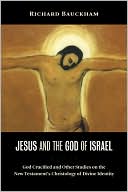
I may be a bit behind on this one, but for those of you who don't know already, Richard Bauckham's newest book, Jesus and the God of Israel (Eerdmans, 2008) is available for purchase. I just received my copy today from Amazon (unlike Chris Tilling, I don't have multiple publishers sending me free books on a regular basis! :)
Anyway, it looks like it will be excellent. Even if you don't agree with all of Bauckham's conclusions (I for one do not), he is in my opinion one of the most creative, brilliant, and thought-provoking New Testament scholars writing today. The discussion that has been provoked by his work, Jesus and the Eyewitnesses, is proof enough for this. And to boot he's prolific-- for the voracious reader, he keeps 'em coming! (So for those of you still waiting for N. T. Wright's sure-to-be-thought-provoking big book on Paul [volume 4 in the series], perhaps this will keep you satisfied in the meantime, unless the Parousia comes first.)
Here are some of the chapter titles:
1. God Crucified
(Containing the entirety of Bauckham's earlier book by this same title, which provoked a great deal of discussion in its own right about the earliest Christology being the highest and articulating what Bauckham calls "christological monotheism" and a "Christology of divine identity.")
2. Biblical Theology and the Problems of Monotheism.
3. The 'Most High' God and the Nature of Early Jewish Monotheism
4. The Worship of Jesus in Early Christianity.
5. The Throne of God and the Worship of Jesus.
6. Paul's Christology of Divine Identity
7. The Divinity of Jesus in the Letter the Hebrews.
8. God's Self-Identification with the Godforsaken in the Gospel of Mark
Two caveats/disappointments on my part.
First, this is not the 'big Christology book' that Bauckham had promised readers way back when God Crucified came out. He's still working on that one, with the provisional title: "Jesus and the Identity of God: Early Jewish Monotheism and New Testament Christology." So don't buy this one expecting to get the final story; it is instead a collection of essays that are fairly independent of one another.
Second, readers will search in vain for a chapter on Jesus' own view (or lack thereof) of his 'divine identity'. The book is all about early Christian Christology, not the Christology of Jesus himself, which is a bit misleading in a book entitled Jesus and the God of Israel. But perhaps that book has yet to be written.
Otherwise, happy reading.
Wednesday, December 24, 2008
Why Was Jesus Born in a Stable?

Every year, around Christmas time, we hear a lot about the fact that Jesus was "born in a manger." There are even songs about it!
However, it is important to point out--as I often do to my students, since it's one of my pet peeves--that Jesus was not born in a manger. According to the Gospel of Luke, he was "laid in a manger"--i.e., a feeding trough for animals--"because there was no place for them in the inn" (Luke 2:7). This suggests that he was born someplace where animals were housed--probably some kind of stable.
Why is this detail significant? First of all, it points up the utter poverty in which Jesus came into the world. But Saint Jerome gives an even deeper reflection (one which I've never heard from the pulpit). According to Jerome, although it would have been fitting for Christ to come into the Holy of Holies in the Temple, he came into this world in a stinking stable, for us:
"Christ found no room in the Holy of Holies that shone with gold, precious stones, pure silk and silver. He is not born in the midst of gold and riches, but in the midst of dung, in a stable where our sins were filthier than the dung. He is born on a dunghill in order to lift up those who come from it: 'From the dunghill he lifts up the poor' (Ps 113:7)" (Jerome, On the Nativity of the Lord, ACCSNT 3:39).
Leave it to Jerome to get right to the point and never mince words.
Gloria in altissimis Deo!
Merry Christmas, everyone.
Tuesday, September 18, 2007
Getting the Big Picture
 I was blown away by the following quote from Gerd Theissen and Dagmar Winter, The Quest for the Plausible Jesus: The Question of Criteria (Louisville: Westminster John Knox Press, 182:
"If someone appears to us to be such a foreign body within his time and environment as not really to belong to it, then a historian would more likely suppose that we do not know enough about his time and environment. Correspondingly, it is valid to say with regard to Jesus that, if on the basis of some words and deeds Jesus sppares in the eyes of many theologians to have left the world of Judaism, it more liekly means that theological scholarship does not yet know this world well enough to judge what was or was not possible and conceivable within it."
In fact, simply chalking up other material deemed non-authentic to the influence of the early Church won't solve the problem since Matthew, Peter, Paul, etc., were all Jews!
So what of the role of Baptism and the celebration of the Eucharist in the New Testament? Many deny such things can be traced back to Jesus himself, recognizing them as later Christian "additions" to the Jesus tradition?
But, again, such an approach fails to account for the Jewishness of the early Church.
Could it be that perhaps we haven't yet adequately understood the cultic understanding of first-century Jews? Perhaps such an understanding could shed light on the development of the Christian cultic practices. Could it be that Christian rites flow from Jesus, a Jew?
Well, that in a nutshell is what I'm working on answering in my dissertation...
Sunday, September 09, 2007
Just Married!
 Well, Kim and I are back from our honeymoon. (For more on Kim, go here.) It was amazing. I thank Brant for his kind post. There's so much to say... I never have been happier in my life than I am right now.
The Nuptial Mass was celebrated at Sacred Heart Catholic Church in Covina--the parish I have always attended since childhood. It was celebrated by my uncle, the incredible priest, Father Peter Irving, whom I've talked a bit about him here on this site. We were deeply honored to have a number of other close priest friends there concelebrating: Fr. Ed Gomez, Fr. Michael Robinson, Fr. Brian Cavanagh, Fr. Scott Daughtery (also mentioned on this blog!), and Fr. Gregory Elder.
The Mass was very beautiful. The music was exceptional. We were very blessed to have the Sacred Heart Adult Choir, directed by Patrick Flahive (who was my grammar school music teacher), in the choir loft. There was a lot of Gregorian Chant--it was awesome!
We were very blessed to have a number of people also come from far away--thanks to the Scott, Kimberly, Michael, Jeremiah, Joe, and David Hahn and Kristin Geers for making the long trip!
Of course, I could go on and on thanking everyone who made it possible. The most important thanks goes to our parents, Tom and Ilene Gilmore and Patrick and Theresa Barber--from them we have learned the most important lessons about living the Christian faith. We are both so grateful to be part of one another's families.
The honeymoon was incredible. About five months ago, my sisters and cousins asked us out to dinner. They told us what they wanted to give us for a wedding present--a dream honeymoon to Rome (Italy, of course, not Alaska).
For two newly-wed Catholics, who both hold advanced degrees in theology, it just can't get any better than that! In fact, we were thinking of simply taking a drive up the coast after the wedding. The only far away locale we mused over was Rome--not truly thinking it was a realistic possibility.
We spent a week there. Here's a short summary.
We started off at the Wednesday general audience with Pope Benedict. We then went to St. Peter's Basilica. We did the Scavi tour under the Basilica, where one can see the excavation that has been done under the Church establishing the virtually certain site of the burial of St. Peter. That has to be among the most amazing things one can see while in Rome.
We then went to the Vatican museums where we spent 4 hours looking around. They have the picture that's on the cover of Coming Soon--an original work done by Raphael. There are so many famous works of art there it is unbelievable. They also have the archeological discoveries of ancient Egypt--including pictures and hieroglyphics from the period of the Exodus, including an image on stone of the Pharaoh who opposed Moses! It is incredible to think that these stones actually were sitting around while Egypt was being run over with locusts and frogs.
The tour ends with the Sistine Chapel, which is, of course, where they elect the new pope. The majority of the work was done by Michelangelo. The ceiling has that famous picture of God's finger touching Adam's in the center. The wall behind the altar is Michelangelo's Last Judgment.
After the museums we took a long walk--which is an awesome thing to do in Rome. It was fun for me because I remember how to get around. I can actually pretty much do it on on foot on my own. We walked from St. Peter's first over to the Pantheon, which was first built by Herod Agrippa. Of course, he was the Herod who condemned Jesus to death and handed him over to Pontius Pilate. He also had John the Baptist beheaded. The original building burned and it was rebuilt by Marcus Agrippa in 125 A.D. It still stands, and is the most ancient intact building in Rome. The building was once a Roman pantheon--a place for all the Roman gods. Now it is a Catholic Church and has priceless works of Christian art all around it.
We then went over to the Trevi Fountain. The legend is that if you throw a coin in the Trevi while you're in Rome you'll one day return. So far it has worked for Kim and I, so, of course, we did it again. Along our walk we also stopped in numerous churches (there's one on every corner--and all of them are spectacular!), including St. Ignatius' and St. Rita's. We also stopped in Herder's book store.
We then visited Santa Maria Maggiore (St. Mary Major), which is really the most important church dedicated to Mary in the whole world. One tidbit important to us Americans--it is said that the ceiling was made with the gold received by Queen Isabella from Christopher Columbus' first trip to the new world. The gold was donated to Rome.
We also went to the Basilica of John Lateran--the Pope's cathedral. A cathedral is a church with the bishop's "cathedra" or "chair"--this is the Pope's, the bishop of Rome. For seven centuries it was the primary Roman Church--since the Avingon excursion, the primary church of the Pope's has really become St. Peter's. Technically, however, his seat is here in John Lateran--a more ancient church. This church has some of the most amazing relics and statues you'll see anywhere, including the supposed-table on which Jesus celebrated the Last Supper. The blessed sacrament chapel has the gold which was taken by Cleopatra in a battle, later given to Augustus (Caesar when Christ was born), inherited by the Emperor Constantine, who used it first to build a temple and then, after his conversion, donated it to the Church. It finally is now in the Lateran. How's that for history!
We also got to go to the holy steps--an ancient site traced back to St. Helen, Constantine's mother.
One of the last things we did was make a trip out to St. Paul's Basilica. Of course, the greatest thing about this church is that St. Paul is buried here--something recently confirmed by an archeological dig. The findings are visible through a glass floor under the altar! This hadn't been done the last time we were here! Here's the news story as it appeared in 2005 when it made headlines (also here). St. Timothy, Paul's close friend a spiritual "child", is buried next to him there. The church also contains the portraits of every single pope through Pope Benedict XVI in chronological. These portraits surround the church. Up above are huge paintings of the life of St. Paul which start in chronological order and wrap around the church.
The greatest part of the visit was that Mass was about to begin when we got there so we got to celebrate the Eucharist there! It was in Italian, but we knew what was going on.
The last day we took a trip out to see the papal summer home in Castel Gandolfo. It is quite beautiful out there.
Thanks so much Noree', Tracee', Julia, Marita, Georgie, Beau, Peter, Kateri and Kellie! We will be able to thank you enough for sending us on this trip!
We made it back and, as much as we love Rome, it was good to be home.
Biblical posts to resume shortly...
Tuesday, September 04, 2007
Was the Prophet Daniel a Member of the Davidic Royal Family?
Michael, this one's for you.
One of the questions Michael (who's still off honeymooning) and I have been exploring in recent months is whether there is any Davidic imagery in the book of Daniel. In particular, we've been intrigued by connections such as the "Son of Man" imagery in the psalms of David (e.g., Psalm 8) and the famous messianic "Son of Man" in Daniel 7. There are many others which we will maybe discuss in future posts.
In the course of the conversations, Michael thought it would be very interesting support for this Davidic imagery if we could show that Daniel was perhaps a member of the royal house of David: i.e, that he may have been an heir to the throne. This was suggested to Michael by the opening verses of Daniel 1, which read:
In the third year of the riegn of Jehoiakim king of Judah, Nebuchadnezzar king of Babylon came to Jerusalem and besieged it. ANd the Lord gave Jehoiakim king of Judah into his hand... Then the king commanded Ashpenaz, the chief eunuch, to bring some of the people of Israel, both of the royal family and of the nobility, youths without blemish, handsome and skilful iin all wisdom, endowned with knowledge, understanding learngin, and competent to serve in the kings palan and to teach the the letters and langaue of the Chaldeans. Among these were Daniel, Hananiah, Mishael, and Azariah of the tribe of Judah. (Dan 1:1-6)
In light of this verse, Michael and I were speculating that perhaps Daniel was not just one of the "people of Israel," but actually a member of the royal family and as such an heir to the Davidic throne. This would be important, because it would potentially heighten the significance of any Davidic imagery in the book of Daniel.
Sure enough, while reading a fascinating first-century A.D. Jewish work known as the Lives of the Prophets, I found the following tradition:
Daniel. This man was of the tribe of Judah, of the family of those prominent in the royal service, but yet while a child he was taken from Judea to the land of the Chaldeans. He was born in Upper Beth-horon, and he was a chaste man, so that the Judeans that that he was a eunuch (Lives of the Prophets 4:1-2)
In the footnote to this text, D.R.A. Hare states that "By combining Dan 1:3, 6 with Isa 39:7, Jewish tradition maintained that Daniel was a member of the royal family" (Charlesworth, OTP, 2:389). In support of this, he refers to both Isaiah and a text from Josephus:
Then Isaiah siad to Hezekiah, "Hear the word of the LORD of hosts: Behold the days are coming, when all that is in your house, and that which your fathers have stored up this day, shall be carried to Babylon; nothings shall be left says the LORD. And some of your own sons, who are born to you, shall be taken away; and they shall be eunuchs in the palace of the king of Babylon." (Isa 39:5-7)
Even more explicit is Josephus:
Now Nebuchadnezzar, king of Babylon, took some of the most noble of the Jews that were children, and the kinsmen of Zedekiah their king, such as were remarkably for their beauty of their bodies and comeliness of their countenances, and delivered them into the hands of tutors... He also made some of them to be eunuchs... Now among these there were four of the family of Zedekiah, of the most excellent dispositions, the one of whom was called Daniel... (Josephus, Antiquities 18.186-189)
One reason this is so significant (for those of you who may be wondering) is that if Daniel was actually a member of the family of Zedekiah--and thus an heir to the Davidic throne--then all of the "kingdom" imagery in the book of Daniel may not be simply generic "apocalyptic" imagery. It may in fact be (coded) Davidic imagery, and hence, by definition, messianic imagery.
All this plays into the debate over whether the "son of Man" in Daniel 7 is in fact the Messiah. Although the text does not explicitly say he is the "messiah" (although cf. Dan 9:24-27), if the "kingdom and dominion" that he receives is in fact the Davidic kingdom--and if it is an heir to the Davidic throne who is having this vision--then this is clearly a messianic text (which is how all the ancient Jews interpreted it, pace Joseph Fitzmyer). We'll do future posts on this, I'm sure, but let me just throw something out:
In Daniel 7, the "son of Man" comes and slays the beasts, in particular "the lion" (Babylonian empire) and "the bear" (the Medo-Persian empire), and then receives the "kingdom." Can you think of any other person who was famous for slaying "lions and bears" before he was elevated to receive a "kingdom"? I'll give you a hint... He's in the books of Samuel.
What's the poin then of Daniel 7? Eventually, the Davidic "son of Man" will triumph over the "beasts" of the pagan empires, and will reign over the universal "kingdom of God" (cf. Daniel 2) forever.
Of course, if Daniel's writing in the second century B.C., when the Davidic kingdom is long gone, none of this coded apocalyptic language makes any sense. But if he's writing during the reign of Babylon, when the Davidic empire is only freshly decimated and its heirs are captive, then all Davidic language and imagery would have to be secret. Which is exactly what we find in the book.
Just some thoughts. More to come.
One of the questions Michael (who's still off honeymooning) and I have been exploring in recent months is whether there is any Davidic imagery in the book of Daniel. In particular, we've been intrigued by connections such as the "Son of Man" imagery in the psalms of David (e.g., Psalm 8) and the famous messianic "Son of Man" in Daniel 7. There are many others which we will maybe discuss in future posts.
In the course of the conversations, Michael thought it would be very interesting support for this Davidic imagery if we could show that Daniel was perhaps a member of the royal house of David: i.e, that he may have been an heir to the throne. This was suggested to Michael by the opening verses of Daniel 1, which read:
In the third year of the riegn of Jehoiakim king of Judah, Nebuchadnezzar king of Babylon came to Jerusalem and besieged it. ANd the Lord gave Jehoiakim king of Judah into his hand... Then the king commanded Ashpenaz, the chief eunuch, to bring some of the people of Israel, both of the royal family and of the nobility, youths without blemish, handsome and skilful iin all wisdom, endowned with knowledge, understanding learngin, and competent to serve in the kings palan and to teach the the letters and langaue of the Chaldeans. Among these were Daniel, Hananiah, Mishael, and Azariah of the tribe of Judah. (Dan 1:1-6)
In light of this verse, Michael and I were speculating that perhaps Daniel was not just one of the "people of Israel," but actually a member of the royal family and as such an heir to the Davidic throne. This would be important, because it would potentially heighten the significance of any Davidic imagery in the book of Daniel.
Sure enough, while reading a fascinating first-century A.D. Jewish work known as the Lives of the Prophets, I found the following tradition:
Daniel. This man was of the tribe of Judah, of the family of those prominent in the royal service, but yet while a child he was taken from Judea to the land of the Chaldeans. He was born in Upper Beth-horon, and he was a chaste man, so that the Judeans that that he was a eunuch (Lives of the Prophets 4:1-2)
In the footnote to this text, D.R.A. Hare states that "By combining Dan 1:3, 6 with Isa 39:7, Jewish tradition maintained that Daniel was a member of the royal family" (Charlesworth, OTP, 2:389). In support of this, he refers to both Isaiah and a text from Josephus:
Then Isaiah siad to Hezekiah, "Hear the word of the LORD of hosts: Behold the days are coming, when all that is in your house, and that which your fathers have stored up this day, shall be carried to Babylon; nothings shall be left says the LORD. And some of your own sons, who are born to you, shall be taken away; and they shall be eunuchs in the palace of the king of Babylon." (Isa 39:5-7)
Even more explicit is Josephus:
Now Nebuchadnezzar, king of Babylon, took some of the most noble of the Jews that were children, and the kinsmen of Zedekiah their king, such as were remarkably for their beauty of their bodies and comeliness of their countenances, and delivered them into the hands of tutors... He also made some of them to be eunuchs... Now among these there were four of the family of Zedekiah, of the most excellent dispositions, the one of whom was called Daniel... (Josephus, Antiquities 18.186-189)
One reason this is so significant (for those of you who may be wondering) is that if Daniel was actually a member of the family of Zedekiah--and thus an heir to the Davidic throne--then all of the "kingdom" imagery in the book of Daniel may not be simply generic "apocalyptic" imagery. It may in fact be (coded) Davidic imagery, and hence, by definition, messianic imagery.
All this plays into the debate over whether the "son of Man" in Daniel 7 is in fact the Messiah. Although the text does not explicitly say he is the "messiah" (although cf. Dan 9:24-27), if the "kingdom and dominion" that he receives is in fact the Davidic kingdom--and if it is an heir to the Davidic throne who is having this vision--then this is clearly a messianic text (which is how all the ancient Jews interpreted it, pace Joseph Fitzmyer). We'll do future posts on this, I'm sure, but let me just throw something out:
In Daniel 7, the "son of Man" comes and slays the beasts, in particular "the lion" (Babylonian empire) and "the bear" (the Medo-Persian empire), and then receives the "kingdom." Can you think of any other person who was famous for slaying "lions and bears" before he was elevated to receive a "kingdom"? I'll give you a hint... He's in the books of Samuel.
What's the poin then of Daniel 7? Eventually, the Davidic "son of Man" will triumph over the "beasts" of the pagan empires, and will reign over the universal "kingdom of God" (cf. Daniel 2) forever.
Of course, if Daniel's writing in the second century B.C., when the Davidic kingdom is long gone, none of this coded apocalyptic language makes any sense. But if he's writing during the reign of Babylon, when the Davidic empire is only freshly decimated and its heirs are captive, then all Davidic language and imagery would have to be secret. Which is exactly what we find in the book.
Just some thoughts. More to come.
Friday, August 24, 2007
Michael and the Magnum Sacramentum
For those of you who didn't know, Michael's getting married tomorrow!!!
This is of course one of the reasons he hasn't been able to post as much in the last two weeks. So, in honor of my good friend and his beautiful bride-to-be, I've just decided to post here a few reflections for him on the nature of what he's about to enter into. (Michael, I know full well you know this stuff already, but maybe when you get back you can help me live it, too!)
The first thing to remember is that marriage is at its very deepest mystery about imaging the life-giving love of the Trinity . This love is supernatural, totally selfless, and fruitfull. No biggie, just remember what the Catechism teaches:
God who created man out of love also calls him to love--the fundamental and innate vocation of every human being. For man is created in the image and likeness of God who is himself love. Since God created him man and woman, their mutual love becomes an image of the absolute and unfailing love with which God loves man. It is good, very good, in the Creator's eyes. (CCC 1604)
Second, always remember that you can't do this on your own power. It takes the grace of God and the power of Christ. That is of course why marriage was elevated to the status of a sacrament. Again, the Catechism teaches:
[Jesus'] unequivocal insistence on the indissolubility of the marriage bond may have left some perplexed and could seem to be a demand impossible to realize. However, Jesus has not placed on spouses a burden impossible to bear, or too heavy--heavier than the law of Moses. By coming to restore the original order of creation destroyed by sin, he himself gives the strength and grace to live marriage in the new dimension of the Reign of God. It is by following Christ, renoucing themselves, and taking up their crosses that spouses will be able to "receive" the original meaning of marriage and live it with the help of Christ. This grace of Christian marriage is a fruit of the cross, the source of all Christian life" (CCC 1615)
The third and final piece of advice flows directly from that last line: always pray for the grace to be willing to climb up on the Cross for your bride. The great error of the world is that it wants the joy of the marriage bed without the cross of the marriage covenant. But there is no marriage without the Cross; it was the Cross that was Christ's marriage bed. "The day will come when the Bridegroom is taken from them, and they will fast on that day" (Mark 2:20). It was there that he sealed the covenant with his Bride: "When Jesus had received the wine, he said, 'It is finished' (Lat consummatum est); and he bowed his head, and he gave up his spirit" (John 19:30). The great mystery of marriage is that at its heart lies a cross, and that only by dying to yourself will the life that is the fruit of marriage spring forth.
Saint Paul, of course, knew all this. This is why he called marriage "the great sacrament":
Husbands, love your wives, as Christ loved the church and gave himself up for her, that he might sanctify her by the washing of water with the word, that he might present the church to himself in splendor, without spot or wrinkle or any such thing, that she might be holy and without blemish. Even so husbands should love their wives as their own bodies... "For this reason a man shall leave his father and mother and be joined to his wife, and two shall become one." This is a great mystery (Lat magnum sacramentum) and I mean in reference to Christ and the Church (Eph 5:25-32)
As one of my favorite theologians likes to say, all this is not difficult, it's just humanly impossible! But with God's grace "all things are possible." And I know that His grace will be with you and Kimberly. Many blessings to you both. We will be praying for you this weekend.
Congratulations, Buddy!
This is of course one of the reasons he hasn't been able to post as much in the last two weeks. So, in honor of my good friend and his beautiful bride-to-be, I've just decided to post here a few reflections for him on the nature of what he's about to enter into. (Michael, I know full well you know this stuff already, but maybe when you get back you can help me live it, too!)
The first thing to remember is that marriage is at its very deepest mystery about imaging the life-giving love of the Trinity . This love is supernatural, totally selfless, and fruitfull. No biggie, just remember what the Catechism teaches:
God who created man out of love also calls him to love--the fundamental and innate vocation of every human being. For man is created in the image and likeness of God who is himself love. Since God created him man and woman, their mutual love becomes an image of the absolute and unfailing love with which God loves man. It is good, very good, in the Creator's eyes. (CCC 1604)
Second, always remember that you can't do this on your own power. It takes the grace of God and the power of Christ. That is of course why marriage was elevated to the status of a sacrament. Again, the Catechism teaches:
[Jesus'] unequivocal insistence on the indissolubility of the marriage bond may have left some perplexed and could seem to be a demand impossible to realize. However, Jesus has not placed on spouses a burden impossible to bear, or too heavy--heavier than the law of Moses. By coming to restore the original order of creation destroyed by sin, he himself gives the strength and grace to live marriage in the new dimension of the Reign of God. It is by following Christ, renoucing themselves, and taking up their crosses that spouses will be able to "receive" the original meaning of marriage and live it with the help of Christ. This grace of Christian marriage is a fruit of the cross, the source of all Christian life" (CCC 1615)
The third and final piece of advice flows directly from that last line: always pray for the grace to be willing to climb up on the Cross for your bride. The great error of the world is that it wants the joy of the marriage bed without the cross of the marriage covenant. But there is no marriage without the Cross; it was the Cross that was Christ's marriage bed. "The day will come when the Bridegroom is taken from them, and they will fast on that day" (Mark 2:20). It was there that he sealed the covenant with his Bride: "When Jesus had received the wine, he said, 'It is finished' (Lat consummatum est); and he bowed his head, and he gave up his spirit" (John 19:30). The great mystery of marriage is that at its heart lies a cross, and that only by dying to yourself will the life that is the fruit of marriage spring forth.
Saint Paul, of course, knew all this. This is why he called marriage "the great sacrament":
Husbands, love your wives, as Christ loved the church and gave himself up for her, that he might sanctify her by the washing of water with the word, that he might present the church to himself in splendor, without spot or wrinkle or any such thing, that she might be holy and without blemish. Even so husbands should love their wives as their own bodies... "For this reason a man shall leave his father and mother and be joined to his wife, and two shall become one." This is a great mystery (Lat magnum sacramentum) and I mean in reference to Christ and the Church (Eph 5:25-32)
As one of my favorite theologians likes to say, all this is not difficult, it's just humanly impossible! But with God's grace "all things are possible." And I know that His grace will be with you and Kimberly. Many blessings to you both. We will be praying for you this weekend.
Congratulations, Buddy!
Sunday, June 03, 2007
The Lost Tribes of Israel, the Promised Land, and the New Creation
 A few weeks ago, one of our (obviously intelligent) readers, David, asked a great question: If Jesus seeks to bring about the restoration of Israel, then what happens to God’s promise to gather the lost tribes of Israel back to the land (cf. Isa 11; Ezek 37; Mic 4, etc.)? Is this promise simply abandoned? Or does the New Testament “over-spiritualize the gospel” (David’s words) it by referring it to the heavenly Jerusalem (e.g., Heb 12)? As he said, “Doesn’t there have to be a bit more to it than that?”
Yes, there is a bit more to it than that.
In the midst of preparing a very lengthy response to David’s question, I realized that the blog would not be the appropriate place to go into the kind of detail I need to on a question of this magnitude. However, I have recently discovered some texts that I think will at least take us further down the path that Michael already started us on by pointing to the fact that the Levites inheritance was not the land of Israel but God himself (see below)—and, as Taylor Marshall has pointed out, the “micro-cosm” of the Tabernacle (see his blog). To add to these points, I would make the following.
First, for ancient Judaism itself—not simply Christianity—the Promised Land is not considered the ultimate “geographical” destiny of Israel. The ultimate destiny of Israel is the new Promised Land of the new Creation: “the new heavens and the new earth” promised by God (cf. Isa 65-66).
Second, Jesus ties his own eschatological hopes not to the earthly Promised Land, but, like other Jews, to this new Creation—the life of “the world to come.”
One does not have to look far to find evidence of this in ancient Judaism. Take, for example, the teaching of the Mishnah:
All Israelites have a share in the world to come, for it is written, “Thy people also shall be all righteous, they shall inherit the land forever; the branch of my planting, the work of my hands that I may be glorified (citing Isa 60:21) (m. Sanh. 10:1).As W. D. Davies points out in his monumental (and monumentally ignored) work, The Gospel and the Land, regarding this text: “here ‘inherting the land’ is equated with having a share in ‘the world to come’” (Heb ha olam habba) (p. 123). This equation is of fundamental significance: even for Rabbinic Judaism, which is often characterized as “this-worldy” in its eschatology, the earthly Promised Land could be considered merely a sign of the new Creation and “the world to come.” And note well that this is no case of “eis-egesis,” for the text cited by the Mishnah—Isaiah 60:21—is a prophecy of the New Jerusalem, which describes a realm where “the sun shall be no more” because “the LORD will be your everlasting light” (Isa 60:19-22). Is this a prophecy of a mere earthly return to Palestine? Or is it about “the new heavens and the new earth” that Isaiah himself will go on to describe (Isa 65-66)?
Should there be any doubt about the strength of this ancient Jewish link between the Promised Land and the new Creation, we need only turn to the Talmudic commentary on the Mishnah. This text—much to my happiness—not only links the Promised Land and the World to Come, but ties both of them to the return of the lost tribes of Israel! Again, in the context of debating whether or not the ten tribes would ever return to the Land—something Rabbi Akiba doubted—the Mishnah reads as follows:
The ten tribes will not return [to Palestine], for it is said, “and cast them into another land,” as is this day: just as the day goes and does not return, so they too went and will not return: this is Rabbi Akiba’s view. Rabbi Eliezer said: as this day—just as the day darkens and then becomes light again, so the ten tribes—even as it went dark for them, so it will become light for them.The Talmud commentary on this passage reads (and this is where it gets cool!):
Our Rabbis taught: The ten tribes have no portion in the world to come, as it says, “And the Lord rooted them out of their land in anger, and in wrath, and in great indignation.” “And the Lord rooted them out of their land” refers to this world, and cast them into another land—to the world to come; this is Rabbi Akiba’s view. Rabbi Simeon ben Judah… said on Rabbi Simeon’s authority: If their deeds are as this days, they will not return; otherwise, they shall. Rabbi said: They will enter the future world, as it is said: “And it shall come to pass in that day, that the great trumpet shall be blow and they shall come which were ready to perish in the land of Assyria, and the outcasts in the land of Egypt, and shall worship the Lord in the holy mount of Jerusalem (b. Sanh. 110b, cited in Davies, p. 124).Notice the Rabbis commentary: the Promised “Land” is equated both with “the world to come”—as distinct from “this world”—and “the future world.” Notice that this even applies to exile from the Promised Land, which seems to have eternal significance as well. Perhaps most important of all: for the Rabbis, the “return” of the lost tribes of Israel to “the land” is equated with their entry into the “future world” and their ability to “worship” on “the holy mount of Jerusalem”! The significance of this is staggering: the Rabbis themselves are recognizing that the hopes of ancient Israel—including the return of the lost ten tribes—will not be fulfilled in “this world,” but in “the world to come”—the new Creation—and the new Jerusalem that will be part of that new Creation. The return of the lost tribes to the Promised Land, the inauguration of the new Creation, and the restoration of Jerusalem are all bound up with one another. It is important to note again that the Rabbis are rooting these connections is Scripture itself, by alluding to prophecies of the return of the lost tribes from Assyria in Isa 11 and to “the holy mount of Jerusalem” described in Isa 27:13.
But I forget myself. What does all this have to do with Jesus? Well, just like the Rabbis, he too connected the restoration of the twelve tribes with the coming of a new Creation and the “world to come.” I submit only one text here: Peter asks Jesus what he and the disciples will get for giving up this-worldly goods, and Jesus says:
Amen, I say to you, in the new creation (Gk palingenesia), when the Son of Man shall sit on his glorious throne, you who have followed me will also sit on twelve thrones, judging the twelve tribes of Israel. And every one who has left houses or brothers or sisters or father or mother or children or lands for my names sake, will receive a hundredfold, and inherit eternal life (Matt 19:28-29)Here Jesus equates the restoration of creation—the “regenesis”—with the restoration of the twelve tribes of Israel and the “inheriting” of “eternal life.” But wait—I thought the Old Testament said Israel was to “inherit” the land? Yes, but not the earthly land of the fallen creation—rather, they will inherit the new Promised Land of the restored creation, which Jesus, like Rabbi Akiba, equated with the new Creation. Should there be doubts about this connection, notice that that in Mark’s version of the saying, Jesus says “in the age to come eternal life”—using the exact Rabbinic expression (Mark 10:30).
There is, of course, much more to say here, but I hope this partially answers David’s question. The early Christian hope was not simply for a new, heavenly Jerusalem, it was for a new Creation. It, like the hope of some Rabbis—and, more importantly, of Isaiah—was a cosmic hope for the restoration of all Israel and all creation.
This is, of course, why at every Sunday Mass, we Catholics profess in the final line of the Nicene Creed: “We believe in the resurrection of the body, and the life of the world to come.”
Amen.
Friday, April 20, 2007
Will Elijah Come Twice?

I frequently find some of my favorite pieces of information simply by pulling random books off the shelf and turning to random pages. This happened last night with one of my favorite (and most expensive) volumes on my shelf: James Scott's Restoration: Old Testament, Jewish, and Christian Perspectives (Brill, 2001), p. 266.
I opened to an article on restoration eschatology in Rabbinic Judaism by Chaim Milikowsky and found a fascinating quote from a Rabbinic work I've never read (or heard much discussed): Seder Olam. This text, which is attributed to Rabbi Yose ben Halaphta (2nd cent A.D.), relates an ancient Jewish tradition that Elijah will come twice: once at the time of the Messiah, and again during the final Great Tribulation. It reads:
In the second year of Azariah (King of Israel) Elijah was hidden away and is not seen until the messiah comes. In the days of the messiah he will be seen and hidden away a second time and will not be seen until Gog will arrive. At present he records the deeds of all generations. (Seder Olam, chap. 17)
This is a fascinating quote, for it suggests that there was an expectation in ancient Judaism that Elijah would not only return, but that he would come twice: once during the days of the Messiah and then a second time during the time of "Gog." This second reference is a reference to the mysterious days of Gog and Magog described in Ezekiel 38-39, after the coming of the Messiah in Ezekiel 37. As many people are aware the days of Gog and Magog are linked in Jewish eschatology and the New Testament with the Great Tribulation that will precede the Final Judgment and the resurrection of the dead (see, e.g., Rev 20:7-10).
One reason this was so interesting to me was that I had already argued in my book on Jesus and the Tribulation that Jesus held John the Baptist to be the new Elijah and that there was a link between the persecution and death of John as Elijah and the eschatological tribulation (see chapter 3 on Mark 9:11-13; Matt 11:11-15). Here this link is confirmed by a rabbinic text of which I was totally unaware when I wrote the dissertation.
Moreover, the passage also is intriguing because it illuminates another quite baffling text in the book of Revelation, which describes the coming of two witnesses during a time of tribulation and persecution. One of these witnesses is described as an Eljiah figure, who "shuts the sky" so that "no rain may fall" just as Elijah did in the Old Testament (Rev 11:4-7). Unfortunately, the beast ascends from the bottomless pit and kills this new Elijah, along with his Moses-like counterpart. Clearly this is a time of tribulation...
Finally, and perhaps most intriguingly, it is a well known fact that many orthodox Jews today are still waiting for the (first) coming of Elijah. This is particularly expressed through the tradition of the Jewish Passover seder, where a cup of wine is left for Elijah to drink when he comes. For Christians, Jesus declares that "Elijah has come" in the figure of John the Baptist (Mark 8:13). But perhaps there is room for agreement here, if we both somehow await Elijah's "Second Coming"? Just a thought, just speculation, but interesting nonetheless...
Thursday, April 05, 2007
Holy Thursday, the Eschatological Passover, and the Flesh of the Lamb
 One of the most fascinating “discoveries” I made during the course of writing my dissertation on Jesus (now published as Jesus, the Tribulation, and the End of the Exile) was that there is a strong link between the eschatological tribulation—the suffering that many Jews expected to precede the coming of the Kingdom of God—and the eschatological Passover—the time of trial that was expected to set in motion the New Exodus. Indeed, one could even argue that the two are identical; just as the eschatological tribulation would set in motion the coming of the Kingdom, so too the eschatological Passover would inaugurate the coming of the New Exodus. In this New Exodus, so the prophets foretold, God would once again save his people in ways that paralleled the salvation he had brought to Israel in their liberation from Egypt, in the days of Moses (see Isa 11; Jer 3, 31; Ezek 36-37, etc). The key difference is that it would not be Moses, but the Messiah, who inaugurated the New Exodus, a messianic Exodus.
After making finding this, I was quite excited—and quite in awe of my own brilliance and originality—when one day I was reading one of the sections on eschatology in the Catechism of the Catholic Church (CCC 668-82) This fascinating section deals with such topics as the Parousia, the conversion of all Israel, the coming of the Antichrist, and the great tribulation that will precede the Second Coming. In the midst of reading, I was stunned to find that yet another of my “discoveries” had been preempted by the Church:
“Before Christ’s second coming the Church must pass through a final trial that will shake the faith of many believers... [goes on to describe the eschatological tribulation] The Church will enter the glory of the kingdom only through this final Passover, when she will follow her Lord in his death and Resurrection.” (CCC 675-76)I just about fell on the floor when I read this; what had taken me two years of meticulous research and reading of the Bible and ancient Jewish sources to discover was right here in the Church’s teaching. What had hit me like a lightning bolt was mentioned here, almost in passing, in the Catechism.
But I was not to be outdone. For my second major “discovery” was to link this eschatological Passover not only with Jesus’ suffering and death but with his actions at the Last Supper. The reason the link between tribulation and Passover is important is that it helps to explain why Jesus had to celebrate the Passover meal of the Last Supper with his disciples before his passion and death, which he had taught would inaugurate both the New Exodus and the coming of the Kingdom of God. The reason: just as the first Exodus was set in motion by the sacrifice of the Passover lamb, so too would the New Exodus be set in motion by a New Passover, the eschatological Passover sacrifice of Jesus himself. It was this sacrifice that he celebrated and set in motion at the Last Supper (Matt 26; Mark 14; Luke 22, etc.) Pretty cool, huh?
Well, the Church has this one in the bag, too. During morning prayer today, I was praying the Scriptures for the feast of Holy Thursday. In my particular missal (the Daily Roman Missal, ed. by James Socias), the Scripture readings are prefaced by quotes from the Catechism. In the quote for today’s readings, I found a paragraph I have read many times over, but never noticed in quite this way:
By celebrating the Last Supper with his apostles in the course of the Passover meal, Jesus gave the Jewish Passover its definitive meaning. Jesus’ passing over to his father by his death and Resurrection, the new Passover, is anticipated in the Supper and celebrated in the Eucharist, which fulfills the Jewish Passover and anticipates the final Passover of the Church in the glory of the kingdom (CCC 1340).Foiled again! I’m starting to think that the only “original” insights I’ve ever had about Scripture are the ones that are wrong. But that’s okay; maybe one day it will actually help me become humble.
Anyway, there are at least three reasons all of this is significant for today’s feast, the feast of the Lord’s Supper.
First, the connection between the new Passover and the Last Supper shows the eschatological significance of the first Eucharist. For it was the Last Supper—as the New Passover—that fulfilled the Jewish Passover, inaugurated the New Exodus, and anticipated the eschatological Passover of the Church into the glory of the Kingdom of God. This was no mere “farewell meal”; it was the eschatological turning point of the ages, the typological and eschatological event that inaugurated the coming of the age of salvation.
Second, it shows the true link between the sacrifice of Jesus and the coming of the Kingdom. Albert Schweitzer once (in)famously stated that Jesus threw himself on the wheel of history in order to force it to turn and bring in the Kingdom, but instead it crushed him. Balderdash. He threw himself on no wheel. Rather, he laid his body on the wooden table of the Upper Room and on the wooden altar of the Cross, and through these acts showed the world the only signs of God’s love that will ever suffice to move it one inch. This is why the Church can teach that “The Kingdom of God has come in Christ’s death and Resurrection”; indeed, “the Kingdom of God has been coming since the Last Supper, and, in the Eucharist, it is in our midst” (CCC 2816).
Third and finally, if Jesus is the eschatological Passover lamb of the New Exodus, then what are we called to do? How did the Israelites of the first Exodus respond? Well, first and foremost, they kept the feast of Passover each year in “remembrance” of what the Lord had done for them (Exod 12:14). We do this at every Eucharist, but today, on Holy Thursday, in a special way. But even more to the point: the sacrifice of the Passover was not completed simply by the death of the victim. That was not ultimately what God wanted. No, what he wanted was a covenant. Hence, the Israelites were commanded not only to kill the lamb, but to “eat the flesh” of the lamb (Exod 12:8). The sacrifice of the first Passover was not completed by the death of the victim, but by communion through the very flesh which had delivered them from death. So too today; we eat “the flesh of the Lamb of God who takes away the sin of the world,” just as he commanded us (John 1:29; 6:55). And, we rejoice, as John said so many centuries ago: “Blessed are those who are invited to the marriage supper of the Lamb” (Rev 19:9).
Many blessings on all of you during this Holy Week and the Sacred Triduum.
Monday, March 26, 2007
Authorship of the Fourth Gospel
 Who wrote the Fourth Gospel?
I've been working on my lecture on John for my Intro to New Testament class. I'm feeling a little overwhelmed by the weight of the earliest testimony regarding the question of authorship.
Clearly the unanimous testimony of the early Church was that John the Apostle wrote the book. Two of the clearest references are found in Irenaeus and the Muratorian fragment.
Irenaeus, Adv. Haer. 3. 3. 4: “Afterwards, John, the disciple of the Lord, who also had leaned upon His breast, did himself publish a Gospel during his residence at Ephesus in Asia.”
Muratorian Canon: The fourth of the Gospels, that of John, (one) of the disciples. When his fellow-disciples and bishops urged him, he said: Fast with me from today for three days, and what will be revealed to each one let us relate to one another. In the same night it was revealed to Andrew, one of the apostles, that, whilst all were to go over (it), John in his own nameshould write everything down.
Other writers who support this view include Tertullian, Clement of Alexandria, and Origen.
In addition, we should note that there is absolutely no manuscript of the Gospel which attributes authorship to anyone else. I think this is too often overlooked.
But does the testimony of the early Church fit the internal evidence? I think so.
1) Eye-witness status of the author. It seems to have been written by someone claiming to be an eye-witness. In some cases this is explicitly stated.
John 1:14: And the Word became flesh and dwelt among us… we have beheld his glory…
John 19:35: He who saw it has borne witness—his testimony is true, and he knows that he tells the truth—that you also may believe.
Other passage seem to be most intelligibly read as eye-witness testimony.
John 13:23-30: One of his disciples, whom Jesus loved, was lying close to the breast of Jesus; 24 so Simon Peter beckoned to him and said, “Tell us who it is of whom he speaks.” 25 So lying thus, close to the breast of Jesus, he said to him, “Lord, who is it?” 26 Jesus answered, “It is he to whom I shall give this morsel when I have dipped it.” So when he had dipped the morsel, he gave it to Judas, the son of Simon Iscariot. 27 Then after the morsel, Satan entered into him. Jesus said to him, “What you are going to do, do quickly.” 28 Now no one at the table knew why he said this to him. 29 Some thought that, because Judas had the money box, Jesus was telling him, “Buy what we need for the feast”; or, that he should give something to the poor. 30 So, after receiving the morsel, he immediately went out; and it was night.
In my view, the recounting of the "beckoning" gesture of Peter is highly suggestive of eye-witnesse testimony. Moreover, it is hard to imagine that the description of the apostles' assumptions regarding Judas' activity at the Last Supper was meant to be read in a way that did not involve recognition of the author's presence in the Upper Room.
2) Added details. There are stories in the Fourth Gospel which appear in the Synoptics--but there is also the appearance of added details, which simply cannot be explained away as theological symbolism. Jesus multiplied five barley loaves (6:9); in the account of Jesus walking on the water John includes a mention of the distance rowed by the disciples across the Sea of Galilee ("twenty five or thirty stadia," 6:19); in the account of the anointing at Bethany, the odor of the woman’s anointing filled the house (12:3); the reaction of the soldiers in the garden to his statement, “I AM” (18:6); the weight of spices brought to Jesus' tomb as about a hundred pounds (19:39). There were also the six stone jars at the wedding in Cana (2:9) and the number of fish caught (153) and the distance the boat was from the land (about a hundred yards), on the occasion of the post-resurrection appearance of Jesus to his disciples (21:8, 11). In addition, we find some inside information about the reactions of the disciples (e.g. 2:11 f.; 4:27; 6:19; 12:16; 13:22 f.) and of the Lord himself (cf. 2:11, 24; 6:15, 61; 13:1). Again, I think all of this is highly suggestive of eye-witness testimony.
3) Familiarity with Jewish Beliefs and Palestinian Geography. The author has a remarkable knowledge of Jewish cultic concerns (purification rites, 2:6; the likely allusion to the libation and illumination ritual at the Feast of Tabernacles 7:37; 8:12; pollution concerns prior to eating the Passover, 18:28; 19:31–42), common Jewish beliefs (the laws concerning the sabbath, 5:10; 7:2 1–23; 9:14 ff.; ideas of hereditary sin, 9:2), and intimate knowledge of Palestinian geography (the knowledge of two Bethanys, 1:28; 12:1; of Aenon near Salim, 3:23; of Cana in Galilee, 2:1; 4:46; 21:2; of Tiberias as an alternative name for the Sea of Galilee, 6:1; 21:1; of Sychar near Shechem, 4:5; Mt. Gerizim's location near a well, 4:21; of Ephraim near the wilderness, 11:54; mention of the pool of Siloam, 9:7). It seems clear that the Gospel is written by a Palestinian with Israelite stock.
4) The "Beloved Disciple" and the Inner Circle. An an important passage in determining authorship comes at the end of the Gospel:
John 21:20-24: Peter turned and saw following them the disciple whom Jesus loved, who had lain close to his breast at the supper and had said, “Lord, who is it that is going to betray you?” 21 When Peter saw him, he said to Jesus, “Lord, what about this man?”… 24 This is the disciple who is bearing witness to these things, and who has written these things; and we know that his testimony is true.
Of course, different scholars have put forth different theories. One line of thought has pointed to the rich young ruler in Mark's Gospel, of whom it is said that Jesus “loved him” (Mark 10:21). Another has suggested that the author is Lazarus (=John 11:3: “he whom you love”). Yet, it is clear that the author is most likely one of the seven mentioned in chapter 21. One of the 7 mentioned in John 21:
John 21:1-2: "After this Jesus revealed himself again to the disciples by the Sea of Tiberi-as; and he revealed himself in this way. 2 Simon Peter, Thomas called the Twin, Nathana-el of Cana in Galilee, the sons of Zebedee, and two others of his disciples were together."
From this list, it would make most sense to suppose that the "beloved disciple"--the author of the Gospel--is one of the sons of Zebedee or one of the two other disciples.
It is interesting to note that, with one exception (John 19:26-27), this disciple is always associated with Peter (in addition to below, see John 13:23-30 above). An example of this is found in John 20:1-10.
John 20:1-10: Now on the first day of the week Mary Magdalene came to the tomb early, while it was still dark, and saw that the stone had been taken away from the tomb. 2 So she ran, and went to Simon Peter and the other disciple, the one whom Jesus loved, and said to them, “They have taken the Lord out of the tomb, and we do not know where they have laid him.” 3 Peter then came out with the other disciple, and they went toward the tomb. 4 They both ran, but the other disciple outran Peter and reached the tomb first; 5 and stooping to look in, he saw the linen cloths lying there, but he did not go in. 6 Then Simon Peter came, following him, and went into the tomb; he saw the linen cloths lying, 7 and the napkin, which had been on his head, not lying with the linen cloths but rolled up in a place by itself. 8 Then the other disciple, who reached the tomb first, also went in, and he saw and believed; 9 for as yet they did not know the scripture, that he must rise from the dead. 10 Then the disciples went back to their homes.
In the Synoptic Gospels it seems clear that Peter along with James and John make up a kind of "inner circle". In addition to the Transfiguration, where Jesus takes these three up the mountain (cf. Matt 17:1//Mark 9:2//Luke 9:28), we could mention other passages.
Mark 5:35-43: While he was still speaking, there came from the ruler’s house some who said, “Your daughter is dead. Why trouble the Teacher any further?” 36 But ignoring what they said, Jesus said to the ruler of the synagogue, “Do not fear, only believe.” 37 And he allowed no one to follow him except Peter and James and John the brother of James…
Mark 13:32-33: And they went to a place which was called Gethsemane; and he said to his disciples, “Sit here, while I pray.” 33 And he took with him Peter and James and John, and began to be greatly distressed and troubled.
Indeed, if the Synoptic Gospels are to be believed, Jesus gave Peter, James and John special attention. It would be natural to expect that the Fourth Gospel's "Beloved Disciple," who has a special relationship with Jesus, is likely one of these three.
Now, it has been noted that the "Beloved Disciple" is virtually always associated with Peter. In connection with this should also be noticed that Luke seems to frequently associate Peter and John.
Luke 22:7-13: When came the day of Unleavened Bread, on which the passover lamb had to be sacrificed. 8 So Jesus sent Peter and John, saying, “Go and prepare the passover for us, that we may eat it.”
Acts 3:1: Now Peter and John were going up to the temple at the hour of prayer, the ninth hour.
Acts 4:13, 19: Now when they saw the boldness of Peter and John, and perceived that they were uneducated, common men, they wondered; and they recognized that they had been with Jesus. 14 But seeing the man that had been healed standing beside them, they had nothing to say in opposition. 19 But Peter and John answered them, “Whether it is right in the sight of God to listen to you rather than to God, you must judge; 20 for we cannot but speak of what we have seen and heard.”
Acts 8:14: Now when the apostles at Jerusalem heard that Samaria had received the word of God, they sent to them Peter and John…
If the "Beloved Disciple" is one of the three in the inner circle, I think it makes most sense to see him as John the Apostle, which beautifully dovetails with the overwhelming testimony of the Church fathers. Having carefully considering the internal evidence in the past few days, I can't find a good reason for denying their testimony.
In conclusion, I want to say that, at first blush, it would seem that the "academically responsible" approach would be to remain noncommittal about Johannine authorship. However, I'm coming to the conclusion that the opposite is true. Hedging on Johannine authorship seems to betray an unwillingness to acknowledge the coherence of the early testimony with the internal evidence. One wonders if such reluctance is motivated by other concerns. Clearly, asserting that someone like the rich young ruler is the author of the Fourth Gospel seems to stretch the limits of credulity. Rather, it would seem the unanimous patristic witness was reliable when it held that the Gospel the manuscripts all call "The Gospel According to John" was written by, well... er, John.
Subscribe to:
Posts (Atom)