Thursday, February 26, 2015

The Beloved Son and the Freedom of the Glory of the Children of God: The Readings for the Second Sunday in Lent

In the second Sunday of Lent, the Church invites us to contemplate the cruciform of the glory of the Beloved Son by linking a series of texts that at first blush might not appear to fit together. However, in this brief reflection, it will be argued that they do indeed fit together and can be united together through Paul’s statement in Romans 8:21, “that creation itself will be set free from its bondage to decay and will obtain the freedom of the glory of the children of God.” In order to illuminate this inner rationale, we begin with the first reading from Genesis 22.

First Reading: Genesis 22:1-2, 9a, 10-13, 15-18
God put Abraham to the test.
He called to him, “Abraham!”
“Here I am!” he replied.
Then God said:
“Take your son Isaac, your only one, whom you love,
and go to the land of Moriah.
There you shall offer him up as a holocaust
on a height that I will point out to you.”

When they came to the place of which God had told him,
Abraham built an altar there and arranged the wood on it.
Then he reached out and took the knife to slaughter his son.
But the LORD’s messenger called to him from heaven,
“Abraham, Abraham!”
“Here I am!” he answered.
“Do not lay your hand on the boy,” said the messenger.
“Do not do the least thing to him.
I know now how devoted you are to God,
since you did not withhold from me your own beloved son.”
As Abraham looked about,
he spied a ram caught by its horns in the thicket.
So he went and took the ram
and offered it up as a holocaust in place of his son.

Again the LORD’s messenger called to Abraham from heaven and said:
“I swear by myself, declares the LORD,
that because you acted as you did
in not withholding from me your beloved son,
I will bless you abundantly
and make your descendants as countless
as the stars of the sky and the sands of the seashore;
your descendants shall take possession
of the gates of their enemies,
and in your descendants all the nations of the earth
shall find blessing—
all this because you obeyed my command.”
In our first reading, the Church turns our attention to one of the most important passages of the entire Old Testament, Genesis 22, the account known as the Aqedah. Before examing this pasasge, it is worth situating it within the wider Abrahamic narrative and in particular, beginning with Genesis 12:1-3. In Genesis 12:1-3, God makes three promises to Abram, (great nation, great name, and blessing to the nations) and each of these promises is in some way elevated to the status of a divine covenant within the Abrahamic narrative (see Genesis 15 and 17 for the first two).[1]

In turning to our passage, it is the promise to bless all nations that is elevated to the status of a divine covenant. While it is true that God has indeed already promised to Abram that all nations would be blessed through him (Gen 12:3), here in Genesis 22 this promise becomes a divine covenant, for God swears by himself that all nations will be blessed through Isaac.

In fact, in his outstanding monograph The New Isaac, Leroy Huizenga suggests four unique aspects to our reading: first, the blessing of Abraham is now categorical, “I will bless you.” Second, Abraham’s descendents are now likened to both the sand of the seashore (22:17) and the stars of the sky (22:17, 15:5). Third, the unique divine oath, for here it is God who swears by his very self to fulfill his covenant with Abraham. Fourth and finally, it is here that God declares that it is now through Abraham’s seed, Isaac, that the nations will be blessed.[2]

In addition to these four aspects, Huizenga also notes that it is possible to detect something of an active role for Isaac in the story, for in addition to Abraham and Isaac “walking together united,” (Gen 22: 6, 8) the Septuagint calls Isaac τὸ παιδάριον (paidarion), which in Gen 37:30 is used to describe seventeen year old Joseph.[3]

Another hint centers on the use of the term “beloved” son for Isaac in the Septuagint, for it can have the connotation of favor due to obedience. [4] In any event, it is very significant that the Septuagint calls Isaac Abraham’s “beloved son,” for this is precisely how God describes Jesus in our Gospel reading for this week.

Before moving on from the first reading, it is important to further illuminate the inner rationale behind this event, and while much more could be said about it, for our purposes it appears best to focus on the nature of the sacrifice that elicited God’s oath to bless the nations.

In the Aqedah, Abraham passes God’s test by offering to God what was dearest to him, his son Isaac, and this sacrifice unto death leads to life, in this case, both God sparing Isaac’s life and swearing to bless the nations through the “beloved Son.” Moreover, Abraham’s offering also becomes the paradigmatic act of sacrifice and fidelity, as can be seen from the fact that the place of this near sacrifice, Mount Moriah, is by the fourth-century B.C. identified as the location of the temple mount in Jerusalem (see 2 Chronicles 3:1; Jubilees, 18:13; Josephus, Ant. 1.224).


Responsorial Psalm 116: 10, 15, 16-17, 18-19
R. (116:9) I will walk before the Lord, in the land of the living.
I believed, even when I said,
“I am greatly afflicted.”
Precious in the eyes of the LORD
is the death of his faithful ones.
R. I will walk before the Lord, in the land of the living.
O LORD, I am your servant;
I am your servant, the son of your handmaid;
you have loosed my bonds.
To you will I offer sacrifice of thanksgiving,
and I will call upon the name of the LORD.
R. I will walk before the Lord, in the land of the living.
My vows to the LORD I will pay
in the presence of all his people,
In the courts of the house of the LORD,
in your midst, O Jerusalem.
R. I will walk before the Lord, in the land of the living. 

In our responsorial Psalm, it is also possible to detect a rather Abrahamic spirituality, for the Psalmist declares that he believes even when he was greatly afflicted, trusting God to deliver him from peril.

In particular, the Psalmist appears to be trusting God in the face of death, for he trusts that he will walk before the Lord in the land of the living, for even the death of the faithful is precious in the eyes of God.

It is against this backdrop that we can turn to our two New Testament passages for this week, beginning with Paul’s famous statement that “If God is for us, who can be against us?”

Second Reading: Romans 8:31b-34
Brothers and sisters:
If God is for us, who can be against us?
He who did not spare his own Son
but handed him over for us all,
how will he not also give us everything else along with him?

Who will bring a charge against God’s chosen ones?
It is God who acquits us, who will condemn?
Christ Jesus it is who died—or, rather, was raised—
who also is at the right hand of God,
who indeed intercedes for us.
 It is fairly common to hear Paul’s line from Romans 8:31 as a line of encouragement, and while it certainly is, it is important to understand why Paul can make such a statement. Far more than simply pious well-wishing, Paul tells the Romans that if God is for them no one is able to effectively stand against them due to the fact that God himself did not spare his beloved son, but instead handed him over for us all.

It is interesting to note that a number of voices as different as Augustine [5] and Douglas Campbell[6] have suggested that Paul is alluding to Genesis 22, for Paul states that God did not spare his own Son but handed him over for us all. As Campbell suggests, “It is a deep concern for the plight of humanity that motivates the Father to send the Son, and the depth of the concern is proved by the fact that the Father does indeed send his only, beloved Son, much as Abraham was prepared to offer up Isaac.” [7]

While it is not possible to prove that Paul had the Aqedah in mind in Romans 8:32, the theological basis for such a suggestion is strong; for Paul is clear that it is the sacrifice of Jesus that demonstrates the righteousness of God (Rom 3:21-26), that is, though he was in the very form of God, Jesus became obedient to the point of death on a cross and as a result, God highly exalted him by giving him a name above all names, including having all nations confess his lordship (see Phil 2:6-11).

Here in our passage, Paul states that the same Jesus whom God handed over now reigns at his right hand interceding for us. As a result, no one is able to effectively stand against those who belong to God, for the crucified and risen Christ reigns in glory and is the one who ensures their victory.

In our Gospel passage, the Gospel of Mark offers us a “preview” of Christ’s resurrected glory, and in a manner that serves to connect both our first and second readings.

 Gospel: Mark 9:2-10
Jesus took Peter, James, and John
and led them up a high mountain apart by themselves.
And he was transfigured before them,
and his clothes became dazzling white,
such as no fuller on earth could bleach them.
Then Elijah appeared to them along with Moses,
and they were conversing with Jesus.
Then Peter said to Jesus in reply,
“Rabbi, it is good that we are here!
Let us make three tents:
one for you, one for Moses, and one for Elijah.”
He hardly knew what to say, they were so terrified.
Then a cloud came, casting a shadow over them;
from the cloud came a voice,
“This is my beloved Son. Listen to him.”
Suddenly, looking around, they no longer saw anyone
but Jesus alone with them.

As they were coming down from the mountain,
he charged them not to relate what they had seen to anyone,
except when the Son of Man had risen from the dead.
So they kept the matter to themselves,
questioning what rising from the dead meant.
Immediately before our passage, Jesus declares to his disciples that he must be crucified, resurrected, and return in glory, and what is more, that some of them will not die until they see the coming of the Kingdom of God in power (Mark 8:31-9:1). Mark then tells us “six days later” Jesus took Peter, James, and John and led them up a high mountain apart by themselves (9:2).

While the transfiguration stands as a fairly well known Gospel story, what is often underestimated are the clues in the narrative that connect it to Genesis 22, and in particular, Jesus to Isaac. While Huizenga suggests a number of interesting potential connections between Genesis 22 and Matthew’s account of the transfiguration (see Matthew 17:1-9), this line of analysis can be applied to the Markan account and produce a number of interesting parallels:

1. As in Genesis 22 (Septuagint), the event occurs “on a high (ὑψηλός) place/mountain” (Gen 22:2, Mark 9:2).
2. As in Genesis 22, there is a heavenly voice (Gen 22:1, 15; Mark 9:7)
3. As in Genesis 22 (Septuagint), there is the presence of the “beloved” son (Gen 22:2, 12, 16)
4. As in Genesis 22, the beloved son is the one to be offered
5. As in Genesis 22, the beloved son is granted “new life.”

In fact, Huizenga suggests that the inner rationale that illuminates the transfiguration intertexually is the connection between “sonship, obedience, and the cross,” a connection that further highlights what it means that Jesus is God’s “beloved” son.[8] For like Abraham’s beloved son, Jesus is obedient to the point of self-sacrifice and as a result is to receive resurrection “glory.”

It is this resurrection glory that is proleptically on display in the transfiguration, and this is not only inferred from the profound glory that Jesus displays as he meets with Moses and Elijah, but in what Jesus tells Peter, James, and John as they come down from the mountain, namely, that they are not to tell anyone about this event until the Son of Man had risen from the dead (Mark 9:9).

As a result, it appears correct to conclude that the transfiguration serves to teach the Church what defines the life of divine sonship, that is, that the road to glory is the road of the cross.

Conclusion

While Jesus’ identity as the Beloved Son of the Father entails a unique level of glory, the glory of divine sonship is not just for Jesus alone as the beloved Son, but for all for whom the Spirit of Sonship dwells.

In fact, Paul goes so far as to state that the whole creation waits in eager expectation for the revelation of the children of God, and at this point all of creation will obtain “the freedom of the glory of the children of God” (Romans 8:19-21).[9]

Yet in context, this glory belongs to all the children of God who suffer with Christ in order that they might be glorified with him, connecting the freedom of the children of God with suffering. In other words, Paul agrees with Matthew (via Huizenga) that sonship is defined by obedience and the cross, and this is the road to glory.


[1] For more on the profoundly covenantal shape of Genesis 12-22, see Scott W. Hahn, Kinship by Covenant: A Canonical Approach to the Fulfillment of God’s Saving Promises, The Anchor Yale Bible Reference Library (New Haven: Yale University Press, 2009), 101-135.
[2] See Leroy A. Huizenga, The New Isaac: Tradition and Intertexuality in the Gospel of Matthew (Leiden: Brill, 2012), 77-78.
[3] See Huizenga, The New Isaac, 80.
[4] See Huizenga, The New Isaac, 80.
[5] See City of God, 16.32.
[6] See Douglas A. Campbell, The Quest for Paul’s Gospel: A Suggested Strategy (London: T&T Clark, 2005), 76. ; idem, The Deliverance of God: An Apocalyptic Rereading of Justification in Paul (Grand Rapids: Eerdmans, 2009), 63, 69, etc.
[7] Campbell, The Deliverance of God, 63.
[8] See Huizenga, The New Isaac, 223-235.
[9] While Romans 8:21 is sometimes translated “the glorious freedom or liberty” of the children of God, this is not the only way to translate the text (see NRSV vs. RSV), and what is more, Paul consistently links glory not with freedom but with those who are in Christ (Rom 2:7, 3;23-24, 8:29-30, I Corinthians 15:35-57, 2 Corinthians 3:17-18). I am grateful to Fr. Gregory Tatum for pointing me in this direction and eagerly await his forthcoming manuscript on Paul with the potential title of The Freedom of the Glorious Children of God.


Monday, February 16, 2015

Join Us in Tyler, Texas, for "Why the Cross?"

This weekend I have the privilege of joining Fr. Leo Patalinghug and Bishop Strickland in Tyler, Texas for a fantastic conference on the meaning of suffering and the beauty of the cross.  Hope you can join us! Click on the image to go to registration.Untitled-1

Thursday, February 12, 2015

Why Not Publicize Miracles? The Readings for the Sixth Sunday of Ordinary Time


In this weekend’s readings, a healed leper disobeys Jesus and spreads the news of his miraculous cure everywhere, impeding the Lord’s ministry.  Why did Jesus tell him to be quiet about the healing?  What is the role of miracles in the Jesus’ ministry, and in the life of the Church today?


1. The First Reading for this weekend’s masses was obviously chosen to provide the background for understanding leprosy as it was experienced by the Jews and other ancient peoples.

Tuesday, February 03, 2015

Gospel Reading and Early Christian Exorcisms

Lots of people use the four Gospels for lots of different things. Ordinarily they are read in the liturgical context of worship, others read them privately for prayer and devotion, still others study them to learn more about the life of Jesus and his disciples.

According to Origen, the great Alexandrian exegete and biblical scholar (ca. 200 A.D.), the Gospels seem to have had another use in the early Church: they were also read in the context of Christian exorcisms, as a means of driving out demonic spirits.

                                                              Origen of Alexandria


In his famous work Against Celsus, Origen defends Christians against the pagan charge that they use incantations and the names of demons to drive out demons. Instead, he argues that it is through the pronouncing of Jesus' name and the reading of the Gospel narratives that demons are overthrown:

"Celsus asserts that it is by the names of certain demons, and by the use of incantations, that the Christians appear to be possessed of (miraculous) power; hinting, I suppose, at the practices of those who expel evil spirits by incantations. And here he manifestly appears to malign the Gospel. For it is not by incantations that Christians seem to prevail (over evil spirits), but by the name of Jesus, accompanied by the announcement of the narratives which relate to Him; for the repetition of these has frequently been the means of driving demons out of men, especially when those who repeated them did so in a sound and genuinely believing spirit." (Origen, Against Celsus, 1.6; trans. ANF 4.398).

This gives new meaning to the early Christian teaching that "the word of God is living and active, sharper than any two-edged sword, piercing to the division of soul and spirit..." (Hebrews 4:12). They obviously took this quite literally, seeing the very reading of the Gospel aloud (with faith, of course) as spiritually powerful. "A new teaching, and with exousia!" indeed (Mark 2:27).

It also gives me one more good reason to assign plenty of Gospel reading to my students.

Friday, January 30, 2015

Marcus Borg, RIP

Benjamin Wiker, an historian of biblical scholarship (among other accomplishments), observes the passing of Marcus Borg in this online essay.

Thursday, January 22, 2015

Drop What You're Doing and Come Now! Readings for 3rd Sunday in Ordinary Time


In my house, not everyone comes for dinner when called.  “It’s dinner time!  Come for dinner!” I’ll call up the stairs, but only a spattering of children materializes in the kitchen—maybe three or four, but where are all the others?  So I have to search the house to find them in various corners, engrossed in some activity—reading, building something, or typing something on their laptop.  They’ve ignored my summons, or didn’t “hear” it.  A wave of frustration sweeps over me, tempered by memories of having been the same way when I was their age.  Then the words pass my lips: “Drop what you’re doing and come now!”  We can’t postpone dinner indefinitely for everyone to finish their pet project before coming to eat.

“Drop what you’re doing and come now!” fairly well summarizes the urgency of the call to repentance that forms the major theme of the Readings for the Third Sunday in Ordinary Time.  The Scriptures have been chosen to emphasize the need for an immediate response to the call of God.

We begin with a reading from the Prophet Jonah:

The Earliest Christian Teaching on Abortion


From sometime in the first (or early second) century A.D.:

“There are two ways, one of life and one of death, and great is the difference between these two ways. And now this is the way of life: First, you shall love God, who made you…

The second commandment of the teaching is:
You shall not murder;
you shall not commit adultery;
you shall not corrupt children;
you shall not be sexually immoral;
you shall not steal;
you shall not practice magic;
you shall not engage in sorcery;
you shall not murder a child in an abortion
nor shall you kill one that is born.”
(Greek ou phoneuseis teknon en pthora oude gennēthen apokteneis)

--Didache 1:1, 2:1-2 (My translation)


Notice here that the Didache uses the term “murder” (Greek phoneuō) when speaking about the destruction of the “child” (Greek teknon) in the womb. This word—unlike the more general word for "kill" (Greek apokteinō)—is taken directly from the Septuagint version of the Ten Commandments, “You shall not murder” (Greek ou phoneuseis) (Exod 20:15). In this way, the Didache roots its teaching against abortion directly in the second tablet of the Decalogue regarding love of neighbor.

Thursday, January 15, 2015

Watson on Augustine

I am currently reading Francis Watson's recent book, Gospel Writing: A Canonical Perspective (Grand Rapids: Eerdmans, 2013). The book is stimulating and I hope to have the opportunity to say a few things about it here in the coming weeks. 

Let me just highlight one aspect of Watson's treatment which I quite like, namely, the insistence on respecting Augustine's commitment to close readings of the text. 

At one point, while disagreeing with Augustine's proposed solutions to the "synoptic problem", Watson insists, "his proposed solutions do not deserve the contempt with which they are often dismissed" (22). 

He highlights, for example, B.F. Streeter's derision of Augustine's argument for Markan posteriority (i.e., that Mark abbreviated Matthew and Luke), who claimed that,
"only a lunatic would leave out Matthew's account of the Infancy, the Sermon on the Mount, and practically all the parables. . ." (23; citing The Four Gospels: A Study of Origins [London: Macmillan, 1930), 158). 
In response, Watson wryly notes, 
"The possibility of a later gospel lacking precisely the items specified by Streeter is demonstrated by the Gospel of John, whose author Streeter views not as a lunatic. . ." (23). 
It is refreshing to read a book by a scholar who takes Augustine seriously as an exegete. Though he certainly takes issue with some of Augustine's moves, it is nice to see Augustine engaged on exegetical grounds. For once, Augustine isn't simply dismissed as a systematic theologian whose work is irrelevant to contemporary biblical scholarship.

In fact, Watson recognizes that, for Augustine, exegetical and theological interests went hand-in-hand:
There isn sense here that, as a merely scholarly project, the study of gospel origins lies outside the concerns of the Christian community. Augustine knows of no such dichotomy between scholarship and the church. Elsewhere, in his great hermeneutical treatise, De Doctrina Christiana, he develops a comprehensive biblical hermeneutic in which he texts' theological rationale--which is to promote the love of God and neighbor--is given pride of place, but in which scholarly procedures such as textual criticism and exegesis of the Greek and Hebrew texts are also eloquently advocated. An ongoing investigation of gospel origins would be entirely at home within the ethos of this generously inclusive hermeneutics. (22)
Yes, Augustine was a theologian. However, he would have balked at any suggestion that doing theology was somehow separable from careful biblical exegesis. 

Watson writes, 
It is true that Augustine is acutely conscious of differences of wording, and trains his reader to notice them and to take them seriously. He never complains that critics of the gospels are forcing him to attend to minutiae that are really beneath his notice, distracting him from his great work on the doctrine of the trinity. Gospel differences are not minutiae noted only by the malicious. On the contrary, they are objective features of the sacred texts, indeed they constitute the individuality of these texts, and they are therefore worthy of attention. While some of the differences Augustine discusses are well-known problems treated by earlier Christian writers, in most cases they seem to reflect his own independent research. (Watson, Gospel Writing, 28-29).
Attention to biblical "minutiae"? Careful biblical research that goes beyond the questions merely asked (and answered) by others? 

Would that all theologians were more like Augustine! 

B. H. Streeter, Tell Us How You Really Feel about Competing Synoptic Problem Hypotheses


B. H. Streeter's work, The Four Gospels: A Study of Origins (London: Macmillan, 1930), may be the single most consequential work of 20th century biblical scholarship for establishing what is now widely known as the "Two-Source Hypothesis": the idea that Matthew and Luke are literarily independent of one another and that they both relied on Mark and "Q" as two key sources for their respective Gospels.
                                                                     B. H. Streeter


Streeter: Sure, Augustine's Theory Works, if Mark was a "Lunatic"

In The Four Gospels, Streeter has some remarkably harsh words for Augustine's (much earlier) theory that Mark published his Gospel after Matthew and was in fact Matthew's "abbreviator" (Latin breviator):

"Augustine did not possess a Synopsis of the Greek text conveniently printed in parallel columns. Otherwise a person of his intelligence could not have failed to perceive that, where the two Gospels are parallel, it is usually Matthew, and not Mark, who does the abbreviation.... [O]nly a lunatic would leave out Matthew's account of the Infancy, the Sermon on the Mount, and practically all the parables, in order to get room for purely verbal expansion of what was retained." (Streeter, The Four Gospels, 158).

Streeter: Sure, Luke Could have Used Matthew and Mark, if He Was a "Crank"

We find similarly rhetoric when Streeter turns his guns on the theory that Luke used both Matthew and Mark (a form of what is today known as the 'Farrer' Hypothesis). 

"If then Luke derived this material [the Temptation narrative] from Matthew, he must have gone through both Matthew and Mark so as to discriminate with meticulous precision between Marcan and non-Marcan material; he must then have proceeded with the utmost care to tear every little piece of non-Marcan material he desired to use from the context of Mark in which it appeared in Matthew--in spite of the fact that contexts in Matthew are always exceedingly appropriate--in order to re-insert it into a difference context of Mark having no special appropriateness. A theory which would make an author capable of such a proceeding would only be tenable if, on other grounds, we had reason to believe he was a crank." (Streeter, The Four Gospels, 183)

I can't help but wonder if such hyperbolic rhetoric played a key role in making it very unfashionable to hold any theory that posited Mark or Luke's uses of Matthew as a source. 

After all, who wants to side with a "lunatic" or a "crank"? 


For a response to the latter criticism, see Marc Goodacre's brilliant study, The Case Against Q (London: T. & T. Clark, 2002).

Thursday, January 08, 2015

"He Will Baptize You With the Holy Spirit": Readings for the Feast of the Baptism of the Lord

This Sunday the Church celebrates the Baptism of Jesus, an event that is every bit as important as it is rich in meaning, and this week’s readings help to draw us deeper into the mystery of Christ’s baptism. While for the first and second readings, along with the responsorial psalm, there are alternative readings for this Sunday, our reflection will center on the readings put forth as the first option in the Lectionary, beginning with the first reading from Isaiah 42.

FIRST READING: Isaiah 42:1-4, 6-7
Thus says the LORD:
Here is my servant whom I uphold,
my chosen one with whom I am pleased,
upon whom I have put my spirit;
he shall bring forth justice to the nations,
not crying out, not shouting,
not making his voice heard in the street.
a bruised reed he shall not break,
and a smoldering wick he shall not quench,
until he establishes justice on the earth;
the coastlands will wait for his teaching. 
I, the LORD, have called you for the victory of justice,
I have grasped you by the hand;
I formed you, and set you
as a covenant of the people,
a light for the nations,
to open the eyes of the blind,
to bring out prisoners from confinement,
and from the dungeon, those who live in darkness.
In order to properly interpret Isaiah 42, it is important to place it within the larger framework deutero-Isaiah (40-55), which famously begins with the “good news” (Isa 40:9) of Yahweh’s redemption of His people (Isaiah 40:1-11).

Yet this “good news” is offered to a people in exile who appear to doubt whether God is able to rescue them from their captivity in Babylon. However, the good news is that even though Israel has failed to trust in Yahweh’s power, he is going to bring about the salvation of his people.

Happy birthday to Matthean scholar Leroy Huizenga!

Today my friend Leroy Huizenga is celebrating his birthday. Leroy is one of the most exciting young Matthean scholars around today.

I highly recommend his monograph, The New Isaac: Tradition and Intertextuality in the Gospel of Matthew (NovTSup 131; Leiden: Brill, 2009). The book has recently been published in paperback making it much more affordable than it had been in the past.

In short, the monograph shows that it is no coincidence that the Gospel begins with a description of Jesus as the "son of Abraham" (Matt 1:1). Throughout the Gospel, Matthew describes Jesus' mission in terms of Isaac imagery.

I learned so much from this book it is hard to write a brief post on it. In short, it highlights just how frequently the New Isaac imagery seems to appear in Matthew's Gospel, pointing out intertextual echoes that have long been largely overlooked.

For example, when the crowd comes with Judas to arrest Jesus in the garden they are specifically said to come "with swords and clubs" (meta maxairōn kai zulōn)(Matt 27:47).

The language here seems to allude to Genesis 22, where the exact same words are used to describe what Abraham takes up the mountain where Isaac is to be authored: Abraham takes the "wood" (ta xula) and the "sword / knife" (tēn machairan)(Gen 22:6).

Of course, there are many other connections that reinforce the impression that such similarities are hardly coincidental. Go get the book.

You can also read a fine article of his, "The Tradition of Christian Allegory: Yesterday and Today," here for free.

I'd also encourage you to follow him on Twitter: @LHuizenga

Happy birthday, Leroy!

Are the Titles of the Books of Scripture Canonical?

One of the questions I sometimes get from students in the Seminary is this: Are the titles of the books of the New Testament also canonical? Or only the contents?
      Along these lines, I've recently reading Bruce Metzger's classic, The Canon of the New Testament: Its Origin, Development, and Significance (Oxford University Press, 1987). In his chapter on the closing of the canon in the West, he makes two fascinating points about early questioning of ancient book attributions by Catholic scholars. First, he points out that many of the doubts about apostolic authorship of certain books of the New Testament can be found already in the work of Cardinal Thomas Cajetan, O. P. (d. 1534). 

                                                       Cardinal Thomas Cajetan, O. P.


Unfortunately, Metzger does not give any direct quotes from Cajetan, but only points out that he  denied Pauline authorship of Hebrews and expressed "doubts" concerning James, Jude, and 2 and 3 John. 
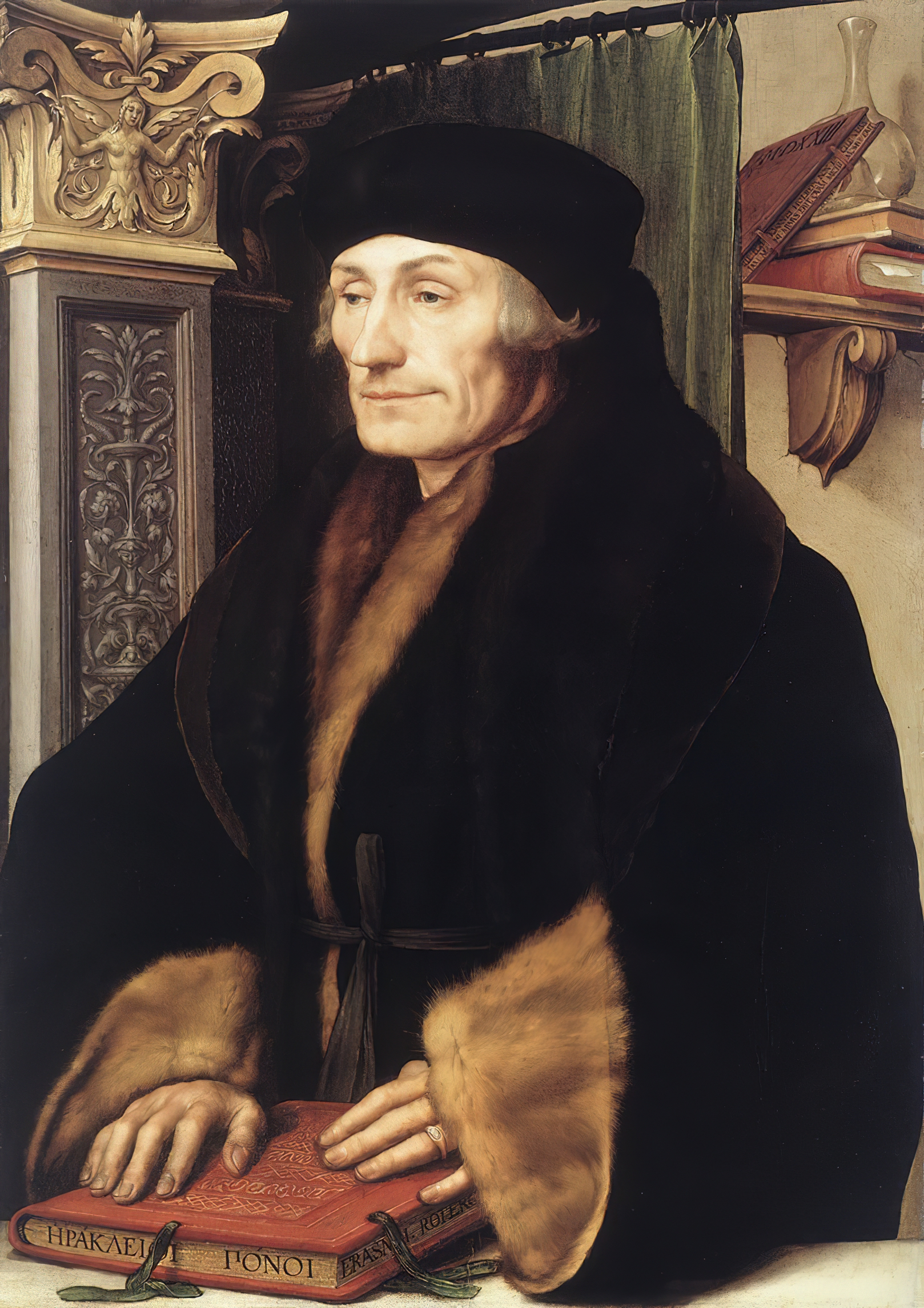
     Second, he also notes that the the famous humanist, philosopher, theologian and Catholic priest, Desiderius Erasmus (d. 1536), likewise denied the apostolic the apostolic authorship of Hebrews and James and raised doubts about 2 Peter, 2 and 3 John and Jude. 

                                                              Erasmus of Rottersdam


What surprised me most was this: despite Erasmus' reputation for being a 'free-thinking' humanist, in the wake of criticisms for raising doubts about the authorship of various books of the New Testament, he apparently responded as follows: "If the Church were to declare the titles they bear to be as canonical as their contents, then I would condemn my doubts, for the opinion formulated by the Church has more value in my eyes than human reasons, whatever they may be." (Erasmus of Rottersdam; cited in Metzger, 1987, p. 241). 


Tuesday, January 06, 2015

Who are the Magi? (And are they "Three Kings"?)


One of the most puzzling questions in the Gospel accounts of Jesus' Nativity is the question of the identity of the Magi. Who exactly are they? From what country do they come? The actual information given to us by Matthew is pretty slim:

Now when Jesus was born in Bethlehem of Judea in the days of Herod the king, behold, wise men from the East came to Jerusalem, saying, “Where is he who has been born king of the Jews? For we have seen his star in the East, and have come to worship him.” (Matthew 2:1)

Who are these "wise men" (magoi)? And where exactly is "the east" (apo anatolon)?

What are "Magi"?
The answer to the first question is fairly simple. The Greek word magos is a rather common term for a "wise man" or "sage" who were renowned for various forms of knowledge, such as the ability to interpret dreams (Daniel 2) or interpret the stars (Josephus Antiquities 10.195, 216). By the first century, the term also came to have negative connotations, and was applied to what we would call "sorcerers" or, of course, "magicians" (think here of Bar-Jesus, the Jewish "false prophet" and "magician" of Acts 13:6). In any given case, context determines whether the meaning is positive or negative.

Are the Magi from Persia, Babylon, or Arabia?
When it comes to the question of the exact nationality of the Magi, the answer is far less clear (see W. D. Davies and Dale Allison, Matthew, 1.227-28). Even in ancient times, the Church Fathers were fairly evenly split between three opinions as to the national origins of the Magi:

1. Persia (Clement of Alexandrian, John Chrysostom, Cyril of Jerusalem, Leo the Great)
This view has in its favor the fact that the Persians were known for interpreting dreams, as in the religion of Zoroastrianism.

2. Babylon (Jerome, Augustine)
This view is supported by the explicit presence of Babylonian magi in the book of Daniel (see 2:2-10), as well as the fact that Babylon is certainly to "the east" of the holy land.

3. Arabia (Justin Martyr, Tertullian, Cyprian of Carthage, Epiphanius)
In my opinion, the strongest position is that the Magi are from Arabia. The primary strength of this view is because, as John pointed out in earlier post on Epiphany, Matthew's statements that the Magi "fell down and worshiped" the infant Christ and brought "gifts, gold, frankincense, and myrrh" (Matt 2:11) appear to be deliberate allusions to Isaiah 60 and Psalm 72, in which Gentile kings from Arabia come to the new Jerusalem and do homage to the king of Israel:

And nations shall come to your light, and kings to the brightness of your rising... [T]he wealth of the nations shall come to you. A multitude of camels shall cover you, the young camels of Midian and Ephah; all those from Sheba shall come.  They shall bring gold and frankincense, and shall proclaim the praise of the LORD. (Isaiah 60:3, 6)

Give the king thy justice, O God, and thy righteousness to the royal son! ...[M]ay the kings of Sheba and Seba bring gifts! May all kings fall down before him, all nations serve him! (Psalm 72:1, 10-11)

What about "We Three Kings"?
Where then do we get the common tradition of associating the Magi with "three kings"? It is worth noting here that this tradition does not seem to be a 'myth' made up out of thin air (as one of my family members suggested over the Christmas break!). Instead, it is an intertextual inference drawn from Matthew's allusions to the fulfillment of the prophecies in Isaiah 60 and Psalm 72, in which  Gentile "kings" from Arabia would bring gifts to the new Jerusalem and worship the Messiah.

Indeed, since ancient times, the Church Fathers picked up on these connections between Matthew's account and the Old Testament, and many Fathers deduced from them that the Magi were not simply "wise men" but also pagan "kings" coming to worship the true King. Apparently, the idea of three kings is also inferred from the three gifts given by the Magi to Jesus: "gold, frankincense, and myrrh" (Matt 2:11).

The Magi and the Israelitica Dignitas
In closing, it may be the case that Matthew's vague description of the Magi as being "from the East" is deliberate, insofar as he is not so much interested in their exact nationality but in the fact that they are Gentiles seeking the "king of the Jews". This is the primary significance that the Church has drawn from the coming of the Magi, seeing in them the first Gentiles to recognize the kingship of Jesus. In the words of the Catechism: 

The Epiphany is the manifestation of Jesus as Messiah of Israel, Son of God and Savior of the world... In the magi, representatives of the neighboring pagan religions, the Gospel sees the first-fruits of the nations, who welcome the good news of salvation through the Incarnation. The magi’s coming to Jerusalem in order to pay homage to the king of the Jews shows that they seek in Israel, in the messianic light of the star of David, the one who will be king of the nations. Their coming means that pagans can discover Jesus and worship him as Son of God and Savior of the world only by turning toward the Jews and receiving from them the messianic promise as contained in the Old Testament. The Epiphany shows that “the full number of the nations” now takes its “place in the family of the patriarchs,” and acquires Israelitica dignitas (are made “worthy of the heritage of Israel”). (CCC 528)

Saturday, January 03, 2015

Doug Campbell on Paul's authorship of Ephesians

I am currently reading Douglas A. Campbell recent monograph on Paul, entitled, Framing Paul: An Epistolary Biography (Grand Rapids: Eerdmans, 2014). Campbell is recognized as one of the most influential Pauline scholars writing today and so, as with any new book from his pen, this new publication is receiving a great deal of attention.

In particular, Campbell is known for offering bold and original readings of Paul. In that regard, Framing Paul does not disappoint. It contains much material worth talking (and blogging!) about. (See T. J. Lang's post on Chris Tilling's blog).

However, since the Second Reading in this Sunday's lectionary offering is taken from the Letter to the Ephesians, I'd like to take a moment to mention the important contribution Campbell makes to the study of this letter.

Friday, January 02, 2015

Epiphany!


The Christmas season is just one joyful feast after another.  We are scarcely past the glow from the Holy Family and Mary, Mother of God, when Epiphany is already upon us!

The word “Epiphany” comes from two Greek words: epi, “on, upon”; and phaino, “to appear, to shine.” Therefore, the “Epiphany” refers to the divinity of Jesus “shining upon” the earth, in other words, the manifestation of his divine nature.

The use of the word “epiphany” for the revelation of divinity predates Christianity.  The Syrian (Seleucid) emperor Antiochus IV (reign 175-165 BC), the villainous tyrant of 1-2 Maccabees, named himself “Epiphanes,” because he considered himself the manifestation of divinity on earth.  His people called him “Epimanes,” which means roughly “something is pressing on the brain,” in other words, “insane.”  Antiochus eventually died in defeat; apparently mankind would need to wait for a different king to be the “Epiphany” of divinity.

1.  Our First Reading is taken from Isaiah 60:1-6: