Thursday, January 15, 2015

Watson on Augustine

I am currently reading Francis Watson's recent book, Gospel Writing: A Canonical Perspective (Grand Rapids: Eerdmans, 2013). The book is stimulating and I hope to have the opportunity to say a few things about it here in the coming weeks. 

Let me just highlight one aspect of Watson's treatment which I quite like, namely, the insistence on respecting Augustine's commitment to close readings of the text. 

At one point, while disagreeing with Augustine's proposed solutions to the "synoptic problem", Watson insists, "his proposed solutions do not deserve the contempt with which they are often dismissed" (22). 

He highlights, for example, B.F. Streeter's derision of Augustine's argument for Markan posteriority (i.e., that Mark abbreviated Matthew and Luke), who claimed that,
"only a lunatic would leave out Matthew's account of the Infancy, the Sermon on the Mount, and practically all the parables. . ." (23; citing The Four Gospels: A Study of Origins [London: Macmillan, 1930), 158). 
In response, Watson wryly notes, 
"The possibility of a later gospel lacking precisely the items specified by Streeter is demonstrated by the Gospel of John, whose author Streeter views not as a lunatic. . ." (23). 
It is refreshing to read a book by a scholar who takes Augustine seriously as an exegete. Though he certainly takes issue with some of Augustine's moves, it is nice to see Augustine engaged on exegetical grounds. For once, Augustine isn't simply dismissed as a systematic theologian whose work is irrelevant to contemporary biblical scholarship.

In fact, Watson recognizes that, for Augustine, exegetical and theological interests went hand-in-hand:
There isn sense here that, as a merely scholarly project, the study of gospel origins lies outside the concerns of the Christian community. Augustine knows of no such dichotomy between scholarship and the church. Elsewhere, in his great hermeneutical treatise, De Doctrina Christiana, he develops a comprehensive biblical hermeneutic in which he texts' theological rationale--which is to promote the love of God and neighbor--is given pride of place, but in which scholarly procedures such as textual criticism and exegesis of the Greek and Hebrew texts are also eloquently advocated. An ongoing investigation of gospel origins would be entirely at home within the ethos of this generously inclusive hermeneutics. (22)
Yes, Augustine was a theologian. However, he would have balked at any suggestion that doing theology was somehow separable from careful biblical exegesis. 

Watson writes, 
It is true that Augustine is acutely conscious of differences of wording, and trains his reader to notice them and to take them seriously. He never complains that critics of the gospels are forcing him to attend to minutiae that are really beneath his notice, distracting him from his great work on the doctrine of the trinity. Gospel differences are not minutiae noted only by the malicious. On the contrary, they are objective features of the sacred texts, indeed they constitute the individuality of these texts, and they are therefore worthy of attention. While some of the differences Augustine discusses are well-known problems treated by earlier Christian writers, in most cases they seem to reflect his own independent research. (Watson, Gospel Writing, 28-29).
Attention to biblical "minutiae"? Careful biblical research that goes beyond the questions merely asked (and answered) by others? 

Would that all theologians were more like Augustine! 

B. H. Streeter, Tell Us How You Really Feel about Competing Synoptic Problem Hypotheses


B. H. Streeter's work, The Four Gospels: A Study of Origins (London: Macmillan, 1930), may be the single most consequential work of 20th century biblical scholarship for establishing what is now widely known as the "Two-Source Hypothesis": the idea that Matthew and Luke are literarily independent of one another and that they both relied on Mark and "Q" as two key sources for their respective Gospels.
                                                                     B. H. Streeter


Streeter: Sure, Augustine's Theory Works, if Mark was a "Lunatic"

In The Four Gospels, Streeter has some remarkably harsh words for Augustine's (much earlier) theory that Mark published his Gospel after Matthew and was in fact Matthew's "abbreviator" (Latin breviator):

"Augustine did not possess a Synopsis of the Greek text conveniently printed in parallel columns. Otherwise a person of his intelligence could not have failed to perceive that, where the two Gospels are parallel, it is usually Matthew, and not Mark, who does the abbreviation.... [O]nly a lunatic would leave out Matthew's account of the Infancy, the Sermon on the Mount, and practically all the parables, in order to get room for purely verbal expansion of what was retained." (Streeter, The Four Gospels, 158).

Streeter: Sure, Luke Could have Used Matthew and Mark, if He Was a "Crank"

We find similarly rhetoric when Streeter turns his guns on the theory that Luke used both Matthew and Mark (a form of what is today known as the 'Farrer' Hypothesis). 

"If then Luke derived this material [the Temptation narrative] from Matthew, he must have gone through both Matthew and Mark so as to discriminate with meticulous precision between Marcan and non-Marcan material; he must then have proceeded with the utmost care to tear every little piece of non-Marcan material he desired to use from the context of Mark in which it appeared in Matthew--in spite of the fact that contexts in Matthew are always exceedingly appropriate--in order to re-insert it into a difference context of Mark having no special appropriateness. A theory which would make an author capable of such a proceeding would only be tenable if, on other grounds, we had reason to believe he was a crank." (Streeter, The Four Gospels, 183)

I can't help but wonder if such hyperbolic rhetoric played a key role in making it very unfashionable to hold any theory that posited Mark or Luke's uses of Matthew as a source. 

After all, who wants to side with a "lunatic" or a "crank"? 


For a response to the latter criticism, see Marc Goodacre's brilliant study, The Case Against Q (London: T. & T. Clark, 2002).

Thursday, January 08, 2015

"He Will Baptize You With the Holy Spirit": Readings for the Feast of the Baptism of the Lord

This Sunday the Church celebrates the Baptism of Jesus, an event that is every bit as important as it is rich in meaning, and this week’s readings help to draw us deeper into the mystery of Christ’s baptism. While for the first and second readings, along with the responsorial psalm, there are alternative readings for this Sunday, our reflection will center on the readings put forth as the first option in the Lectionary, beginning with the first reading from Isaiah 42.

FIRST READING: Isaiah 42:1-4, 6-7
Thus says the LORD:
Here is my servant whom I uphold,
my chosen one with whom I am pleased,
upon whom I have put my spirit;
he shall bring forth justice to the nations,
not crying out, not shouting,
not making his voice heard in the street.
a bruised reed he shall not break,
and a smoldering wick he shall not quench,
until he establishes justice on the earth;
the coastlands will wait for his teaching. 
I, the LORD, have called you for the victory of justice,
I have grasped you by the hand;
I formed you, and set you
as a covenant of the people,
a light for the nations,
to open the eyes of the blind,
to bring out prisoners from confinement,
and from the dungeon, those who live in darkness.
In order to properly interpret Isaiah 42, it is important to place it within the larger framework deutero-Isaiah (40-55), which famously begins with the “good news” (Isa 40:9) of Yahweh’s redemption of His people (Isaiah 40:1-11).

Yet this “good news” is offered to a people in exile who appear to doubt whether God is able to rescue them from their captivity in Babylon. However, the good news is that even though Israel has failed to trust in Yahweh’s power, he is going to bring about the salvation of his people.

Happy birthday to Matthean scholar Leroy Huizenga!

Today my friend Leroy Huizenga is celebrating his birthday. Leroy is one of the most exciting young Matthean scholars around today.

I highly recommend his monograph, The New Isaac: Tradition and Intertextuality in the Gospel of Matthew (NovTSup 131; Leiden: Brill, 2009). The book has recently been published in paperback making it much more affordable than it had been in the past.

In short, the monograph shows that it is no coincidence that the Gospel begins with a description of Jesus as the "son of Abraham" (Matt 1:1). Throughout the Gospel, Matthew describes Jesus' mission in terms of Isaac imagery.

I learned so much from this book it is hard to write a brief post on it. In short, it highlights just how frequently the New Isaac imagery seems to appear in Matthew's Gospel, pointing out intertextual echoes that have long been largely overlooked.

For example, when the crowd comes with Judas to arrest Jesus in the garden they are specifically said to come "with swords and clubs" (meta maxairōn kai zulōn)(Matt 27:47).

The language here seems to allude to Genesis 22, where the exact same words are used to describe what Abraham takes up the mountain where Isaac is to be authored: Abraham takes the "wood" (ta xula) and the "sword / knife" (tēn machairan)(Gen 22:6).

Of course, there are many other connections that reinforce the impression that such similarities are hardly coincidental. Go get the book.

You can also read a fine article of his, "The Tradition of Christian Allegory: Yesterday and Today," here for free.

I'd also encourage you to follow him on Twitter: @LHuizenga

Happy birthday, Leroy!

Are the Titles of the Books of Scripture Canonical?

One of the questions I sometimes get from students in the Seminary is this: Are the titles of the books of the New Testament also canonical? Or only the contents?
      Along these lines, I've recently reading Bruce Metzger's classic, The Canon of the New Testament: Its Origin, Development, and Significance (Oxford University Press, 1987). In his chapter on the closing of the canon in the West, he makes two fascinating points about early questioning of ancient book attributions by Catholic scholars. First, he points out that many of the doubts about apostolic authorship of certain books of the New Testament can be found already in the work of Cardinal Thomas Cajetan, O. P. (d. 1534). 

                                                       Cardinal Thomas Cajetan, O. P.


Unfortunately, Metzger does not give any direct quotes from Cajetan, but only points out that he  denied Pauline authorship of Hebrews and expressed "doubts" concerning James, Jude, and 2 and 3 John. 
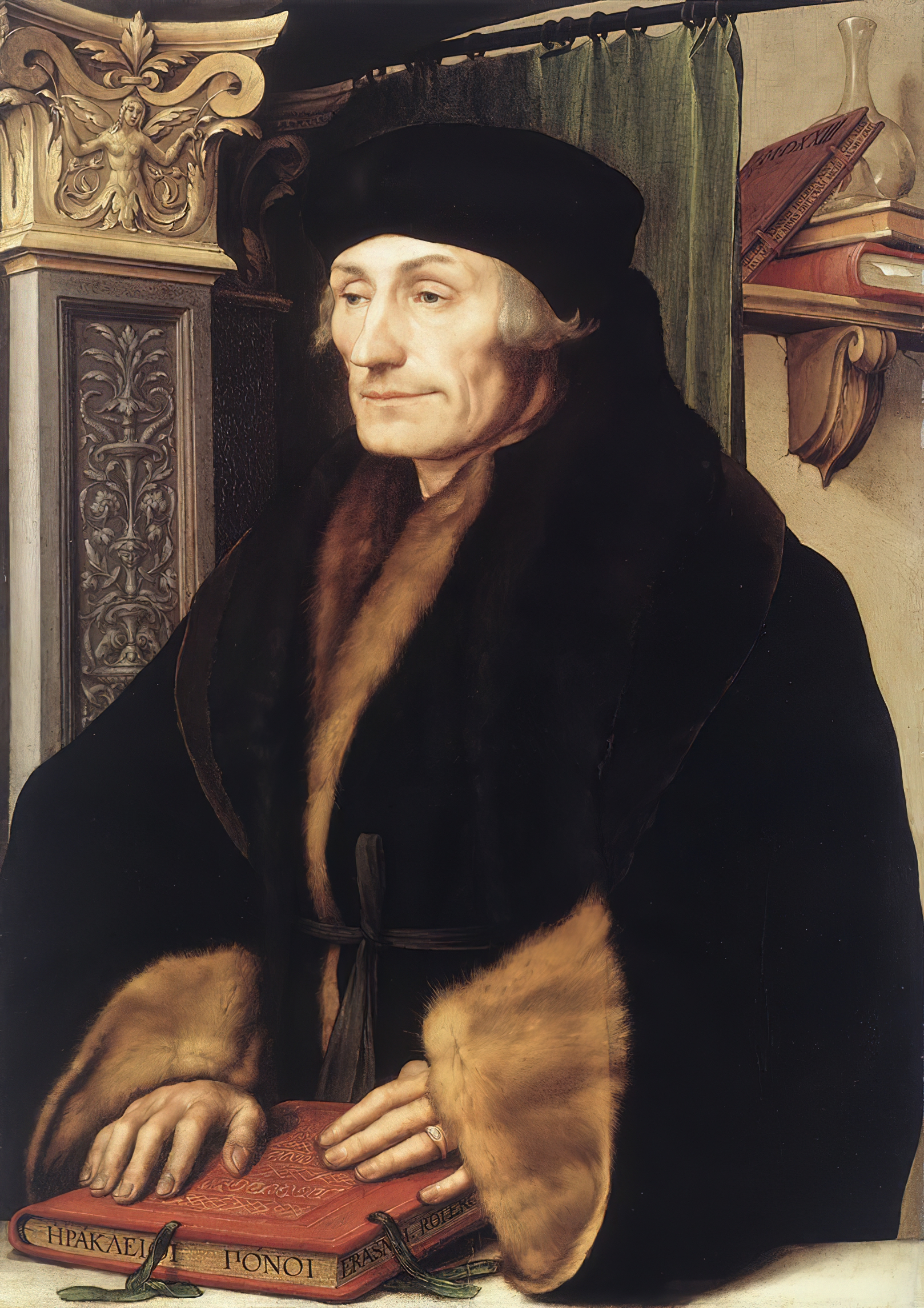
     Second, he also notes that the the famous humanist, philosopher, theologian and Catholic priest, Desiderius Erasmus (d. 1536), likewise denied the apostolic the apostolic authorship of Hebrews and James and raised doubts about 2 Peter, 2 and 3 John and Jude. 

                                                              Erasmus of Rottersdam


What surprised me most was this: despite Erasmus' reputation for being a 'free-thinking' humanist, in the wake of criticisms for raising doubts about the authorship of various books of the New Testament, he apparently responded as follows: "If the Church were to declare the titles they bear to be as canonical as their contents, then I would condemn my doubts, for the opinion formulated by the Church has more value in my eyes than human reasons, whatever they may be." (Erasmus of Rottersdam; cited in Metzger, 1987, p. 241). 


Tuesday, January 06, 2015

Who are the Magi? (And are they "Three Kings"?)


One of the most puzzling questions in the Gospel accounts of Jesus' Nativity is the question of the identity of the Magi. Who exactly are they? From what country do they come? The actual information given to us by Matthew is pretty slim:

Now when Jesus was born in Bethlehem of Judea in the days of Herod the king, behold, wise men from the East came to Jerusalem, saying, “Where is he who has been born king of the Jews? For we have seen his star in the East, and have come to worship him.” (Matthew 2:1)

Who are these "wise men" (magoi)? And where exactly is "the east" (apo anatolon)?

What are "Magi"?
The answer to the first question is fairly simple. The Greek word magos is a rather common term for a "wise man" or "sage" who were renowned for various forms of knowledge, such as the ability to interpret dreams (Daniel 2) or interpret the stars (Josephus Antiquities 10.195, 216). By the first century, the term also came to have negative connotations, and was applied to what we would call "sorcerers" or, of course, "magicians" (think here of Bar-Jesus, the Jewish "false prophet" and "magician" of Acts 13:6). In any given case, context determines whether the meaning is positive or negative.

Are the Magi from Persia, Babylon, or Arabia?
When it comes to the question of the exact nationality of the Magi, the answer is far less clear (see W. D. Davies and Dale Allison, Matthew, 1.227-28). Even in ancient times, the Church Fathers were fairly evenly split between three opinions as to the national origins of the Magi:

1. Persia (Clement of Alexandrian, John Chrysostom, Cyril of Jerusalem, Leo the Great)
This view has in its favor the fact that the Persians were known for interpreting dreams, as in the religion of Zoroastrianism.

2. Babylon (Jerome, Augustine)
This view is supported by the explicit presence of Babylonian magi in the book of Daniel (see 2:2-10), as well as the fact that Babylon is certainly to "the east" of the holy land.

3. Arabia (Justin Martyr, Tertullian, Cyprian of Carthage, Epiphanius)
In my opinion, the strongest position is that the Magi are from Arabia. The primary strength of this view is because, as John pointed out in earlier post on Epiphany, Matthew's statements that the Magi "fell down and worshiped" the infant Christ and brought "gifts, gold, frankincense, and myrrh" (Matt 2:11) appear to be deliberate allusions to Isaiah 60 and Psalm 72, in which Gentile kings from Arabia come to the new Jerusalem and do homage to the king of Israel:

And nations shall come to your light, and kings to the brightness of your rising... [T]he wealth of the nations shall come to you. A multitude of camels shall cover you, the young camels of Midian and Ephah; all those from Sheba shall come.  They shall bring gold and frankincense, and shall proclaim the praise of the LORD. (Isaiah 60:3, 6)

Give the king thy justice, O God, and thy righteousness to the royal son! ...[M]ay the kings of Sheba and Seba bring gifts! May all kings fall down before him, all nations serve him! (Psalm 72:1, 10-11)

What about "We Three Kings"?
Where then do we get the common tradition of associating the Magi with "three kings"? It is worth noting here that this tradition does not seem to be a 'myth' made up out of thin air (as one of my family members suggested over the Christmas break!). Instead, it is an intertextual inference drawn from Matthew's allusions to the fulfillment of the prophecies in Isaiah 60 and Psalm 72, in which  Gentile "kings" from Arabia would bring gifts to the new Jerusalem and worship the Messiah.

Indeed, since ancient times, the Church Fathers picked up on these connections between Matthew's account and the Old Testament, and many Fathers deduced from them that the Magi were not simply "wise men" but also pagan "kings" coming to worship the true King. Apparently, the idea of three kings is also inferred from the three gifts given by the Magi to Jesus: "gold, frankincense, and myrrh" (Matt 2:11).

The Magi and the Israelitica Dignitas
In closing, it may be the case that Matthew's vague description of the Magi as being "from the East" is deliberate, insofar as he is not so much interested in their exact nationality but in the fact that they are Gentiles seeking the "king of the Jews". This is the primary significance that the Church has drawn from the coming of the Magi, seeing in them the first Gentiles to recognize the kingship of Jesus. In the words of the Catechism: 

The Epiphany is the manifestation of Jesus as Messiah of Israel, Son of God and Savior of the world... In the magi, representatives of the neighboring pagan religions, the Gospel sees the first-fruits of the nations, who welcome the good news of salvation through the Incarnation. The magi’s coming to Jerusalem in order to pay homage to the king of the Jews shows that they seek in Israel, in the messianic light of the star of David, the one who will be king of the nations. Their coming means that pagans can discover Jesus and worship him as Son of God and Savior of the world only by turning toward the Jews and receiving from them the messianic promise as contained in the Old Testament. The Epiphany shows that “the full number of the nations” now takes its “place in the family of the patriarchs,” and acquires Israelitica dignitas (are made “worthy of the heritage of Israel”). (CCC 528)

Saturday, January 03, 2015

Doug Campbell on Paul's authorship of Ephesians

I am currently reading Douglas A. Campbell recent monograph on Paul, entitled, Framing Paul: An Epistolary Biography (Grand Rapids: Eerdmans, 2014). Campbell is recognized as one of the most influential Pauline scholars writing today and so, as with any new book from his pen, this new publication is receiving a great deal of attention.

In particular, Campbell is known for offering bold and original readings of Paul. In that regard, Framing Paul does not disappoint. It contains much material worth talking (and blogging!) about. (See T. J. Lang's post on Chris Tilling's blog).

However, since the Second Reading in this Sunday's lectionary offering is taken from the Letter to the Ephesians, I'd like to take a moment to mention the important contribution Campbell makes to the study of this letter.

Friday, January 02, 2015

Epiphany!


The Christmas season is just one joyful feast after another.  We are scarcely past the glow from the Holy Family and Mary, Mother of God, when Epiphany is already upon us!

The word “Epiphany” comes from two Greek words: epi, “on, upon”; and phaino, “to appear, to shine.” Therefore, the “Epiphany” refers to the divinity of Jesus “shining upon” the earth, in other words, the manifestation of his divine nature.

The use of the word “epiphany” for the revelation of divinity predates Christianity.  The Syrian (Seleucid) emperor Antiochus IV (reign 175-165 BC), the villainous tyrant of 1-2 Maccabees, named himself “Epiphanes,” because he considered himself the manifestation of divinity on earth.  His people called him “Epimanes,” which means roughly “something is pressing on the brain,” in other words, “insane.”  Antiochus eventually died in defeat; apparently mankind would need to wait for a different king to be the “Epiphany” of divinity.

1.  Our First Reading is taken from Isaiah 60:1-6:

Thursday, January 01, 2015

The Holy Family as an Earthly Image of the Trinity

Happy Feast of Mary Theotokos!


During the Christmas break--and yes, it is still Christmas! (which means I'm still building Legos with my kids)--I've been reading through the 16th-17th century Jesuit Cornelius A Lapide's commentary on the Gospels. This commentary, popularly known as The Great Commentary, is a masterpiece of post-Reformation biblical scholarship that should be read by every modern New Testament scholar and, frankly, anyone interested in the history of Gospel interpretation. The commentary on the Gospel of Matthew alone is 1200 pages! (For New Testament scholars, A Lapide's commentary is basically a 16th century 'Davies and Allison'.).

Jim West does the December 2014 round up of biblioblogs

Here. As usual, it's well done. Grateful to have been included.

Tuesday, December 30, 2014

Top Academic Reads of 2014 (Updated)

UPDATE: After some reflection, I've added two more titles that definitely belong on the list. See below. 

As we wrap up 2014, I thought it would be a good idea to put together a list of some of my favorite reads of the past year. Of course, coming up with a "best of" list is painful--there were so many great books I read this year and I can't write a long post. But in order to keep this short and meaningful (a list of 10 is just going to be too long), I'm going to list 5 7 of the most important books I read this year.

Two caveats: 

1. Notice I said these are seven "of the most important books". I can't say for sure these are the most important books; I've just left too many good ones off the list. If I had to come with the list of the m seven most important books, I'd agonize over it for so long that I'd never be able to finish this post. 

2. Not all of these books were released this year. The point is, I read them this year so they are still new to me. 

With those caveats in place, here are my picks.

1. Michael Bird, The Gospel of the Lord: How the Early Church Wrote the Story of Jesus (Grand Rapids: Eerdmans, 2014). 

Bird's book, which I just recently finished, is a tour de force of Gospel scholarship and research into the transmission of the Jesus tradition. 

I can't say enough nice things about this book--in fact, expect a post or two on some elements of Bird's book in the future.


2. Nijay Gupta, Worship That Makes Sense to Paul: A New Approach to the Theology and Ethics of Paul's Cultic Metaphors (Berlin: De Grutyer, 2010). 

This year I poured myself into Pauline research with particular attention to soteriology and cultic imagery in Paul. This book by Nijay Gupta was particularly exciting. I've already posted on the book this year but I have to mention it again here. 

3. Henri de Lubac, History and Spirit: The Understanding of Scripture According to Origen (San Francisco: Ignatius Press, 2007). 

De Lubac was one of the most influential patristic scholars of the twentieth century. This reprint reproduces some of his most important--and revolutionary!--research on Origen. 

Origen denigrated the value of history in favor of spiritual readings? Well, that's what everyone says--except those who have read this comprehensive study.


4. Beverly Gaventa, ed., The Apocalyptic Paul: Cosmos and Anthropos in Romans 5-8. (Waco: Baylor University Press, 2013).

This book contains numerous excellent essays but the one by John Barclay takes the cake--at least, that's my opinion. Barclay demonstrates how Paul's understanding of "grace" fits well within first-century Greco-Roman attitudes regarding the nature of gift-giving. 

The soteriological implications are incredibly profound. 

I must say, Barclay's essay in this book may be one of the top five most important pieces I have ever read on Paul. No exaggeration.

5. Matthew Ramage, Dark Passage of the Bible: Engaging Scripture with Benedict XVI and Thomas Aquinas (Washington, D.C.: Catholic University of America Press, 2013).  

I must say that I may be confused here and might have read this book at the end of last year. Either way, I'd like to give it a shout out. 

Ramage looks specifically at some of the thorny exegetical issues in Catholic biblical interpretation. Guided by Benedict XVI and Aquinas, Ramage offers a wonderfully thoughtful approach to the difficult question of how some of the challenges of historical-critical methodology can be engaged in a way informed by Catholic tradition. 

UPDATE: Even though I was going to originally keep this list to five works, I had to add two more titles that I somehow failed to include above. Even though there are still many other books I could mention here, few works have been more impactful on my thinking than the two below. Apologies to Chris and Ben.

6. Ben Blackwell, Chistosis: Pauline Soteriology in Light of Deification in Irenaeus and Cyril of Alexandria (WUNT 2/314; Tübingen: Mohr Siebeck, 2011). 

How I ever left this book off of my original list, I'm not sure. It might be because I first looked through it in 2013. Whatever the reason, I couldn't possibly neglect to mention it here. This easily should have been on my list. It was certainly far more important for my thinking than even the De Lubac work.

Put simply, this book is one of the most important monographs I have ever read on Pauline soteriology--in terms of my own thinking, it might even be the most important one. And, yes, I mean that.

In sum, Blackwell shows how patristic exegesis helps unpack Paul's thought. Specifically, Blackwell focuses on the way the fathers' understanding of theosis faithfully explicates what is found in the Pauline epistles.

To sum things up, Blackwell shows that, for Paul, salvation is about so much more than merely being "acquitted"; it involves nothing less than participation in the divine life through union with Christ.

Other scholars have also argued that the concept of theosis accurately captures Paul's reading. Here, in particular, I think of Michael Gorman, from whose work I have also learned much.

What I particularly like about Blackwell's work is his command of patristic sources. Contemporary exegesis often distances itself from Christian interpretive tradition. Either modern scholars convince themselves that we have simply moved beyond ancient Christian writers (and so, conveniently, we need not read them) or, worse, they simply dismiss their works, imagining that the earliest Christian thinkers grossly misunderstood the New Testament writers (implying a kind of scholarly triumphalism--no one really read the New Testament correctly until we can along).

While it is certainly true that the fathers do not engage certain important critical issues that contemporary scholarship has helped to shed light on, I believe we lose much by ignoring them. Ignorance is certainly not bliss.

Let me be clear: it is true that contemporary biblical scholarship has helped shed important light on the biblical texts. Among other things, materials like the Dead Sea Scrolls have made it possible for us to have a much more nuanced understanding of certain aspects of the Judaism of Jesus' and Paul's day than the fathers could have attained. 

At the same time, recognizing the strengths of contemporary exegesis does not necessarily mean that the fathers had nothing valuable to say. Indeed, they are often far more helpful in illuminating the biblical text than modern exegetes recognize. (Here I am getting into the very issues Ramage deals with in his important contribution mentioned above.)

This shouldn't be surprising. For example, the Greek fathers knew the biblical language extremely well--after all, it was their native language!

I could go on and on about specific aspects of Blackwell's important work but let me just say that it demonstrates the advantage of retrieving patristic readings in spades. If you pick up just one book on Pauline soteriology, let it be this one.


7. Chris Tilling, Paul's Divine Christology. (Grand Rapids: Eerdmans, forthcoming 2015). 

I also originally left this off the list. That was also a major mea culpa. 

Suffice it to say, this book is, in my opinion, the definitive work on Paul's Christology. Well-researched, carefully nuanced, and convincing, this book tackles a very complex subject with clarity and thoughtfulness.

Whereas other treatments of Paul's Christology focus on titles or limit their analysis to a handful of passages, Tilling looks at Paul's Christology against the larger matrix of his overall thought, examining numerous themes and facets of the Pauline corpus. At the same time, Tilling drills down into specific issues with exegetical rigor, offering numerous insights.

Perhaps my favorite part of the book is his analysis of Paul's Christology against the backdrop of Enochic literature. I won't spoil the surprise but let's just say he makes some tantalizing suggestions, which I find quite compelling.

Tilling's monograph, a revision of his doctoral thesis, was originally published by the prestigious German publisher, Mohr Siebeck. Unfortunately, although Mohr Siebeck is about as respectable as you can get when it comes to academic publication, the titles in their catalogue are not cheap. This meant the book was out of the price range of most readers.

Yet, despite the hefty price tag, the book has received a great deal of attention and praise--and rightfully so! I'm therefore delighted that it is being republished by Eerdmanns, an American publisher. Eerdmans is doing a nice roll out for the book, giving it the attention it deserves. Their reprint will also make the book much more affordable and help it find a wider audience.

The book's significance is also underscored by the fact that the new release will also feature a Foreword by Doug Campbell. In sum, expect to hear the name Chris Tilling a lot in the coming years as this seminal work is establishing him as one of the most important names in the future of Pauline scholarship.

As with Blackwell's book, I can't say enough about Tilling's. It easily should have made it into the top five above. The reality is, since I worked through it prior to this year it simply didn't come to mind as a "new find" for this year when I first wrote this post.

Nevertheless, I had to rectify the situation by updating this post. Suffice it to say, this was definitely one of the most important books I worked through this year.


Did Jesus deliberately misquote the Old Testament?

This is the second post in a few days in which I'm "exploring our matrix"--that is, interacting with a blog post by James McGrath.

In a post, "Was Jesus Wrong on Purpose?," James looks at the story in Mark 2 where Jesus appears to misremember the Old Testament.

In particular, Jesus defends his disciples' action of plucking grain on the Sabbath by referring to a story recorded in 1 Samuel:
And he said to them, “Have you never read what David did, when he was in need and was hungry, he and those who were with him: how he entered the house of God, when Abiathar was high priest, and ate the bread of the Presence, which it is not lawful for any but the priests to eat, and also gave it to those who were with him?” (Mark 2:25-26)
The problem is, the story Jesus references involves Ahimelech, not Abiathar.

Saturday, December 27, 2014

Were the titles of the Gospels added later? The implications of the genre question

James McGrath has kindly linked over to a post I wrote a while back in which I briefly mention an article by Simon Gathercole. Gathercole meticulously examines the extant manuscripts of the Gospels and demonstrates that there is no textual evidence--not a shred!--to support the commonly held scholarly theory that the titles of the Gospels were added later.

James' post also includes a link back to a previous one he wrote on the topic. Although I missed it, I noted that he had written on the article long before I had.

In his earlier piece, James expresses openness to the possibility that the titles were original. He says,
It seems that, when the earliest texts are considered and both types of titles are considered, it may be that the widespread idea that the Gospels were originally anonymous may need to be discarded.
I have enjoyed reading James' thoughts on this.

There is one key dimension of the issue of the authorship question he doesn't mention though that I'd like to raise here.

"The Second Annunciation": The Gospel Reading for the Feast of the Holy Family

This Sunday we celebrate the Feast of the Holy Family. There are a number of options available in the lectionary for the first and second readings, and so, to simplify matters, I am just going to offer a brief post on the single Gospel reading that we will all here. 

GOSPEL: Luke 2:22-40
When the days were completed for their purification
according to the law of Moses,
They took him up to Jerusalem
to present him to the Lord,
just as it is written in the law of the Lord,
Every male that opens the womb shall be consecrated to the Lord,
and to offer the sacrifice of
a pair of turtledoves or two young pigeons,
in accordance with the dictate in the law of the Lord.
Now there was a man in Jerusalem whose name was Simeon.
This man was righteous and devout,
awaiting the consolation of Israel,
and the Holy Spirit was upon him.
It had been revealed to him by the Holy Spirit
that he should not see death
before he had seen the Christ of the Lord.
He came in the Spirit into the temple;
and when the parents brought in the child Jesus
to perform the custom of the law in regard to him,
He took him into his arms and blessed God, saying:
“Now, Master, you may let your servant go
in peace, according to your word,
for my eyes have seen your salvation,
which you prepared in sight of all the peoples,
a light for revelation to the Gentiles,
and glory for your people Israel.”
The child’s father and mother were amazed at what was said about him;
and Simeon blessed them and said to Mary his mother,
“Behold, this child is destined
for the fall and rise of many in Israel,
and to be a sign that will be contradicted
—and you yourself a sword will pierce—
so that the thoughts of many hearts may be revealed.”
There was also a prophetess, Anna,
the daughter of Phanuel, of the tribe of Asher.
She was advanced in years,
having lived seven years with her husband after her marriage,
and then as a widow until she was eighty-four.
She never left the temple,
but worshiped night and day with fasting and prayer.
And coming forward at that very time,
she gave thanks to God and spoke about the child
to all who were awaiting the redemption of Jerusalem.

When they had fulfilled all the prescriptions
of the law of the Lord,
they returned to Galilee,
to their own town of Nazareth.
The child grew and became strong, filled with wisdom;
and the favor of God was upon him.
Much could be said about this reading. Here let me offer four thoughts.

1. The story stresses the Holy Family's obedience to Torah. 

According to the Old Testament, after a woman gave birth she was ritually unclean (cf. Lev. 12:1-5). In order to be purified, a sacrifice was required (Lev. 12:6-8). By telling us that they went up to Jerusalem, Luke is actually depicting Mary and Joseph as Torah observant Jews. The Holy Family, therefore, is presented as the model of obedience to God's Law.

Friday, December 26, 2014

Stephen: The Christ-Like Martyr

Yours truly at the traditional site of
St. Stephen's tomb. 
Happy Feast of St. Stephen! I have always loved the story of St. Stephen in the book of Acts - so much so, in fact, we named our second son after him: Matthew Stephen.

The book of Acts describes Stephen as a "Christ-like" figure.

As I have explained elsewhere on this blog, this coheres with a larger theme of the book of Acts--Luke describes the life of the early Church in terms similar to the life of Christ in the Gospel of Luke. The message is clear: Christ is continuing to live in his Church. (Go here for more on that).

Like Jesus, then, Stephen is arrested, made to stand before the ruling council, accused by false witnesses of claiming Jesus would destroy the temple (a charge leveled against Jesus at his trial in Matthew and Mark), questioned by the high priest, and executed.

The climactic moment of Jesus’ trial is Jesus' response to the high priest in which he explains that Caiaphas will see the Son of Man coming on the clouds of heaven (Luke 22:69–70). After this, of course, he is condemned to death (Luke 22:71).

In the book of Acts, Stephen’s trial climaxes with a similar statement: “Behold, I see the heavens opened, and the Son of man standing at the right hand of God” (Acts 7:56).

After this, Stephen is martyred.

Moreover, Stephen is even described as being like Jesus in death. Just before dying Jesus prays, “Father, into thy hands I commit my spirit!” (Luke 23:46). Stephen likewise prays, “Lord Jesus, receive my spirit” (Acts 7:59).

Furthermore, when Jesus is crucified he prays, “Father, forgive them; for they know not what they do” (Luke 23:34).

Similarly, Stephen prays for his accusers: “Lord, do not hold this sin against them” (Acts 7:60). Notably, Acts goes on to describe the conversion of one of those who was involved in his murder, namely, Saul/St. Paul (cf. Acts 7:58; 8:1).

St. Augustine famously attributed great efficacy to Stephen's prayer, saying, “Had Stephen not prayed, the Church today would have no Paul” (Sermon on the Nativity of St. Stephen 6, 5).

I'll end this post with a quote from Benedict XVI:
The life of St. Stephen is entirely shaped by God, conformed to Christ, whose passion is repeated in him; in the final moment of death, on his knees, he takes up the prayer of Jesus on the cross, trusting in the Lord (Acts 7:59) and forgiving his enemies: "Lord, do not hold this sin against them" (60). Filled with the Holy Spirit, as his eyes are about to close, he fixed his gaze on "Jesus standing at the right hand of God" (55), the Lord of all, who draws all to him. 
On St. Stephen’s Day, we are called to fix our gaze on the Son of God, who, in the joyful atmosphere of Christmas, we contemplate in the mystery of his incarnation. . . Allowing ourselves be drawn by Christ, like St. Stephen, means opening our lives to the light that calls, directs and makes us walk the path of good, the path of humanity, according to God’s loving plan. (Angelus address, December 26, 2012)[source]

Tuesday, December 23, 2014

"For unto us a child is born": Readings for Christmas Mass at Midnight

The lectionary readings for the Christmas mass at midnight focus on the coming of the glory of God in the person of Christ.

Of course, in scripture, God's glory is often associated with the imagery of "light" and "splendor".

As we celebrate the eucharist in the middle of the night ("midnight"), we reflect on the coming of the one who is the "light of the world".

The darkness of night helps us reflect on the state of humanity before the Incarnation. As our first reading explains, we "walked in darkness".

In Christ, we have "seen a great light".

Yet the lectionary selections are also meant to lead us to reflect upon the way Christians are still awaiting the dawning of the day when the fullness of Christ's glory will be revealed; as the Second Reading reminds us, we await "the blessed hope of the appearance" of Christ at the end of time.

The light "has come" yet it is also "still to come" in its fullness. The darkness has not yet been finally vanquished. (Anyone who has been to the mall this season is painfully aware of that!)

With all of this in mind, let us turn to our readings.

Christmas Readings for the Day


It's almost here!  I thought I would post on the Readings for Christmas Day at Dawn and Noon:

Mass at Dawn

1. Reading 1 Is 62:11-12
 
See, the LORD proclaims
to the ends of the earth:
say to daughter Zion,
your savior comes!
Here is his reward with him,
his recompense before him.
They shall be called the holy people,
the redeemed of the LORD,
and you shall be called “Frequented,”
a city that is not forsaken.

Wednesday, December 17, 2014

Mystery Now Revealed: The Fourth Sunday in Advent


In this fourth Sunday of Advent, the Church calls us to contemplate the mystery kept secret from ages past that is now revealed. In fact, while this mystery was kept secret, it is also paradoxically found within the pages of the Old Testament, including in our first reading from 2 Samuel 7.

FIRST READING: 2 Sam 7:1-5, 8b-12, 14a, 16
When King David was settled in his palace,
and the LORD had given him rest from his enemies on every side,
he said to Nathan the prophet,
“Here I am living in a house of cedar,
while the ark of God dwells in a tent!”
Nathan answered the king,
“Go, do whatever you have in mind,
for the LORD is with you.”
But that night the LORD spoke to Nathan and said:
“Go, tell my servant David, ‘Thus says the LORD:
Should you build me a house to dwell in?’ 
“It was I who took you from the pasture
and from the care of the flock
to be commander of my people Israel.
I have been with you wherever you went,
and I have destroyed all your enemies before you.
And I will make you famous like the great ones of the earth.
I will fix a place for my people Israel;
I will plant them so that they may dwell in their place
without further disturbance.
Neither shall the wicked continue to afflict them as they did of old,
since the time I first appointed judges over my people Israel.
I will give you rest from all your enemies.
The LORD also reveals to you
that he will establish a house for you.
And when your time comes and you rest with your ancestors,
I will raise up your heir after you, sprung from your loins,
and I will make his kingdom firm.
I will be a father to him,
and he shall be a son to me.
Your house and your kingdom shall endure forever before me;
your throne shall stand firm forever.”
In 2 Samuel 7, the Church puts before us one of the most significant passages in the Old Testament, for in it God enters into an everlasting covenant with the house of David. While the term “covenant” is not found in the passage, the content of a covenant is, and in this case, a certain kind of covenant.

In the Ancient Near East, covenants established kinship bonds between previously unrelated people by means of solemn oath taking and ritual enactment. While covenant making could take different shapes, Scott Hahn has helpfully suggested that covenant making falls into three basic categories: kinship (between equals), treaty, and grant.[1]

Christmas as a retelling of Egyptian Mythology? Maybe not (VIDEO)


H/T JP Catholic student Anna Rossi on Facebook

Tuesday, December 16, 2014

Congratulations to Michael Bird!

Michael's book, The Gospel of the Lord: How the Early Church Wrote the Story of Jesus (Eerdmans) has just won Christianity Today's 2015 book award in the category of biblical studies.

This is great news. And it couldn't happen to a better scholar.

Michael's has done some excellent work on the historical Jesus and I hope the attention this book is getting will also inspire others to pick up his other books as well.

His monograph, Jesus and the Origins of the Gentile Mission (Bloomsbury T & T Clark, 2007), is a learned study and a model of academic erudition. In addition, his book, Are You the One Who Is to Come? The Historical Jesus and the Messianic Question (Eerdmans, 2009), is a wonderfully balanced study.

So I must confess that I am praising these works because I have not yet read his latest. It has been sitting on the top of my guilt pile but because my recent work has focused more on Pauline studies I haven't been able to get to it.

Brant Pitre, in particular, has been urging me to read it.

And so I look forward to reading it though over the Christmas break. It'll be my reward for finishing grading.

Get your copy, here and let me know what you think.


Monday, December 15, 2014

All I Want For Christmas. . .

UPDATE:
Thanks to two anonymous readers I've been able to cross two books off my list. Thanks so very much! 

This time of year a number of internet sites and blogs run lists of gift ideas for "men".

For the record, I definitely don't want a flask or a knife or a pipe.

In years past, some very kind readers have amazingly sent gifts on Christmas. Those gifts have all been  helpful and, of course, very much appreciated.

To be honest, I've got a number of academic projects I'd really like to finish this coming year and I require a number of resources to realize those goals. And what I need isn't going to be cheap.

I don't mean to be presumptuous but if anyone is planning on helping out a young Catholic scholar with four little children this Christmas, this is what I would put on my wish list.

I've put in some links below but a quick check on www.Bookfinder.com is always the recommended way to find books at the lowest possible price. You can also check out my Amazon Wish list - see the panel on the right.

Martha Himmelfarb, Between Torah and Temple. Tübingen: Mohr-Siebeck, 2013. 

Markus Bockhmuehl. The Remembered Peter. Tübingen: Mohr-Siebeck, 2010. Price: ~$112

Ben Cooper. Incorporated Servanthood: Commitment and Discipleship in the Gospel of Matthew. London: Bloomsbury T & T Clark, 2013. Price: ~$30

Holly Beers. The Followers of Jesus as the 'Servant': Luke’s Model from Isaiah for the Disciples in Luke-Acts. London: Bloomsbury T & T Clark, 2015. Price: ~$112

Jonathan Knight, The Open Mind: Essays in Honour of Christopher Rowland. London: Bloomsbury T & T Clark, 2015. Price: ~$112

Stefanos Mihalios. The Danielic Eschatological Hour in the Johannine Literature. London: Bloomsbury T & T Clark, 2012. Price: ~$30

Karen Wenell. Jesus and Land: Sacred and Social Space in Second Temple Judaism. London: Bloomsbury T & T Clark, 2012. Price: ~$125

R. Timothy McLay. The Temple in Text and Tradition: A Festschrift in Honour of Robert Hayward. London: Bloomsbury T & T Clark, 2012. Price: ~$115

Jens Schröter. Jesus of Nazareth: Jew from Galilee, Savior of the World. Waco: Baylor University Press, 2014. Price: ~$50

L. M. Morales, Cult and Cosmos. Leuven: Peeters, 2014. Price: $140

If there is any kind soul out there interested in sending me something, books can be sent to the following address:
Dr. Michael Barber
c/o JP Catholic University
220 W. Grand Ave.Escondido, CA 92025

If anyone does plan on sending something my way, thanks so very much. And please leave a comment and tell me what I can cross of the list.

Peace!


Friday, December 12, 2014

"I Am the Very Model of a Biblical Philologist"


H/T Nathan Eubank and Michael Thomson

Rejoice! The Readings for Gaudete Sunday!


Rejoice, everybody!  This Sunday we light the rose-colored (not pink!) candle of the Advent wreath, as a sign of our joy that we have passed the mid-point of Advent.  During this penitential season (are you practicing a small penance?) in anticipation of the coming of Our Lord, we take a break from our practices of self-denial this Sunday in order to celebrate that Christmas is drawing near!

The Readings for this Sunday are unified by the theme of rejoicing, and they provide a good meditation on the role of joy in the Christian life.  Perhaps a line from the first Reading best sums up the message of the Scriptures this Sunday: “God is the joy of my soul.”  How true this is!  How often we are tempted to put something else into the “God” slot in that statement: “________ is the joy of my soul.”  How do we fill in the blank?  Money?  Success?  Caffeine/Alcohol/some other drug?  Sex?  Football?  Some other sport? A hobby?  This Sunday is time to rejoice for all those who put “God” in the blank.

1. Our First Reading is Isaiah 61:1-2a, 10-11:

Sunday, December 07, 2014

The Readings for the Immaculate Conception


This Monday is the Solemnity of the Immaculate Conception of the Blessed Virgin Mary.  It is a Holy Day of Obligation for Catholics in the United States, since it is the patronal feast day of our nation.  (Have you ever pondered that the irony in the fact that our capital is a little square of territory nestled in the heart of “Mary-land”?)

The Readings for this Solemnity are extremely rich, and include two famous passages (the account of the curses of after the fall in Genesis 3; and the Annunciation in Luke 1) that are pivotal in salvation history and touch on mega-themes in biblical theology.  Mary is at the heart of the story of salvation; understanding her and her role properly entails understanding the divine economy (salvation history) properly as well.

The First Reading is from Genesis 3:

Wednesday, December 03, 2014

Jesus and the Jewish Roots of Advent

http://store.catholicproductions.com/jesus-and-the-jewish-roots-of-advent-cd/ 

Well, the season of Advent is here once again! Of all the liturgical seasons of the year, for me, Advent is certainly the most stressful, and it may be the most confusing.  We often seem to have a good grasp of Christmas, Lent, and Easter. But what is the deeper meaning of Advent? And how can understanding this season help us better prepare for Christmas?

In the Bible study Jesus and the Jewish Roots of Advent, I tried to show how a deeper understanding of the biblical prophecies of the Messiah can help unlock the hidden meanings of the season. It covers topics like:

The Sunday Lectionary Readings for Advent (Years A-C): The entire Bible study revolves around the Sunday lectionary readings for this season, which are (in my humble opinion) some of the richest and most fascinating passages in the Bible.

(NOTE TO PREACHERS: if you're preaching homilies for the Lectionary, the Bible study goes into readings from all three years, so that it can be useful for Advent preaching any year.)

The Second Advent of Christ: What will happen at the end of time? Why does Advent begin with end-time prophecies about the Tribulation, the Final Judgment, and the second coming of Christ?

Biblical Prophecies of the Messiah: How do we know that Jesus is really the Messiah and not just one more religious leader? What are the most important Old Testament prophecies about the first “coming” of the Messiah?

The Mystery of John the Baptist: Who was John the Baptist? Why did Jesus call him the greatest of all the prophets, and why does the Church spend so much time on him during the Advent season?

The Jesse Tree: What are the biblical roots of the Advent custom of the Jesse tree? Where does this tree come from in the Jewish Bible?

The Virgin Birth: Why was Jesus born of a Virgin? What should we say to those who are skeptical about this great miracle? And what does it mean for our lives as Christians?

And lots of other stuff. If you're preparing for Christmas and would like to dig deeper into the biblical roots of Advent, consider checking it out.

Have a blessed Advent.

Wednesday, November 26, 2014

"Already and Still More": The First Sunday in Advent

In this first Sunday of Advent, the Church invites us to prepare in a rather urgent manner for God’s coming in the person of Jesus Christ. If you are anything like me, it is tempting to view the Advent Season as celebrating something that is “in the rear view mirror”, that is, a definitive event of the past that defines the salvation we can now rejoice in as believers in Christ.

While this is true, it is nonetheless incomplete at best and dangerous at worst, for the coming of God in Christ requires an ever-present vigilance, one that is always ready for the coming of God.

FIRST READING: Isaiah 63:16b-17, 19b; 64:2-7 
You, LORD, are our father,
our redeemer you are named forever.
Why do you let us wander, O LORD, from your ways,
and harden our hearts so that we fear you not?
Return for the sake of your servants,
the tribes of your heritage.
Oh, that you would rend the heavens and come down,
with the mountains quaking before you,
while you wrought awesome deeds we could not hope for,
such as they had not heard of from of old.
No ear has ever heard, no eye ever seen, any God but you
doing such deeds for those who wait for him.
Would that you might meet us doing right,
that we were mindful of you in our ways!
Behold, you are angry, and we are sinful;
all of us have become like unclean people,
all our good deeds are like polluted rags;
we have all withered like leaves,
and our guilt carries us away like the wind.
There is none who calls upon your name,
who rouses himself to cling to you;
for you have hidden your face from us
and have delivered us up to our guilt.
Yet, O LORD, you are our father;
we are the clay and you the potter:
we are all the work of your hands.
In this first reading, the prophet Isaiah speaks of the coming of God in rather apocalyptic terms, that is, that Yahweh would “rend the heavens and come down” and bring salvation. In context, Yahweh does indeed come down and bring salvation, for he comes and liberates Judah from Babylon and brings them back to Canaan.

However, as Loren Stuckenbruck rightly notes, apocalyptic salvation in the faith of Israel entails an “already and still more,”[1] and this dynamic can be seen within Isaiah itself, for reading the book as a whole helps to reveal that not all aspects of Isaiah’s promised salvation is completely fulfilled with Judah’s return from exile.

Tuesday, November 18, 2014

Solemnity of Christ the King: The Readings


Congratulations, everyone!  God has seen fit to let us live to complete another liturgical year!  We have journeyed with Our Lord from his birth through his ministry, passion, death, resurrection, and into the growth of the Church and the spread of the Gospel to all the nations.  Now, at the end of the year, we reflect on the Final Judgment, when Jesus Christ, King of the Universe, will pass sentence on each and every human being, establishing justice, punishing evil and rewarding love and self-sacrifice.  The Feast of Christ the King is a profession of our faith that ultimately there is a moral standard to the universe, that all is not in flux or random, that the Good, the True, and the Beautiful triumph in the end over darkness, ugliness, and selfishness. 

Our First Reading comes from Ezekiel 34:11-12, 15-17:

Friday, November 07, 2014

What is the Church? Readings for the Feast of the Lateran Basilica


This year we have a special treat in the month of November, in that the Feast of the Lateran Basilica, the Cathedral of the City of Rome and Mother Church of Christianity, falls on a Sunday.  Usually only week-day mass goers get exposed to this wonderful feast and its Lectionary readings.