This week's video is now out. Check it out below for The Mass Readings Explained.
Catholic Productions' Notable Quote:
So you can imagine, Peter’s probably tired (on a human level), and he’s frustrated from not having caught any fish and this carpenter comes along and says, “Well, hey, did you try the deep water? Go out into the deep water and try and put your nets down and see what happens.” So this is a test.
Is Peter going to do the human thing which would be, “I know what I’m doing, thank you very much. We failed. Nothing, caught nothing all night. I’m not about to just go out into the water again and let down a net.” ...And yet, what does Peter say? “At your word, I will let down the nets.”
Monday, February 04, 2019
Wednesday, January 30, 2019
Why Do People Hate the "Good Person"? The 4th Sunday in OT
The Readings for this Sunday show both Jesus and
Jeremiah facing opposition for speaking God’s truth to their
contemporaries. They raise interesting
questions about why it is that the “good person” so often suffers at the hands
of others, and offer encouragement to those who experience this suffering.
Monday, January 28, 2019
Jesus' First Sermon in Nazareth [Part 2] (The Mass Readings Explained)
This week's video for The Mass Readings Explained is now out. Check it out below and please Like and Share.
Thank you.
Catholic Productions Notable Quote:
Now I don’t know about you, but whenever I see this passage…if I was sitting in the synagogue and he quoted this, I’d just be like, “Oh. That’s interesting. Naʹaman… widow of Zarʹephath… okay.” I would not rise up and want to throw him off of a hill for saying that. So if you don’t understand the crowd’s vehement response to Jesus, it’s obvious that you don’t get the allusion to those Old Testament texts that he’s quoting there. So it’s really important for us to actually go back to those Old Testament passages and look at them in context.
Thank you.
Catholic Productions Notable Quote:
Now I don’t know about you, but whenever I see this passage…if I was sitting in the synagogue and he quoted this, I’d just be like, “Oh. That’s interesting. Naʹaman… widow of Zarʹephath… okay.” I would not rise up and want to throw him off of a hill for saying that. So if you don’t understand the crowd’s vehement response to Jesus, it’s obvious that you don’t get the allusion to those Old Testament texts that he’s quoting there. So it’s really important for us to actually go back to those Old Testament passages and look at them in context.
Thursday, January 24, 2019
Jesus Proclaims the Jubilee: The 3rd Sunday of OT
The past three Sundays have
focused on the three early “manifestations” or “epiphanies” of Jesus’ divine
nature recorded in the Gospels: the Visit of the Magi, the Baptism, and the
Wedding at Cana. Now the Lectionary
“settles in” to Ordinary Time, which this year involves reading through the
Gospel of Luke. This Sunday, we pick up
the introduction to Luke’s Gospel (Lk 1:1-4), but then skip to the beginning of
Jesus’ ministry (Luke 4:14-21) because we’ve already heard all the accounts of
Jesus’ childhood and early life (Luke 1–3) during Advent, Christmas and
Epiphany.
The Readings this Sunday
focus on the importance of the public proclamation of God’s Word. In the First Reading, we see Ezra, the great
priest and scholar of the Law, reading the Law of Moses out loud to the people
of Israel after their return from Babylonian exile. In the Gospel, we see Jesus, our great high
priest and interpreter of God’s Law, reading the promises of salvation from
Isaiah to the Jews in the Synagogue of Nazareth. In both situations, the proclamation of God’s
Word is a call both to repentance and to hope for salvation. However, in Ezra’s day, the salvation was far
off; in Jesus day, He announces that the salvation is present now.
Monday, January 21, 2019
Jesus' First Sermon in Nazareth [Part 1] (The Mass Readings Explained)
This week's video is now out. Check it out below.
Catholic Productions Notable Quote:
"Another little side note, this is why Jesus is going to get into conflict with the Pharisees so much in the gospels. Have you ever wondered why he’s always bumping heads with the Pharisees? It’s not because the Pharisees were priests. They weren’t priests either; they were laymen who mastered the scriptures and who studied the traditions of the fathers and they ran the show in the synagogues. So if Jesus’ custom was to go about preaching in the synagogues, the first people he’s going to come into conflict with aren’t the priests in the temple of Jerusalem, it’s the Pharisees, the lay people in the synagogues who were used to preaching and teaching tradition of the fathers, then Jesus steps in and he blows them all out of the water."
Catholic Productions Notable Quote:
"Another little side note, this is why Jesus is going to get into conflict with the Pharisees so much in the gospels. Have you ever wondered why he’s always bumping heads with the Pharisees? It’s not because the Pharisees were priests. They weren’t priests either; they were laymen who mastered the scriptures and who studied the traditions of the fathers and they ran the show in the synagogues. So if Jesus’ custom was to go about preaching in the synagogues, the first people he’s going to come into conflict with aren’t the priests in the temple of Jerusalem, it’s the Pharisees, the lay people in the synagogues who were used to preaching and teaching tradition of the fathers, then Jesus steps in and he blows them all out of the water."
Friday, January 18, 2019
The Bridegroom Revealed: The 2nd Sunday of OT
This Sunday we remain in the
afterglow of Epiphany, the celebration of the “manifestation” of Jesus’ divine
glory. [Greek epi – phaino = “shine
upon” = “reveal, manifest.”] Epiphany,
which once was its own season (like Advent or Christmas), has often been
associated with three events from the Gospels: the Magi, the Baptism, and the
Wedding at Cana. These are the first
events that reveal or “manifest” Jesus’ glory in the Gospels of Matthew, Mark,
and John, respectively. Certain
well-known Epiphany hymns (e.g. “Songs of Thankfulness and Praise”) make
reference to all three events, and in antiquity the celebration of all three
was clustered around January 6 in many rites.
Eventually, the different rites separated out the liturgical celebration
of the different events and placed them on separate days.
In Year C, the Church quite
consciously offers us the Wedding at Cana for our meditation on the Sunday
immediately following the Baptism. By
happy Providence, this year we are able to ponder the Magi, the Baptism, and
Cana on successive Sundays.
The Readings for this Lord’s
Day highlight Jesus as our spiritual bridegroom.
1. The First Reading is the
same used at the Christmas Vigil, Isaiah 62:1-5:
Thursday, January 17, 2019
EXCITING ANNOUNCEMENT: An M.A. in Scripture at the Augustine Institute
I am very pleased to announce that we are launching a new M.A. in Sacred Scripture at the Augustine Institute Graduate School of Theology. We are looking to accept about three students into this rigorous program.
Those who are accepted will have access to funding for the degree. Students will learn from professors like Brant Pitre, Mark Giszczak, John Sehorn, Tim Gray, and myself in small seminar style courses taught here in beautiful Denver, CO. More information is provided in the video below. If you are a professor and have questions, please let me know. This is a special opportunity for your students interested in pursuing an academic career in biblical studies. Please help us spread the word about this exciting new program!
Tomorrow, Friday, January 17, at 3pm (EST) I will be doing a special webinar to answer any questions people might have. To join us, please contact our Director of Admission, Kathryn Murray: kathryn.gillette@augustineinstitute.org
Hope you can join us!
Monday, January 14, 2019
The Wedding at Cana (The Mass Readings Explained)
This week's video is now out on the Wedding at Cana for The Mass Readings Explained. Check it out below.
Catholic Productions' Notable Quote:
But Jesus says something else, he says, "My hour has not yet come." So, in John's gospel, that points forward to his passion and death, the hour of the cross, the hour of his passion. And so, mysteriously, somehow Mary's words, “they have no wine,” Jesus has taken them not just to refer to the problem of the practical loss of wine, but somehow to refer to the hour of his passion and his death. Why does he go there? How does he get from "A" to "Z"? How does he get from "running out of wine" to "the hour of the cross"?
Catholic Productions' Notable Quote:
But Jesus says something else, he says, "My hour has not yet come." So, in John's gospel, that points forward to his passion and death, the hour of the cross, the hour of his passion. And so, mysteriously, somehow Mary's words, “they have no wine,” Jesus has taken them not just to refer to the problem of the practical loss of wine, but somehow to refer to the hour of his passion and his death. Why does he go there? How does he get from "A" to "Z"? How does he get from "running out of wine" to "the hour of the cross"?
Thursday, January 10, 2019
Baptism of Our Lord
The end of the Season
of Christmas arrives this Sunday, as we celebrate the event that marked the end
of Jesus’ early life and the beginning of his public ministry: the Baptism.
The Christmas
decorations coming down in our churches and homes inevitably leaves a feeling
of sadness and nostalgia. We don’t want
to move on from meditation on all the joyful aspects of Our Lord’s early life,
the incidents of wonder and mystery, like the angels singing to the shepherds,
or the visit of the Magi. Nonetheless,
as we leave the Christmas Season behind, today’s readings remind us of the
power of the Holy Spirit that we share with Jesus! The very Spirit of God has been given us in our
own baptisms—this Spirit has ushered us into a new world, a New Creation in
which we can daily walk with God, just like Adam and Eve once walked with God
in the garden in the cool of the day.
So we will look for
“New Creation” themes as we work through this Sunday’s Readings.
Monday, January 07, 2019
The Baptism of the Lord (The Mass Readings Explained)
This week's video is now out for The Mass Readings Explained. Check it out below.
Catholic Productions' notable quote:
"So the reason the Church picks this passage as background to the Baptism of Jesus is because Jesus is being revealed as the beloved — not just the Son — but the beloved servant of God, in whom God’s soul takes delight, upon whom the Spirit comes and who will eventually bring this new law, this new light, not just to Israel but to the Gentiles as well. That's what he’s going to do, and the way you’ll know he's the servant … is through his miracles, right. He's going to 'open the eyes of the blind,' he’s going to bring out the 'prisoners from the dungeon.' That's exactly what Jesus is going to begin to do in his public ministry: Open people's eyes to the truth of his new law, but also literally open their eyes through his healings, and his signs, and his wonders."
Catholic Productions' notable quote:
"So the reason the Church picks this passage as background to the Baptism of Jesus is because Jesus is being revealed as the beloved — not just the Son — but the beloved servant of God, in whom God’s soul takes delight, upon whom the Spirit comes and who will eventually bring this new law, this new light, not just to Israel but to the Gentiles as well. That's what he’s going to do, and the way you’ll know he's the servant … is through his miracles, right. He's going to 'open the eyes of the blind,' he’s going to bring out the 'prisoners from the dungeon.' That's exactly what Jesus is going to begin to do in his public ministry: Open people's eyes to the truth of his new law, but also literally open their eyes through his healings, and his signs, and his wonders."
Thursday, January 03, 2019
The Readings for Epiphany
The
word “Epiphany” comes from two Greek words: epi,
“on, upon”; and phaino, “to appear,
to shine.” Therefore, the “Epiphany” refers to the divinity of Jesus “shining
upon” the earth, in other words, the manifestation of his divine nature.
The
use of the word “epiphany” for the revelation of divinity predates
Christianity. The Syrian (Seleucid)
emperor Antiochus IV (reign 175-165 BC), the villainous tyrant of 1-2
Maccabees, named himself “Epiphanes,” because he considered himself the
manifestation of divinity on earth. His
people called him “Epimanes,” which means roughly “something is pressing on the
brain,” in other words, “insane.” Antiochus eventually died in defeat;
apparently mankind would need to wait for a different king to be the “Epiphany”
of divinity.
1. Our First Reading is taken from Isaiah 60:1-6:
Monday, December 31, 2018
Mary, Mother of God
January 1 is the Solemnity (Holy
Day) of Mary, Mother of God. To call
Mary the “Mother of God” must not be understood as a claim for Mary’s
motherhood of divinity itself, but in the sense that Mary was mother of Jesus,
who is truly God. The Council of Ephesus
in 431—long before the schisms with the Eastern churches and the
Protestants—proclaimed “Mother of God” a theologically correct title for
Mary.
So far from being a cause of
division, the common confession of Mary as “Mother of God” should unite all
Christians, and distinguish Christian orthodoxy from various confusions of it,
such as Arianism (the denial that Jesus was God) or Nestorianism (in which Mary
mothers only the human nature of Jesus but not his whole person).
Two themes are present in the
Readings for this Solemnity: (1) the person of Mary, and (2) the name of Jesus.
Why the name of Jesus? Prior to the
second Vatican Council, the octave day of Christmas was the Feast of the Holy Name, not Mary Mother of God. The legacy of that tradition can be seen in
the choice of Readings for this Solemnity.
(The Feast of the Holy Name was removed from the calendar after Vatican
II; St. John Paul II restored it as an optional memorial on January 3. This year, it will be an optional mass on Thursday.)
1. The First
Reading is Numbers 6:22-27
Epiphany: The Mystery of the Magi (The Mass Readings Explained)
This week's video is now out for the Epiphany. Happy New Year Everyone.
Catholic Productions' notable quote from this week's video:
"...[T]hink about this for a second, the star in the heavens, which is kind of like the book of creation, so the Magi are reading the book of creation and it gives them some guidance, but then the other is the city of Bethlehem which they read about in the book of the Scriptures. So these two books, the book of creation and the book of the Scriptures, need to be read together in order for the Magi to find the Christ child, in order for them to find the one who has been born, the King of the Jews. So the book of nature gets them so far, it gets them to Jerusalem, but they need the Scriptures to finally locate the true Messiah, to locate the King."
Catholic Productions' notable quote from this week's video:
"...[T]hink about this for a second, the star in the heavens, which is kind of like the book of creation, so the Magi are reading the book of creation and it gives them some guidance, but then the other is the city of Bethlehem which they read about in the book of the Scriptures. So these two books, the book of creation and the book of the Scriptures, need to be read together in order for the Magi to find the Christ child, in order for them to find the one who has been born, the King of the Jews. So the book of nature gets them so far, it gets them to Jerusalem, but they need the Scriptures to finally locate the true Messiah, to locate the King."
Saturday, December 29, 2018
Readings for the Feast of the Holy Family
The Sunday within the octave of Christmas is
always dedicated to contemplation of the Holy Family, giving us the opportunity
to meditate on the way in which the family structure, established by God and perfectly
mirrored in the Holy Family, reflects His own familial nature (as Father, Son,
and Spirit) and shows us the truth about ourselves and our deepest longings for
love, acceptance, and communion with other persons.
The Readings for this beautiful feast provide
the celebrant with two options for a set of Readings: the standard Readings for
the feast (ABC): Sirach 3:2-14; Psalm 128; Col 2:12-21; and Matt 2:13-23. Then, there are the optional alternative
readings for Year C: 1 Sam 1:20-28; Ps 84 (selections); 1 John 3:1-2, 21-24;
and Luke 2:41-52. The Readings are
chosen as a thematic whole, so it is best not to “mix and match” between the
two sets of Readings. [Strangely,
the USCCB website provides both sets of Readings except for the Gospel, for
which they give only the Year C alternative (Luke 2:41-52).] In what follows, I will
provide comments on all the Reading options, both ABC and C. (See here for the full readings options:
https://bit.ly/2BKn3Ia)
1. The
First Reading (ABC) is Sirach 3:2-6, 12-14:
Thursday, December 20, 2018
Readings for the Christmas Masses
The Christmas Solemnity has distinct readings for four separate
masses: Vigil, Midnight, Dawn, and
Day. The Readings for these Masses are stable from year to year (ABC), so my comments below are largely the same as previous years. There’s such a wealth of material
here to meditate on, that not everything can be covered. In fact, there is almost an entire biblical
theology in the sequence of readings of these four masses. In what follows, I am going to offer just a
few brief comments on the more salient points.
Christmas Vigil
Mass
Mary, Queen Mother of the Crown Prince: The 4th Sunday of Advent
The Fourth Sunday of Advent
marks a switch in focus from John the Baptist (on the previous two Sundays) to
the events immediately leading up to the birth of Christ.
The Readings for this Sunday
focus on Jesus’ royalty: his descent from the line of Davidic kings. As we will see, this royal status also
accrued to his mother Mary, and this is the basis for the practice of Marian
veneration in the Catholic Church. In
fact, the first instance of Marian veneration by another human being takes
place in this Sunday’s Gospel.
Monday, December 17, 2018
The Visitation to Elizabeth (The Mass Readings Explained)
This week's video for the 4th Sunday of Advent is now out. You can check it out below.
Catholic Productions' notable quote from this week's video:
"...[S]ometimes our non-Catholic brothers and sisters, non-Catholic Christians, will say, you know, why do you Catholics give so much honor to Mary? Don't you think it's just too much? Is just too much emphasis. You're taking away from Jesus by honoring her. Not according to the Bible.
I mean notice here, who is it that inspires Elizabeth to utter these words of honor over Mary? It’s the Holy Spirit. So apparently the Holy Spirit didn't have a problem with Elizabeth blessing Mary. Same thing, it's the Holy Spirit who inspires the author of Luke's gospel, Luke, to tell us that Elizabeth was humbled in the presence of Mary. None of this takes away from Christ, it's Christ himself who makes Mary mother of the Messiah, that makes Mary mother of God. And so Elizabeth doesn't honor either Christ or Mary, she honors Mary because of Christ. It's a both and, not an either or."
Catholic Productions' notable quote from this week's video:
"...[S]ometimes our non-Catholic brothers and sisters, non-Catholic Christians, will say, you know, why do you Catholics give so much honor to Mary? Don't you think it's just too much? Is just too much emphasis. You're taking away from Jesus by honoring her. Not according to the Bible.
I mean notice here, who is it that inspires Elizabeth to utter these words of honor over Mary? It’s the Holy Spirit. So apparently the Holy Spirit didn't have a problem with Elizabeth blessing Mary. Same thing, it's the Holy Spirit who inspires the author of Luke's gospel, Luke, to tell us that Elizabeth was humbled in the presence of Mary. None of this takes away from Christ, it's Christ himself who makes Mary mother of the Messiah, that makes Mary mother of God. And so Elizabeth doesn't honor either Christ or Mary, she honors Mary because of Christ. It's a both and, not an either or."
Thursday, December 13, 2018
Rejoicing in the Midst of Suffering: Gaudete Sunday!
This Sunday is “Gaudete”
Sunday, from the Latin gaudete,
“Rejoice!” which traditionally begins the introit for this Mass, taken from
Phil. 4:4. Many parishes will mark this
Sunday with rose-colored vestments (not “pink”—“pink” is not a liturgical
color!), and the theme of joy runs through the readings and the liturgy.
Gaudete Sunday marks the liturgical
half-way point of Advent, and the Church rejoices because Jesus’ coming is
near. This year, since Christmas falls early
in the fourth week of Advent, Gaudete Sunday falls only a little more than a
week (!) (nine days, to be exact) before that holy day!
1. Our First Reading is Zephaniah 3:14-18a:
Monday, December 10, 2018
What Should We Do To Prepare? (The Mass Readings Explained)
The 3rd Sunday of Advent, often called Gaudete Sunday, is this weekend. Check out the video on this Sunday's Mass Readings. If you haven't subscribed yet, now's a perfect time to do so.
Catholic Productions' notable quote from this week's video:
"In this case the special passage from Luke is about the ministry of John the Baptist, and it's a window that we are given into John's ethical teaching, or his moral teaching. So we know about, so to speak, his sacramental activity of, you know, calling people to repent so that they might be baptized with the baptism of repentance for the forgiveness of sins. But, it's easy to miss, because the other gospels don’t tell us about it -- that John also had a moral dimension to his preaching. He called people to change their lives in very specific ways and so today the Church gives us one of those exchanges."
Catholic Productions' notable quote from this week's video:
"In this case the special passage from Luke is about the ministry of John the Baptist, and it's a window that we are given into John's ethical teaching, or his moral teaching. So we know about, so to speak, his sacramental activity of, you know, calling people to repent so that they might be baptized with the baptism of repentance for the forgiveness of sins. But, it's easy to miss, because the other gospels don’t tell us about it -- that John also had a moral dimension to his preaching. He called people to change their lives in very specific ways and so today the Church gives us one of those exchanges."
Thursday, December 06, 2018
A Straight Path in the Wilderness of Our Soul: 2nd Sunday of Advent
As we start the second week
of Advent, the Church turns her attention from the second coming of Christ to
his first coming, and in particular to the figure of John the Baptist, the
forerunner or herald of Jesus Christ.
Usually the Church reads
heavily from the prophet Isaiah during the Advent season, and indeed, Isaiah 40
would have made a good First Reading for this Sunday because it is quoted in
the Gospel. However, in Year C, the
Church takes a little break from exclusive attention to Isaiah and reads some
other Old Testament texts that are also important for understanding the
significance of Christ’s coming.
Monday, December 03, 2018
John the Baptist and the New Exodus (The Mass Readings Explained)
The video for the 2nd Sunday of Advent is now out. Check it out below.
Catholic Productions' notable quote from this week's video:
"First, notice the fact that Luke is clearly not writing mythology. He’s also clearly not writing a fairytale, right. No fairytale begins, "In the fifteenth year of the reign of Tiberius Caesar," you know, "during the governorship of Pontius Pilate."
That’s not how fairytales begin. Fairytales begin with once upon a time, right. So Luke is clearly talking about history. So what we’re preparing for during Advent and what we’re going to celebrate during Christmas is not some myth. It's an actual historical event that took place in real space and real time, and the gospels describe it as such."
Thursday, November 29, 2018
Soberly Awaiting the Second Coming: Readings for 1st Sunday of Advent
Happy
New Year everyone! We start the
liturgical calendar anew this weekend, and we are in Year C, which has some of
the most creative and stimulating combinations of lectionary readings.
We
just concluded the liturgical calendar by reading largely from the Book of
Revelation and Our Lord’s eschatological discourse from the Gospel of
Luke. We spent a good deal of time
meditating on the second coming of Our Lord, the end of history, and the final
judgment. We now make a smooth segue
into Advent, because the first week of this liturgical season is given over to
contemplating the second coming, as well.
The second week of Advent will move into the “John the Baptist” stage of
the season, where we meditate on John as the introductory and transitional
figure between the Old and the New Testaments.
But
for now, we are thinking about the return of Christ and the final
judgment. This Sunday’s Readings
continue to present to us Jesus as the King, the Son of David and Son of God,
who will come to bring human history to its conclusion.
Monday, November 26, 2018
The Second Coming of Jesus: Be Prepared (The Mass Readings Explained)
With the new liturgical year upon us, the 1st video for the Mass Readings Explained, Year C is now out for this upcoming Sunday (the 1st Sunday of Advent). Check out this series here (it has a 14 day free trial), and you can watch an intro to this week's video below.
Catholic Productions' notable quote from this week's video:
"…[Y]ou’ve probably had this experience — if you’ve ever read the lives of the Saints… The power of their ability to convert souls to Christ, to draw people to Jesus, flows out of the fact that they’ve been engaged in spiritual exercises, right. There not just lounging about; they’re not just laying about. They’re trying to grow every single day in holiness, in prayer, in fasting, in reading the word of God, in teaching and preaching."
Catholic Productions' notable quote from this week's video:
"…[Y]ou’ve probably had this experience — if you’ve ever read the lives of the Saints… The power of their ability to convert souls to Christ, to draw people to Jesus, flows out of the fact that they’ve been engaged in spiritual exercises, right. There not just lounging about; they’re not just laying about. They’re trying to grow every single day in holiness, in prayer, in fasting, in reading the word of God, in teaching and preaching."
Saturday, November 24, 2018
The Readings for Christ the King
This Sunday is the 34th
Sunday of Ordinary Time, and as everyone knows, that means it is the Solemnity
of Christ the King! This is the last
Sunday of the liturgical year. The last
day of the liturgical year will be Saturday December 1, and Liturgical Year
2019 will begin with the First Sunday of Advent, December 2.
I give thanks to God for many
things at this time of year, including the joy of living the liturgical
calendar, which is such a consolation and guide for one’s spirituality through
the seasons of life and the seasons of the year. Each liturgical year is like a whole
catechesis of the Christian faith, as well as a kind of microcosm of the entire
life of the believer, from birth and baptism to final anointing and death.
Monday, November 19, 2018
My Kingdom Is Not of This World (The Mass Readings Explained)
This week's video is now out. The new liturgical year starts with the following video ("Year C") on the 1st Sunday of Advent. Subscribe now and view all of Year C.
Catholic Productions' notable quote from this week's video:
"Even in these contexts he frequently will throw back a person's words to them and get them to either ask the question or answer it for themself. We’ve seen him do this throughout the Gospels: 'What do you think, what do you say, who do you say that I am?'
And he’s doing it here with Pilate as well: 'Are you saying this of your own accord or are others saying it to you about me?'
He’s... in a sense... trying to elicit a confession of faith... by Pilate in his messiahship."
Catholic Productions' notable quote from this week's video:
"Even in these contexts he frequently will throw back a person's words to them and get them to either ask the question or answer it for themself. We’ve seen him do this throughout the Gospels: 'What do you think, what do you say, who do you say that I am?'
And he’s doing it here with Pilate as well: 'Are you saying this of your own accord or are others saying it to you about me?'
He’s... in a sense... trying to elicit a confession of faith... by Pilate in his messiahship."
Thursday, November 15, 2018
The Final Judgment: Readings for the 33rd Sunday of OT
“Tempus fugit,” the Romans
used to say. “Time flies.” It’s hard to believe that we are already at
the second-to-last Sunday of the liturgical year.
[My brother Tim used to say,
“Time flies like an arrow, but fruit flies like a banana.” But that has nothing to do with anything.]
Where has the year gone? How can it be so close to the end
already? Yet these feelings are very
appropriate for Mass we will celebrate this Sunday, whose readings encourage us
to count time carefully, to be aware of its passage, to meditate on our
mortality and the passing of all things, and to think soberly of the end and
the final judgment.
The Church gives us the
entire month of November to contemplate the Last Things: Death, Judgment,
Heaven, and Hell. We still have about
two weeks left, and we should resist letting Advent and Christmas “creep
forward” in our thoughts and spirituality, causing us to miss the graces that
are meant for us in November.
1. The Readings look forward
to the final judgment. The First is
Daniel 12:1-3:
Monday, November 12, 2018
No One Knows the Day or Hour (The Mass Readings Explained)
This week's The Mass Readings Explained video is now out. Check it out below.
Catholic Productions' notable quote from this week's video:
Now, when you read those verses, your first move — the first you think of — will probably be the final coming of Jesus, the end of time. … And there is a sense in which that’s definitely true of these verses.
However, a number of scholars have pointed out that if you look at Jesus’ words in light of the Old Testament, the very images he uses here of the sun being darkened, the moon not giving its light, the stars falling from heaven — are also images that the prophets…use to refer to the destruction of a city or the destruction of an empire.
Tuesday, November 06, 2018
Acting on Faith: Readings for 32nd Sunday in OT
In this month of November, we
are pondering the Last Things (Death, Judgment, Heaven, Hell) and gearing up
for the celebration of Christ the King in two weeks (!). The falling leaves remind us that our bodies
will one day fall to the ground, and our spirits return to God (Eccl. 12:7) to
face judgment for the “deeds done in the body” (2 Cor. 5:10). Can anyone face the judgment of God? Only those who trust completely in him, and
we call this trust “faith.” This
Sunday’s Readings give us a powerful lesson in faith.
1. Our First Reading is from 1 Kings 17:10-16,
the story of Elijah’s visit to the widow of Zarephath:
Monday, November 05, 2018
The Widow's Two Cents (The Mass Readings Explained)
This week's video for The Mass Readings Explained is now out. Check it out below.
Also, Year C begins with Advent -- right around the corner -- so be sure to subscribe.
Year C, which primarily focuses on the Gospel of Luke, is when this series all began 3 years ago. And, we're re-filming the entire year! So, be sure to subscribe.
Catholic Productions' notable quote from this week's video:
“It [the temple] has all the money it could possibly need. But, this woman takes her money and she makes an offering to God. Now, was it a whole burnt offering, was it money for some gold for the temple, was it money for a free-will offering? We don’t know. Was she paying her tithe for the year? We don’t know.
But, what we do know is that it’s all that she had. And, Jesus takes that moment and he uses it to teach the apostles that although the rich people put in quantitatively more money than she did, she qualitatively far exceeded them with her donation because she gave all that she had. She gave the last of her living to God, and to the sacrifices and to the temple.”
Also, Year C begins with Advent -- right around the corner -- so be sure to subscribe.
Year C, which primarily focuses on the Gospel of Luke, is when this series all began 3 years ago. And, we're re-filming the entire year! So, be sure to subscribe.
Catholic Productions' notable quote from this week's video:
“It [the temple] has all the money it could possibly need. But, this woman takes her money and she makes an offering to God. Now, was it a whole burnt offering, was it money for some gold for the temple, was it money for a free-will offering? We don’t know. Was she paying her tithe for the year? We don’t know.
But, what we do know is that it’s all that she had. And, Jesus takes that moment and he uses it to teach the apostles that although the rich people put in quantitatively more money than she did, she qualitatively far exceeded them with her donation because she gave all that she had. She gave the last of her living to God, and to the sacrifices and to the temple.”
Friday, November 02, 2018
Loving God: The 31st Sunday in Ordinary Time
The Readings for this
upcoming Sunday revolve around the themes of love of God and perfect
priesthood.
Moses spoke to the people, saying:
"Fear the LORD, your God,
and keep, throughout the days of your lives,
all his statutes and commandments which I enjoin on you,
and thus have long life.
Hear then, Israel, and be careful to observe them,
that you may grow and prosper the more,
in keeping with the promise of the LORD, the God of your fathers,
to give you a land flowing with milk and honey.
"Hear, O Israel! The LORD is our God, the LORD alone!
Therefore, you shall love the LORD, your God,
with all your heart,
and with all your soul,
and with all your strength.
Take to heart these words which I enjoin on you today."
"Fear the LORD, your God,
and keep, throughout the days of your lives,
all his statutes and commandments which I enjoin on you,
and thus have long life.
Hear then, Israel, and be careful to observe them,
that you may grow and prosper the more,
in keeping with the promise of the LORD, the God of your fathers,
to give you a land flowing with milk and honey.
"Hear, O Israel! The LORD is our God, the LORD alone!
Therefore, you shall love the LORD, your God,
with all your heart,
and with all your soul,
and with all your strength.
Take to heart these words which I enjoin on you today."
Monday, October 29, 2018
The Greatest Commandments (The Mass Readings Explained)
This week's video is now out for the 31st Sunday in Ordinary Time on the Greatest Commandments.
Enjoy!
Catholic Productions' notable quote from this week's video:
"Now, once he makes that leap — when he recognizes that it’s the interior movement of the heart and the mind that God ultimately desires and that that’s the most valuable thing — Jesus says something that he says really only to him here … “You are not far from the Kingdom of God.” In another words, “You are really close here to the mystery I’ve come to unveil…”, which is about driving the law of God into the human heart, mind and the soul.
Not just engaging in those exterior actions — although they are important — but rather making the interior movements of the heart and mind conform to the exterior worship. So, that what is expressed is ultimately what God wants from us, which is our love."
Enjoy!
Catholic Productions' notable quote from this week's video:
"Now, once he makes that leap — when he recognizes that it’s the interior movement of the heart and the mind that God ultimately desires and that that’s the most valuable thing — Jesus says something that he says really only to him here … “You are not far from the Kingdom of God.” In another words, “You are really close here to the mystery I’ve come to unveil…”, which is about driving the law of God into the human heart, mind and the soul.
Not just engaging in those exterior actions — although they are important — but rather making the interior movements of the heart and mind conform to the exterior worship. So, that what is expressed is ultimately what God wants from us, which is our love."
Tuesday, October 23, 2018
20/20 Vision: The Readings for the 30th Sunday in OT
My vision
is terrible. Uncorrected, it’s probably
much worse than 20/200. My glasses
prescription is about -8.5 diopters, for those of you who know what that
means. Without my glasses, the whole
world looks like a poorly-executed Impressionist painting. I’ve often wondered if Monet had bad
eyesight, too.
Bad vision
usually isn’t too much of an inconvenience these days. High index lenses have taken the bulk out of
the old “coke bottles.” For sports, I
can slip in a pair of contacts. However,
there remains a more serious form of “visual impairment” in the spiritual
realm: the inability to see reality properly, to see it from God’s
perspective. The Readings for this
Sunday seem to be about physical sight on the surface, but on a deeper level
point us to our need to see things through the eyes of God.
Monday, October 22, 2018
Jesus and Blind Bartimaeus (The Mass Readings Explained)
The Mass Readings Explained video is now out. Check it out below.
Catholic Productions' notable quote from this week's video:
“‘The Way’ is an evocative term because if you are asking Jews about ‘The Way’ or ‘The Road’ another connotation would be the road through the desert, the time of the exodus — when God made a path in the wilderness. So, there are two ‘ways’ in the Bible: there’s the way or the path of the Exodus under Moses, and then there’s the way or the path of the new exodus under Jesus. …You’ve got all these Exodus images swirling around beneath the surface of Mark’s Gospel. Well, here’s one more: the new exodus, the new path, the new way that we’re all called out of bondage and called to journey into is the way of discipleship.”
Catholic Productions' notable quote from this week's video:
“‘The Way’ is an evocative term because if you are asking Jews about ‘The Way’ or ‘The Road’ another connotation would be the road through the desert, the time of the exodus — when God made a path in the wilderness. So, there are two ‘ways’ in the Bible: there’s the way or the path of the Exodus under Moses, and then there’s the way or the path of the new exodus under Jesus. …You’ve got all these Exodus images swirling around beneath the surface of Mark’s Gospel. Well, here’s one more: the new exodus, the new path, the new way that we’re all called out of bondage and called to journey into is the way of discipleship.”
Thursday, October 18, 2018
His Life as a Ransom for Many: 29th Sunday of OT
The
First Reading for this Lord’s Day is personally very significant to me, because
it caused me to be disturbed as a young man, and even contributed to a bout of
depression I had.
When
I was in college, a group of Messianic (Christian) Jewish singers called “The
Liberated Wailing Wall” came to my home church to put on a concert. One of their numbers was a setting of Isaiah
53 adapted for choir. They got to verse
10 and belted out in a very catchy way, “It was the will of the Father to crush
him!” Musically, it made a great impact,
but the line stuck with me and nagged me for years.
A
few years later I began to face several severe family and career setbacks and
began to slip into depression. “If it
was the will of the Father to crush Jesus,” I thought, “How much more is it the
Father’s will to crush me?” I felt that
God had it in for me and was trying to destroy me. I didn’t get over the resulting depression
until my old spiritual director assured me that God didn’t want to destroy me,
but rather loved me. That let loose on
emotional dam and I had a spiritual experience that enabled me to break through
the darkness.
Nonentheless,
that line from Isaiah 53:10 begins our First Reading for this Lord’s Day. Is God cruel?
Why would he crush anyone, much less his own son? This raises the question of the mystery of
redemptive suffering, which we will get into as we explore these readings.
Reading 1 Is 53:10-11
Monday, October 15, 2018
Did Jesus Die for "Many," or For All? (The Mass Readings Explained)
My latest video for The Mass Readings Explained is now out. You can check it out over at Catholics Productions.
Catholic Productions' Notable Quote:
"I think this is an important teaching to highlight from the Catechism for a couple of reasons. First, the idea that Jesus is just a good teacher or a great prophet or a world leader of a religion has become much more widespread where we have this tendency to just look at religions as created equal. And, that can mislead us about the unique character of Christianity and in particular about the radical nature of the claim that we’re making in Christianity.
When we say that the death of Jesus of Nazareth atoned for all the sins of all humanity — from the beginning of time to the end of time — that’s a big claim. …You can’t make that claim about a regular human being, about just an ordinary human being. There were lots of…prophets who were tortured and killed over the course of Israel’s history. No one ever claimed that any of their deaths made up for the sins of all humanity."
Thursday, October 11, 2018
How Do I Live Forever? The 28th Sunday of OT
Very few of us want to die. In fact, there’s an obsession in this country
with staying young and looking young.
Entire industries have developed around cosmetics, nutritional supplements,
plastic surgery, and fitness gyms, all for the sake of staying young and
staving off the natural effects of aging.
I think it’s partly a refusal to embrace the inevitability of
death.
Along one of the roads between
Steubenville (where I live) and Pittsburgh, there is a cyrogenics warehouse
that stores the frozen corpses and heads of persons who paid a lot of money to
be preserved until medical technology is able to thaw them out and cure their
ailments. I suppose that’s the ultimate
attempt to gain eternal life for those who believe we are composed of nothing
but a physical body.
The desire to live forever is not
new. We see it in this Sunday’s Gospel
reading, when a wealthy young man comes to Jesus to ask for the path to eternal
life. Jesus’ answer does not involve
cyrogenics or nutritional supplements.
His answer is as relevant now as it was then.
Monday, October 08, 2018
The Camel and the "Eye of the Needle" (The Mass Readings Explained)
My latest video for the 28th Sunday in Ordinary Time is now out.
Check out the intro below and you can subscribe and get a 14 day free trial if you haven't already.
Catholic Productions' notable quote from this' week's video:
Check out the intro below and you can subscribe and get a 14 day free trial if you haven't already.
Catholic Productions' notable quote from this' week's video:
"I just pause on that for just a second because sometimes Catholics are accused of being unbiblical because of our focus on keeping the Commandments.
Sometimes Catholics are accused of teaching a “works righteousness” religion that earns our way into heaven because we insist on keeping the Commandments. And, the reality of the fact is that the authentic Catholic faith its emphasis on obedience to the Commandments is something that flows straight out of the teaching of Christ himself. When asked what he needed to do to inherit eternal life, Jesus told the young man, “Keep the commandments.”
This is an essential part of what it means to be a disciple; and, it’s an essential part of entering the kingdom of heaven. Now, it doesn’t encompass everything — we’re going to see that in just a minute — but it is an essential component."
Friday, October 05, 2018
“What God Has Joined Together”: 27th Sunday of OT B
You
don’t need to read a lot of news to realize marriage and family in the United
States and Western culture generally are really in a bad state and getting
worse. Marriage and birth rates in the
US are at historic lows and continue to decline. The average age a person gets married in the
U.S. has sky rocketed in recent years, reflecting the fact that fewer are
getting married, and they wait longer before they do. Divorce rates both inside and outside the
Church remain high. Only one-third of all children in the United States will
spend their whole growing up with both biological parents in the home. The vast majority grow up with just their
mother, mother and step-father, or some other mixed situation. Does this have psychological and social
effects on children? You bet it does,
but no one is too concerned about the kids these days, unless faux concern for
children can be used as a proxy battle to advance some identity-politics ideology.
Monday, October 01, 2018
Jesus, Divorce, and Remarriage (The Mass Readings Explained)
This week's video for the Mass Readings explained is now up. Check it out below and you can subscribe over at Catholic Productions to watch the full version. Thank you.
Catholic Productions' notable quote from this week's video:
This week's video for the Mass Readings explained is now up. Check it out below. Notable quote from this week's video: But Mark’s Gospel doesn’t just mention the husband. In Mark’s Gospel Jesus mentions both a husband initiating divorce and a wife initiating divorce. So, both parties — whether it’s the man or woman, the husband or the wife — should they divorce their spouse and marry another person, they’re guilty of adultery. Why? Because marriage cannot be dissolved by a human being. Because it is something God has joined together and made permanent, or, as we say today, indissoluble. And therefore whoever divorces and then remarries breaks the sixth commandment, the commandment against adultery.
Catholic Productions' notable quote from this week's video:
This week's video for the Mass Readings explained is now up. Check it out below. Notable quote from this week's video: But Mark’s Gospel doesn’t just mention the husband. In Mark’s Gospel Jesus mentions both a husband initiating divorce and a wife initiating divorce. So, both parties — whether it’s the man or woman, the husband or the wife — should they divorce their spouse and marry another person, they’re guilty of adultery. Why? Because marriage cannot be dissolved by a human being. Because it is something God has joined together and made permanent, or, as we say today, indissoluble. And therefore whoever divorces and then remarries breaks the sixth commandment, the commandment against adultery.
Wednesday, September 26, 2018
Ralph Martin's Critique of Karl Rahner
I absolutely despise thinking about damnation. The concept, it seems to me, is often used in a less than charitable and prudent way. Nonetheless, because I am writing a book on salvation, I'm forced to now think through issues relating to it.
I've been carefully re-reading Hans Urs van Balthasar and Karl Rahner. I'm naturally inclined to their more optimistic view of salvation--wouldn't it be nice if in the end most if not all were saved?
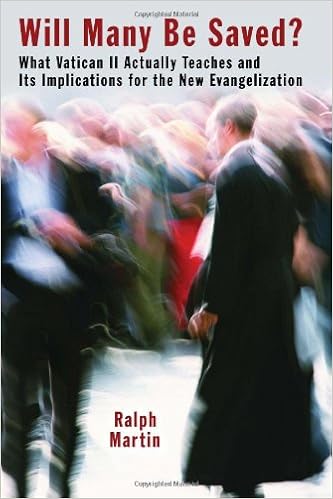
Yet I'm now reading through Ralph Martin's Will Many Be Saved?: What Vatican II Actually Teaches and Its Implications for the New Evangelization (Grand Rapids: Eerdmans, 2012).
I was particularly struck by this section of Martin's critique of Rahner.
"Apart from the scriptural and magisterial witness to the contrary, even from an empirical point of view it is difficult to understand Rahner's optimistic view of human beings' response to what he postulates as the supernatural existential. He acknowledges that's optimistic theory of the 'positive response rate' of human beings needs to be tested against empirical observation of actual human beings and what we can observe of their response. The puzzling empirical fact is that he spent virtually his whole priesthood (1932-1984) first under Nazi rule and then, after World War II, with half of Germany under Soviet communism. He published his first major works in 1939 and 1941. He spent the whole of World War II in Nazi Germany and Nazi occupied Austria, free to lecture although not at a university. From 1939 to 1944 he lectured in Leipzig, Dresden, Strasbourg, and Cologne, laying the theological groundwork for his theories. Consider the slaughter of so many tens of millions--including the firebombing of Dresden; the horrifying realities of the campaign to exterminate the Jews and the millions of concentration camp deaths--including those of many Polish Catholics; the fiendish medical experimentation. Did this not give pause to his theory that almost everybody says 'yes' to the offer of salvation contained in the 'supernatural existential' apart from any hearing of the gospel? Is it at all credible to posit that the grace of God has 'overtaken' the 'false choices' of men in these and many other empirically observable situations?" (p. 103)Indeed, the more I think about it, it does seem that many Catholic thinkers of the twentieth century failed to come to terms with the truly horrifying reality of the holocaust. It is surprising to see how little it actually is accounted for in much modern theology. It is affirmed, yes. I'm certainly not implying people like Rahner are holocaust deniers. The issue is deeper. What real impact did it make on his thought? In the case of Rahner's rather optimistic view of humanity, that does seem to be a valid question.
Releasing Your Inner Prophet: The 26th Sunday of OT
The Catechism of the Catholic Church
says that we are baptized into Christ’s prophethood, but if you cornered any
typical Catholic coming out of mass on a Sunday morning, they would vehemently
deny having any prophetic gifts, because “I’m not Charismatic.”
Well, the prophetic role of the
Christian is not limited to people involved in the Charismatic Renewal. The Readings for this mass are, in a sense,
united by a theme of prophethood, discussing what it means to follow in the
footsteps of Christ and his prophetic charism.
Our First Reading is Numbers 11:25-29:
Monday, September 24, 2018
Jesus and Gehenna (The Mass Readings Explained)
This week's video is now out! Check out the intro below and you can subscribe over at Catholic Productions to watch the full version. Thank you.
Catholic Productions' notable quote from this week's video:
"Before I jump into the Gospel, just as a preface: I think it’s really important to notice that although in our own day and time the topic of hell — the idea of eternal separation from God — has become very unpopular, it’s important to remember that in the Gospels — if you look at the New Testament and the Gospels as a whole — Jesus actually speaks about the fires of hell, the punishments of hell, and the reality of Gehenna more times in the Gospels than the rest of the New Testament combined. So, this really an important issue in the teaching and preaching ministry of Jesus Christ. And, so it needs to be important for us as well, however unpopular it might be."
Catholic Productions' notable quote from this week's video:
"Before I jump into the Gospel, just as a preface: I think it’s really important to notice that although in our own day and time the topic of hell — the idea of eternal separation from God — has become very unpopular, it’s important to remember that in the Gospels — if you look at the New Testament and the Gospels as a whole — Jesus actually speaks about the fires of hell, the punishments of hell, and the reality of Gehenna more times in the Gospels than the rest of the New Testament combined. So, this really an important issue in the teaching and preaching ministry of Jesus Christ. And, so it needs to be important for us as well, however unpopular it might be."
Wednesday, September 19, 2018
Why Being Good Doesn't Pay: 25th Sunday of OT
When I was
younger, especially from high school through my early days as a Protestant
pastor, I had this strong sense that if a person always did what was right,
“things would work out.” That is to say,
righteousness was the path to the good life.
God would pave the way in front of the person that does his will.
There is
some truth to that, of course. A great
deal of interior and exterior suffering is cause by our wicked and selfish
choices. When I used to work as an urban
missionary, occasionally I would have the chance to witness a fairly
significant conversion in the life of a person who had been living a life
basically consisting of criminal activity.
Sometimes there would often be a “honeymoon” period after the person’s
conversion, as so much stress and sadness in their life faded away as they
stopped making evil choices.
Monday, September 17, 2018
The Second Passion Prediction (The Mass Readings Explained)
This Sunday's video is now available over at Catholic Productions. Check it out and subscribe today if you haven't already.
Catholic Productions' Notable Quote from this week's video:
"The description of this suffering righteous man in the Book of Wisdom is strikingly similar to what we see of Christ in the New Testament. The most important part being here is that the righteous man calls himself “God’s Son.” The reason that’s so critical is that in the Old Testament “Son of God” is a term that gets applied to the angels as a group. It gets applied to Israel as a group — they are the “sons of God.” But, whenever it’s applied to an individual, it’s exclusively applied to the King of Israel… So, when the Wisdom of Solomon uses the language of a suffering, righteous, Son of God, it’s also a Messianic context. So, this is about a coming Messiah who’s going to suffer, who’s going to be persecuted, and who’s going to die."
Catholic Productions' Notable Quote from this week's video:
"The description of this suffering righteous man in the Book of Wisdom is strikingly similar to what we see of Christ in the New Testament. The most important part being here is that the righteous man calls himself “God’s Son.” The reason that’s so critical is that in the Old Testament “Son of God” is a term that gets applied to the angels as a group. It gets applied to Israel as a group — they are the “sons of God.” But, whenever it’s applied to an individual, it’s exclusively applied to the King of Israel… So, when the Wisdom of Solomon uses the language of a suffering, righteous, Son of God, it’s also a Messianic context. So, this is about a coming Messiah who’s going to suffer, who’s going to be persecuted, and who’s going to die."
Subscribe to:
Posts (Atom)