Sunday, April 04, 2010

Easter Vigil as a Celebration of Covenant History


Brant, Michael and I belong to a school of thought that sees covenant as a central concept in biblical theology, particularly Catholic biblical theology. Such an approach has strong support in the text of Scripture and in the tradition and liturgy of the Church, and would seem to be a "no-brainer," yet there are those who oppose it and de-emphasize the significance of covenant for interpreting the Scriptures in the Church. For that reason, it's necessary periodically to justify this approach.

When I teach biblical theology, I focus on a series of covenants which are central to the economy of salvation: the (1) Creation (or Adamic; Genesis 1-3; Hosea 6:7), (2) Noahic (David Noel Freedman preferred "Noachian"; Genesis 9), (3) Abrahamic (Genesis 15, 17, 22); (4) Mosaic (Exodus 24), (5) Davidic (2 Samuel 7; Psalm 89); and (6) New (Jeremiah 31:31; Luke 22:20). It has always struck me, and my students, how well this overview of the divine economy accords with the readings of the lectionary of the Mass, especially the readings of the Easter Vigil.

I'll proceed to point out how all these covenants appear in various forms in the seven Old Testament readings that form the backbone of the Liturgy of the Word for the Vigil.

The readings begin with the creation story from Genesis 1, a text concerning the Creation Covenant. That there was a covenant present at creation is controversial, but it has the backing of Popes John Paul II and Benedict XVI, as well as certain contemporary scholars and a stream of the Jewish tradition. Benedict XVI's argument for the presence of a creation covenant hinges on the culmination of the creation week with the Sabbath, which elsewhere in the OT is understood to be the sign of the covenant (Exod 31:16-17). Hosea 6:7 (in Hebrew: "Like Adam they transgressed the covenant") testifies to a very early interpretive tradition which understood a covenant to be present already at the beginning of human history.

The second OT reading is Genesis 22, one of the most central texts in all the Old Testament. I call it the "Calvary of the Old Testament," perhaps the most important type of Christ's sacrifice on the cross in the pages of the Scriptures of Israel. Genesis 22, of course, recounts the "Aqedah" or binding of Isaac, in which Abraham comes close to sacrificing his "one and only" or "only begotten" son on the wood of the altar on the top of Mt. Moriah. God's solemn oath of blessing on Abraham in vv. 15-18 is one of the central texts in all the Bible: arguably, this the culmination of the covenant with Abraham begun in Genesis 15 and continued in Genesis 17. Although the word "covenant" does not appear in Genesis 22, God's solemn oath in vv. 15-18 was understood as a covenant in subsequent Scripture (e.g. Deut 7:8-9; Luke 1:72-73). This solemn covenant-oath by God promises blessing to all nations through the seed of Abraham; Easter is a celebration of the fulfillment of that promise, as all nations have been blessed through Jesus the seed of Abraham (Matt 1:1) who pours out the Spirit on all nations through his self-sacrifice on the cross.

The third OT reading for the Vigil is Exodus 14, the account of the triumph of God in delivering the Israelites from the armies of Egypt at the Red Sea. This corresponds to the Mosaic Covenant (the covenant with Israel through Moses), as the people of Israel had already entered into a covenant relationship with God through the Passover (Exodus 12-13) and were headed out to Sinai where the covenant would be further solemnized (Exodus 24).

The fourth OT reading is a beautiful passage from Isaiah 54:5-14, which, surprisingly, makes reference to the Noahic Covenant (Isaiah 54:9), and compares the coming “covenant of peace” (Isaiah’s term for the reality described by Jeremiah as the “new covenant,” Jer 31:31) to the covenant made with Noah. This passage also employs touching marital imagery to describe God’s relationship with Israel. Marriage was a form of covenant in ancient Israel, so it was natural to describe God’s covenant relationship with Israel in terms of marriage.

The fifth OT reading (Isaiah 55:1-11) is one of my favorite, and one of the most amazing, texts from Isaiah. In this passage, God promises that at some point in the future, he will offer the covenant of David (“I will make with you an everlasting covenant, my covenant fidelity [Hebrew hesed] for David”; Isa 55:3) to every one who is hungry and thirsty. He will offer this covenant through eating and drinking (Isa 55:1)!

The sixth OT focuses on divine wisdom, but the seventh and last (Ezek 36:16-28) has important covenant themes. After recounting Israel’s unfaithfulness to the (Mosaic) covenant, Ezekiel prophesies a coming day when God will sprinkle his people with water and put a new spirit within them which will enable them to keep their covenant with God (“live by my statutes, careful to observe my decrees”). Ezekiel 36 is found canonically in the middle of Ezekiel’s “Book of Consolation” (Ezek 34-37), a long section of Ezekiel in which the prophet offers hope for a new age for Israel, a hope that culminates in Ezek 37:25-28 with the establishment of a “covenant of peace”, an “everlasting covenant” (37:26), Ezekiel’s terms for Jeremiah’s “new covenant” (Jer 31:31).

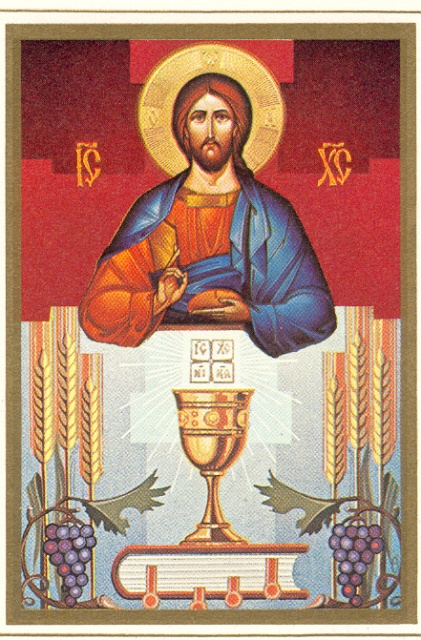
Thus, all the major covenants of salvation history are referred to in some form in the seven OT readings for the Easter Vigil, and taken together the readings (not to mention the psalms that go with them!) make a beautiful synopsis of the general structure of the divine economy (salvation history). Since the Vigil, like every mass, culminates in the consecration of the bread and wine which become “the New and Everlasting Covenant” in Christ’s blood, it is appropriate that the OT readings recount the older and provisional covenants that anticipated the new one celebrated in the Liturgy. Understanding salvation history through the lens of the covenant is an authentically Catholic approach to biblical theology.

Blessed Easter to Everyone!


Christ is risen! A blessed Easter to all our readers! I've just finished the last week of Lent and the incredible experience of the Triduum, with nightly solemn masses on Maundy Thursday, Good Friday, and the Easter Vigil at our local parish, and I have to say, it rocks to be Catholic! The experience of Lent culminating in the Triduum is one of the most physically, emotionally, socially, and spiritually cathartic and ecstatic experiences of my life. To be able to watch the Easter Vigil Mass in St. Peter's Basilica (courtesy of EWTN) with the world's greatest living theologian, successor of Peter, celebrating the resurrection of Christ with over a billion people worldwide, in a language spoken in Christ's own day--it's just too much! This is my ninth Easter as a Catholic and the euphoria has not worn off! A happy Easter to everyone, and some comments on the Easter readings are soon to follow!

Thursday, April 01, 2010

Was Jesus Really Crucified with the Passover Lambs?

It's rather commonplace to hear these days, both in the pulpit and on the page, that Jesus was sentenced to death at the "very hour" the Passover lambs were being offered in the Temple. Above all, Raymond Brown made this idea popular in his commentary on the Gospel of John, when he argued that John's reference to Jesus' standing before Pilate on the Pavement (Gabbatha) at "about the sixth hour" (John 19:14) was a Johannine clue meant to signal to the reader that Jesus, the true Passover lamb, was being led to the cross to take away the sins of the world. (See Brown, The Gospel according to John, 2:556).
There's only one problem with Brown's theory; he's got no evidence to back it up. In fact, the little evidence we do have contradicts his assertion. For example, Josephus, who was a priest in the Temple in the first century A.D., makes very clear that the Passover lambs were sacrificed between 3 and 5 o'clock.:
Accordingly, on the occasion of the feast called Passover, at which they sacrifice from the ninth hour [=3p.m.] to the eleventh hour [=5 p.m.], and a little fraternity, as it were, gathers around each sacrifice, of not fewer than ten persons. (Josephus, War 6:423-24)
If this is correct--and the later Mishnah backs up Josephus, saying that at the earliest, the Passover lambs would not be sacrificed until 1:30p.m. (cf. Pesahim 5:1)--then John 19:14 cannot be a signal to the reader that Pilate is sentencing Jesus to death just as the Passover lambs are beginning to be killed in the Temple. Strangely, however, this false interpretation is so widespread that I regularly encounter people now who say that John "says" Jesus was crucified at the same time as the Passover lambs. But he says no such thing.
The Perpetual Sacrifice in the Temple: 9a.m. and 3 p.m.
So, is there any cultic significance to the hour of Jesus' passion and death? Did Jesus' death on Calvary correspond to any sacrifices in the Temple?
I would suggest there is, and that it is the Synoptic evangelists who have brought this out. For while the Synoptic Gospels make it explicit that the Passover lambs were slaughtered twenty-four hours before Jesus' death (cf. Mark 14:12; Luke 22:7), there was one other sacrifice that was going on in the Temple when Jesus was crucified on Good Friday: the perpetual sacrifice, known as the Tamid.
Strangely, this sacrifice, which is forgotten by almost everyone, was arguably the most memorable of all the Jewish sacrifices, since it happened every day, twice a day. According to the Torah itself, twice a day, in the morning and the evening, an unblemished male lamb was to be sacrificed in the sanctuary, and offered along with an unbloody sacrifice of flour and wine (see Num 28:1-8; Exod 29:38-42).
Now, although the Old Testament does not say exactly when the morning and evening sacrifice took place, according to ancient Jewish sources outside the Bible, the morning offering of the Tamid took place at 9 a.m., while the evening offering took place at 3 p.m. (See Mishnah, Tamid 3:7; Josephus, Antiquities 14.4.3; Philo, Special Laws, 1:169).
The New Tamid
With that information in mind, go back to the Synoptic accounts of Jesus' death on Good Friday. Remarkably, the Gospel of Mark makes very clear that Jesus' passion and death coincided with the offerings of the perpetual sacrifice:
And it was the third hour (9a.m.), when they crucified him (Mark 15:25).
And when the sixth hour had come, there was darkness over the whole land until the ninth hour (3 p.m.). And at the ninth hour, Jesus cried with a loud voice, "Eloi, Eloi, lama sabacthani?" which means, "My God, my God, why hast thou forsaken me?"... And Jesus uttered a loud cry, and breathed his last. (Mark 15:33-37)
Notice that Mark twice states that Jesus expired at the ninth hour, 3 o'clock. Why the emphasis? Apart from historical accuracy, what is Mark trying to communicate?
I would suggest that both chronological references are meant to tie Jesus' passion and death to the perpetual sacrifice being offered in the Temple: the bloody sacrifice of the unblemished lambs and the unbloody sacrifice of cakes and wine. In other words, Mark is showing us that Jesus is the true Tamid, the true perpetual sacrifice, who replaces the atoning power of the Temple cult. Perhaps this is why he stresses the effect of Jesus' death on the Temple:
"And Jesus uttered a loud cry and breathed his last. And the veil of the Temple was torn in two, from top to bottom." (Mark 15:37-38)
In short, there is no reason to strain to connect the hour of Jesus' death with the Passover lambs that had been offered Thursday afternoon. For there was another sacrificial lamb, that was directly linked to atonement, which was being offered at the very hours of his crucifixion and death.
Now, I should probably stop here. But since it's Good Friday, I'll make one last point.
What Were the Jews in the Temple Praying for when Jesus Died?
According to ancient Jewish tradition, as found in the Mishnah and Talmuds, the daily Tamid was not just about sacrifice; it was also accompanied by prayers, which Jews everywhere would say while the sacrifices were being offered in the Temple. According to these traditions, a series of blessings, commonly known as the "Eighteen Benedictions," were being said by Jews everywhere in union with the Tamid (b. Ber. 26b; Gen. R. lxviii). Remarkably, the Rabbis claim that this was taking place even during the Second Temple Period (see Babylonian Talmud, Ber.33a, Meg. 17b.)--with the exception of the benediction against the "heretics," which the Rabbis say was added by Gamaliel II at Yabneh after the destruction of Jerusalem in 70A.D. (see b. Ber. 28b).
Now, before you balk at the idea of using Talmudic traditions to reconstruct Second Temple practices, recall that the New Testament itself tells us that Jesus own followers would go up to the Temple at the hours of the perpetual sacrifice to pray. This is explicit in the book of Acts:
Now Peter and John went up to the Temple at the hour of prayer, the ninth hour (=3p.m.) (Acts 3:1; cf. 2:15).
The question is: What prayers were Jews saying while the Tamid was being sacrificed in the first century? On the one hand, we could say, 'we don't have any idea'. On the other hand, ancient Jewish tradition, provides a rather concrete answer: it tells us that the Eighteen Benedictions were being prayed at that time.
What is striking about these prayers is this: If these ancient Jewish traditions are correct--and I realize that this is disputed--then what follows below are the kind of things the Jews in the Temple would have been praying for while the Tamid was being sacrificed and while Jesus was dying on the Cross:
1. According to Jewish tradition, at 9a.m. and 3p.m., the Jews in the Temple would have been praying for redemption:
"Look upon our affliction and plead our cause,and redeem us speedily for your name's sake, for you are a mighty redeemer. Blessed are you, O Lord, the redeemer of Israel." (7th Benediction)
2. According to Jewish tradition, at 9a.m. and 3p.m., the Jews in the Temple would have been praying for the forgiveness of sins:
"Forgive us, O our Father, for we have sinned; pardon us, O our King, for we have transgressed; for you pardon and forgive. Blessed are you, O Lord, who is merciful and always ready to forgive." (6th Benediction)
3. According to Jewish tradition, at 9a.m. and 3p.m., the Jews in the Temple would have praying for the coming of the Messiah:
"Speedily cause the offspring of your servant David to flourish, and let him be exalted by your saving power, for we wait all day long for your salvation. Blessed are you, O Lord, who causes salvation to flourish." (15th Benediction)
4. In fact, according to Jewish tradition, at 9a.m. and 3p.m., the Jews in the Temple would have been praying for the resurrection of the dead:
"You, O Lord, are mighty forever, you revive the dead, you have the power to save. You sustain the living with lovingkindness, you revive the dead with great mercy, you support the falling, heal the sick, set free the bound and keep faith with those who sleep in the dust... Who resembles you, a king who puts to death and restores to life, and causes salvation to flourish? And you are certain to revive the dead. Blessed are you, O Lord, who revives the dead." (2nd Benediction)
In short, if these traditional prayers do in fact go back to the Second Temple period, then something remarkable emerges. For we find a plausible explanation for why Mark emphasizes Jesus' crucifixion and death as corresponding to the hours of 9a.m. and 3p.m.. We find that ancient Jews were praying for the very things Christians believe were dispensed by Jesus on the Cross, at the very hour he was dispensing them.

Have a blessed Triduum and a holy Easter.


Saturday, March 27, 2010

The Jewish Roots of Palm Sunday


Tomorrow is, of course, Palm Sunday.
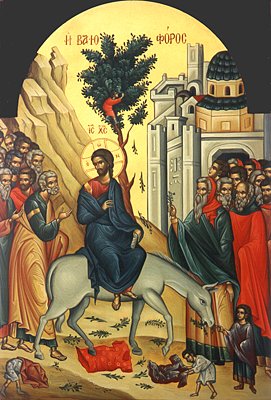
Most Christians will celebrate this feast with two prominent features: the story of Jesus' triumphal entry into Jerusalem and the blessing and waving of palm branches.
This raises the questions: Why did Jesus enter Jerusalem on a donkey? Why not on a horse? Why not in a chariot? And why did the crowds greet him with branches? The answers to these questions can be found by exploring the Jewish roots of the Triumphal Entry, as revealed in the texts of the Old Testament.
Solomon's Rides a Mule into Jerusalem
The answer to the first question is rooted in two texts: 1 Kings 1 and Zechariah 9. In the book of Kings, we learn that Jesus wasn't the first king to ride triumphantly into Jerusalem. Long before him, Solomon had done the same, immediately before he was enthroned as king of Israel:
King David said... "Cause my son Solomon to rid on my own mule, and bring him down to Gihop, and let Zadok the priest and Nathan the prophet there anoint him king over Israel; then blow the trumpet, and say, 'Long live King Solomon!' You shall then come up after him, and he shall come and sit upon my throne... So Zadok the priest, Nathan the prophet, and Benaiah the son of Jehoiada, and the Cherethites and Pelethites, went down and caused Solomon to ride on King David's mule, and brought him to Gihon [the spring alongside the Temple mount]. There Zadok the priest took the horn of oil from the tent, and anointed Solomon. Then they blew the trumpet, and all the people said, "Long live King Solomon!" And all the people went up after him, playing on pipes, and rejoicing with great joy, so that the earth was split by their noise. (1 Kings 1:32-40)
Notice that Solomon's triumphal entry on the mule takes place after his having been anointed king in the waters of the Gihon and immediately before his enthronement. Thus, this is not just a triumphal entry, but a royal enthronement.
The Triumphal Entry of the Messiah
Moreover, this text gives rise to a prophecy in Zechariah, which speaks of the coming Messiah, the future king, who will recapitulate the actions of Solomon:
Rejoice greatly, O daughter of Zion!Shout aloud, O daughter of Jerusalem!Lo, your king comes to you;triumphant and victorious is he,humble and riding on an ass, on a colt, the foal of an ass. (Zechariah 9:9)
Now, most readers stop here, noting the obvious parallels between this messianic oracle and the actions of Jesus. But keep reading: What does the Messiah do when after he rides into Jerusalem on an ass?
I will cut off the chariot from Ephraim and the war horse from Jerusalem; and the battle bow shall be cut off, and he shall command peace to the nations; his dominion shall be from sea to sea, and from the River to the ends of the earth. As for you also, because of the blood of my covenant with you, I will set your captives free from the waterless pit. Return to your stronghold, O prisoners of hope... (Zechariah 9:10-11)
This is a stunning oracle. In it, the future king not only rides into Jerusalem on an ass in humility, but establishes (1) a universal kingdom ('to the ends of the earth'), which is characterized by peace, not war (the chariot is 'cut off). Finally, and most stunning, (3) by means of a blood covenant, God sets Israel's "captives" free from "the waterless Pit" and brings them hold to Jerusalem (the 'stronghold'). This last line is particularly strange; since what is clearly in view is deliverance from Exile in Sheol, the realm of the dead, which is frequently referred to in the Old Testament as "the Pit." Zechariah clearly seems to expect the messianic return from exile to include those who had descended into Sheol, who would somehow be released through the "blood of [the] covenant."
Jesus' Triumphal Entry
Once this Old Testament background is in place, Jesus' Triumphal Entry takes on a deeper significance. First, he is deliberately recapitulating Solomon's royal entry into Jerusalem when he was enthroned as king. Second, he is performing a prophetic sign of the fulfillment of Zechariah's prophecy of the coming of the Messiah. In other words, Jesus is both a New Solomon and the long-awaited Messiah. Should there be any doubt about this, Matthew's Gospel makes both very clear, since he not only cites Zechariah 9, but the crowds describe Jesus as none other than the 'son of David', a title to which, above all people, Solomon bore the right:
And when they drew near to Jerusalem and came to Bethphage, to the Mount of Olives, then Jesus sent two disciples, saying to them, "Go into the village opposite you, and immediately you will find an ass tied, and a colt with her; untie them and bring them to me. If any one says anything to you, you shall say, 'The Lord has need of them', and he will send them immediately." This took place to fulfill what was spoken by the prophet, saying, "Tell the daughter of Zion, Behold, your king is coming to you, humble, and mounted on an ass, and on a colt, the foal of an ass." [Zech 9:9]. The disciples went and did as Jesus had directed them; they brought the ass and the colt, and put their garments on them, and he sat thereon. Most of the crowd spread their garments on the road, and other cut branches from the trees and spread them on the road. And the crowds that went before him and that followed him shouted, "Hosanna to the Son of David! Blessed is he who comes in the name of the Lord! Hosanna in the highest!" (Matthew 21:1-9)
The Palm Branches of the King Who Comes to Offer Sacrifice
This leaves us with one key question: Why the palm branches? No palms are mentioned in 1 Kings or Zechariah . As Matthew's account makes clear, the branches are tied to Psalm 118, the Great Hallel psalm, which the Jewish crowds are chanting as Jesus enters into Jerusalem. What is striking about this psalm is, when read in context, it too describes the coming of the king into the city. But in this case, the king enters not to be enthroned, but to ascend to the altar and offer sacrifice:
[King speaking:] "Open to me the gates of righteousness, that I may enter through them and give thanks to the Lord. I thank you that you have answered me and have become my salvation. The stone which the builders rejected has become the head of the corner...
[Crowd speaking:] "Save us [Hosanna], we beseech you, O LORD! O LORD, we beseech you, give us success! Blessed is he who comes in the name of the LORD! We bless you from the house of the LORD... Bind the festal procession with branches, up to the horns of the altar!" (Psalm 118:19-27)
That this is the psalm chosen by the pilgrims to celebrate Jesus' entry into Jerusalem is no accident. For while the crowds recognize that Jesus is indeed the long-awaited king of Israel, the new Solomon, what they do not see--what they cannot see--is what kind of king he is, and how he is going to reign. For the altar on which Jesus will pour out "the blood of the covenant" is not the bronze altar in the Temple, but the table of the Last Supper. And the throne to which Jesus is about to ascend as king is not the golden throne of Solomon, but the wooden throne of Golgotha. As king, he will indeed go up to the horns of the altar to offer sacrifice and ascend to the throne of his kingdom to reign. But his triumph will not be through the power of the chariot or the violence of the bow, but through the offering his own life. By means of his blood, the blood of the new covenant, he will bring home the exiles from the land from which no man returns, and will set all captives free, including those imprisoned in the "waterless pit."
At every Eucharist, when we sing the Sanctus, the Church, the new Jerusalem, takes up this cry of the crowds in Jerusalem on Palm Sunday and makes it our own: "Blessed is he comes in the name of the LORD!" (Ps 118:26).

Tuesday, March 23, 2010

Three Reasons for Teaching the Bible


Why teach the Bible?
In his inaugural lecture at the University of Paris, when St. Thomas Aquinas was installed as Magister in Sacra Pagina--note, as a master commentator on the Bible, not first and foremost as a philosopher--Thomas gave three primary reasons, based on a quotation from the book of Baruch:
"This is the book of the commandments of God, and the law that is for ever. All that keep it shall come to life: but they that have forsaken it, to death" (Baruch 4:1)
[Thomas speaking:] According to Augustine in On Christian Doctrine 4:12, one skilled in speech should so speak as to teach, to delight, and to change; that is, (1) to teach the ignorant, (2) to delight the bored, and (3) to change the lazy.
The speech of Sacred Scripture does these three things in the fullest manner. For it firmly teaches with its eternal truth. Psalm 118.89: "Thy word, O Lord, stands firm forever as heaven." And it sweetly delights with its pleasantness. Psalm 118.103: "How sweet are thy words to my mouth!" And it efficaciously changes with its authority. Jeremiah 23.29: "Are not my words as a fire, saith the Lord?"
Therefore, in the text above [Baruch 4:1] Sacred Scripture is commended for three things. First, for the authority with which it changes: "This is the book of the commandments of God." Second, for the eternal truth with which it instructs, when it says, "And the law that is forever." Third, for the usefulness with which it entices, when it says, "All that keep it shall come to life."
--Thomas Aquinas, Hic Est Liber, 1256
(Ralph McInerny, Thomas Aquinas, Selected Writings, 5-6)
Thomas' statements are remarkable for two reasons.
First, he lays out an admirable philosophy of pedagogy. Teachers should not simply strive to communicate information; they should strive to do it in a way that is delightful, as well as transformative.
Second, he points out that Scripture--above all other objects of study--has the power to accomplish all three of these "in the fullest manner."
I must say that in my own experience, I have seen this time and time again in the classroom. I studied many subjects in college, in which I found great instruction and much delight, but they paled beside the first course I took on the Bible. The experience was... electrifying. That's the only way to describe it.
Now that I'm on the other side of the desk, it's even better. I can't tell you how many times in the classroom we have what you might call an "Emmaus Road" experience, in which the hearts of the students (and my own heart) are "burning within us" when we get down to the task of explaining the sacred page.
Moreover, I've also noticed the distinct power that the Bible has not only has to instruct and to delight (as do many other subjects) but to actually transform students. I like how Thomas puts it: "To change the lazy." (Thomas evidently had no illusions about students in the 13th century, who were evidently not much different than students in the 21st century!)
For those of you who've taught Scripture, have you had this experience?
For those of you who've studied Scripture in the classroom, did your Scripture courses accomplish all three of Thomas goals?


Thursday, March 11, 2010

Lent: The Romance of the Wilderness


I've recently been intrigued by two themes which seem to run through Lent: the desert and nuptiality. On the one hand, Lent is a "desert" experience, in which our forty days of self-denial are meant to bring us into closer communion with Christ who fasted forty days in the desert (or "wilderness"). On the other hand, Lent is a preparatory time in the Church as catechumens prepare for their Nuptial Bath (Baptism) and the Wedding Feast of the Lamb (the Eucharist). So, for catechumens and, to a lesser extant, the rest of the Church that spiritually accompanies them on this journey, Lent has the aspect of the final days of courtship and preparation for a spiritual marriage. Nuptial themes run through some of the readings from the Gospel of John used during Lent and the Holy Triduum (Good Friday, Holy Saturday, and Easter).

But the juxtaposition of desert imagery with the joy of wedding preparation seems incongruous; except that they are conjoined in a beautiful passage of Scripture:

Hos. 2:14 “Therefore, behold, I will allure her, and bring her into the wilderness, and speak tenderly to her. 15 And there I will give her her vineyards, and make the Valley of Achor a door of hope. And there she shall answer as in the days of her youth, as at the time when she came out of the land of Egypt. 16 “And in that day, says the LORD, you will call me, ‘My husband,’ and no longer will you call me, ‘My Baal.’

In this passage, the prophet Hosea speaks to Northern Israel and promises a resumption, at some future date, of the nuptial (spousal, covenantal) relationship between the LORD and his wayward people. The place of the nuptial tryst between the LORD and Israel is described as "the wilderness"--in part because it was in the wilderness that Israel first entered into a covenant relationship with the LORD (at Sinai, Exodus 24). But what does this mean for us?

Lent, when lived well, is a desert experience in which we deny ourselves many of the comforts that usually pad our existence, and the addictive crutches we turn to when stressed. We practice, to greater or lesser extents, sensory deprivation that recalls the barren wilderness of Judea, which offers little to comfort the senses. The advantage of sensory deprivation, however, is that there is less to distract. The wilderness does not have the flashing lights and allurements of Times Square. In the wilderness, one can focus. One can concentrate. And that may be another reason that the LORD leads his people into the wilderness to allure her. In the desert she will not be distracted. In the desert she can focus once more on her beloved. The intent of the Church is that in the desert of Lent we would deny ourselves some of our more common distractions and learn to be alone, and to fall in love once again, with our Bridegroom.

Saturday, March 06, 2010

Wooing the Woman at the Well: Gospel for the Third Sunday of Lent


The Gospel reading for this Sunday, if your local parish is following the readings for RCIA, is the "Woman at the Well" (John 4).

This is one of the key texts in the Gospel of John that present to us Jesus as the Bridegroom Messiah.

Recall that the Gospel of John begins with an enumeration of seven days, with a wedding on the seventh (the Wedding at Cana, John 2:1-11). There is probably an intentional parallel here to the creation story, in which Adam is created on the sixth day, falls asleep, and wakes up (on the seventh day?) and, seeing Eve, pronounces the covenant words ("bone of my bone and flesh of my flesh") with establishes the first marital covenant. The only identified characters at the Wedding at Cana are Jesus and Mary, whom the Church recognizes as the New Adam and New Eve.

In the following chapter (John 3), John the Baptist explicitly identifies Jesus as the Bridegroom.

Now in chapter 4, Jesus is traveling through Samaria and sits down by a well.

The minute Jesus sits down by the well, the reader familiar with the Old Testament expects a woman to show up. The reader is not disappointed: here she comes (John 4:7). Recall that Jacob and Moses both met their wives at a well, and that Abraham's servant found Rebecca for Isaac at a well. Moreover, the well in John 4 is identified as "Jacob's Well". Although it was clearly not the same well where Jacob met Rachel (which would have been in Northwest Mesopotamia), there was a tradition that this well near Sychar was in fact that very same well, which had now moved to the Land of Israel. In light of all this, it seems like John is telling this story in such a way as to evoke a betrothal scene in the style of the Old Testament.

Jesus' request of the woman, "Give me a drink," (4:7) recalls the request of Eliezer (Abraham's steward) to Rebecca when he was seeking to determine if she was the Lord's intended bride for Isaac. This serves to heighten the nuptial atmosphere of the whole passage.

Jesus and the woman begin to discuss water, living water in particular. At one point, Jesus implies that anyone who drinks of the water he provides will him- or herself become a well of living water (John 4:14), which calls to mind one of the images that the Bridegroom uses to describe the Bride in the Song of Songs (Song 4:15).

Finally, the conversation turns explicitly to marriage (4:16): "Go, call your husband, and come here." We discover that the woman has had five husbands, and the man she is living with now is not properly her husband.

It is probably not coincidental that the Samaritans were the ethnically-mixed descendants of poor Israelites left behind by the conquering Assyrians (8th cent. BC), and FIVE other ethnic groups (each with their own male patron deity) brought in by the Assyrian to repopulate northern Israel (2 Kings 17:24). Apparently, the Israelites left behind intermarried with the five immigrant peoples and worshipped their gods, until some point in history, perhaps after the return of the Judeans from Babylon, when they quit the paganism and returned to the worship of the God of Israel--but not in the authorized way or place! Instead of going down to the legitimate temple in Jerusalem, they built their own sanctuary on Mt. Gerizim and altered the text of Deuteronomy to make it appear that Gerizim was the LORD's intended site for a central sanctuary. So the Samaritan people, after having participated in five different foreign cults, were now back "living with" the LORD, but not in a proper covenant relationship. The experience of this woman of Samaria mirrors the spiritual history of her people.

Trying to change the subject of conversation to something else besides her personal life, the woman tries to distract Jesus with a theological question (v. 19). Jesus responds, speaking about the true manner of worship, but his answer goes over the woman's head. All she can say in response is to make a profession of faith in the coming Messiah, whom she hopes will be able to explain everything. Jesus answers: "He who speaks to you, I AM!"

At this point the woman drops her water jar in amazement and wanders dazed back into town, telling everyone to come out and see this man who has told her everything she did. Can this really be the Messiah? Jesus stays with the villagers two days and many come to place their faith in him.

So what has happened in this story? Jesus, who is the LORD, the God of Israel, has come to woo these descendants of northern Israel (the Samaritans) back to himself, as he promised to do in many prophecies, notably those of Hosea:

Hos. 2:14 “Therefore, behold, I will allure her, and bring her into the wilderness, and speak tenderly to her. 15 ... And ... she shall answer as in the days of her youth, as at the time when she came out of the land of Egypt. 16 “And in that day, says the LORD, you will call me, ‘My husband,’ and no longer will you call me, ‘My Baal.’ 17 For I will remove the names of the Baals from her mouth, and they shall be mentioned by name no more. 18 And I will make for you a covenant on that day ... 19 And I will betroth you to me for ever; I will betroth you to me in righteousness and in justice, in steadfast love, and in mercy. 20 I will betroth you to me in faithfulness; and you shall know the LORD."

The woman is a type and image of her people, the people of Samaria, whom the LORD did not forget, but return to woo them to himself.

Christ the LORD, the Bridegroom Messiah, comes to woo each one of us at the Eucharistic Liturgy (Mass). Despite our sins, shames, and checkered histories, he comes suddenly under the images of bread and wine, offering himself to us, calling himself to us, to be his spotless bride (Eph 5:25-27; Rev 21:9-11).

Friday, March 05, 2010

Defintive Biblical Evidence AGAINST Dogs Going to Heaven


Anyone who's ever taught a High School Religion course knows that at some point, that perennial question that has troubled theologians for centuries and continues to plague modern and post-modern young people will arise: "Do Dogs go to heaven when they die?" To answer this question positively is to give comfort and consolation to the fearful souls of students.
But God forbid you answer this question negatively. As one of my former students learned in his first year of teaching, to even suggest the possibility that dogs might not go to heaven (e.g., because they do not have immortal souls, or that they are not persons, or for some other reason)--much less to unequivocally declare that they do not--will arouse the wrath of students and the ire of their pet-loving parents (not to mention a potential trip to your supervisor's office for teaching such 'rigid' and 'disturbing' doctrines).
Up until now, when asked how to deal with this situation by students, I've simply suggested that they use reason (Hah!) and philosophy (double Hah!) to attempt to persuade the students that the longing to be with 'Fluffy' forever in the heavenly Jerusalem may in fact go unfulfilled.
However, I recently discovered that there is actual biblical evidence against dogs going to heaven. Well, this is entirely different. It's one thing to make a philosophical argument, but quite another to have Sacred Scripture on your side. So here it is. In the final chapter of the Bible, the Book of Revelation is describing the heavenly Jerusalem come down to earth, and in this context explicitly states:
Then he showed me the river of the water of life, bright as crystal, flowing from the throne of God and of the Lamb through the middle of the street of the city [the new Jerusalem]; also, on either side of the river, the Tree of Life... Blessed are those who wash their robes, that they may have the right to the Tree of Life and that they may enter the city by the gates. Outside are the dogs and sorcerers and fornicators and murderers and idolaters, and every one who loves and practices falsehood (Revelation 22:1-2, 14-15)
There you have it, in black and white! Even the Greek is clear: Outside are "the dogs" (kunes). The Heavenly Jerusalem has a sign, and it reads: "No Dogs allowed." So, for all you dog-lovers, sorry. Dog's don't go to heaven; the Bible says so; that settles it. Whatever you may hope for, you won't be seeing Rover in the New Jerusalem.
P.S. I might note in closing that this brings me no particular grief. I'm a cat person, and of cats being excluded from heaven the Bible says nothing.
P.P.S. It might have helped the now-famous church sign debate over the issue for somebody to actually proof-text Scripture. That is, after all, the usual exegetical method of such signs.


Sunday, February 21, 2010

The Temptation, Kings, Nuns and Priests


The Gospel reading for the first Sunday of Lent is the temptation of Christ in the desert according to Luke.

Christ is tempted in three ways: through his physical desires (hunger for food), through his eyes (being shown all the glory of the kingdoms of the world), and through the temptation to pride (to stage a magnificent stunt that would win him fame throughout the nation).

This threefold temptation of Christ corresponds to St. John’s warning about the “lust of the flesh, lust of the eyes, and the pride of life” in 1 John 2:15. This threefold categorization has been known in the Church as the “threefold concupiscence,” the unholy Trinity of temptation.

Eve was tempted in the same way. She saw that the fruit was “good for food, pleasing to the eye, and to be desired to make one wise.” “Good for food” is lust of the flesh. “Pleasing to the eye” is lust of the eye. “Desired to make one wise” is a temptation to pride—Eve wants to be wise like God.

Thousands of years later, the king of Israel was commanded by Moses to restrain himself from the temptations of the threefold concupiscence. Deut 17:16-17 forbids the Israelite king from multiplying horses (military might), women (sensual pleasure), and gold/silver (greed/avarice) for himself. These three items correspond to lust of the flesh (women), lust of the eyes (gold), and pride (self-aggrandizing military build-up).

First Kings 10–11 describe how, in his latter years, Solomon, the first Son of David to sit on his father’s throne and a kind of “New Adam” figure in the biblical story line, egregiously fell prey to the threefold concupiscence by multiplying for himself everything Deuteronomy 17 forbids.

In today’s Gospel, we see Jesus, the New Adam, overcoming the threefold concupiscence, and so undoing the sin of Eve, and overcoming the failings of the first Son of David, Solomon. “One greater than Solomon is here” (Luke 11:31).

All Christians share in Christ’s royal anointing and therefore must take steps to overcome lust, avarice, and pride. In particular, in the Catholic tradition, those who enter the religious life take vows of poverty, chastity, and obedience. These vows are radicalized ways to mortify the threefold concupiscence: lust of the flesh (chastity), lust of the eyes (poverty), and pride (obedience). We should view these “evangelical counsels” as means toward a profound conformity to Christ and his power to overcome temptation. Even Catholic diocesan clergy, who do not take formal vows of poverty, chastity, and obedience, nonetheless de facto commit themselves to this lifestyle. It seems fitting that they should, since they are in a sense the viceroys of the New Israel (Gal 6:16), and therefore should commit themselves more radically to the self-denials required of anyone who would rule over the people of God (Deut 17:16-17).

Saturday, February 20, 2010

Back from St. Michael's Parish Houston


While Brant, Michael, and Dr. Hahn are partying in Lubbock, I've been down to Houston to a wonderful parish there, St. Michaels. I gave my conversion story on Thursday night, and spoke to a women's retreat on Friday morning about the Cross as both a priestly and nuptial act on the part of Jesus the Christ. I can't say enough good things about the people and hospitality at St. Michael's parish. I think we all had a great time.

The talks I gave, although in different versions, are available on CD at www.catholic-productions.com.

Thursday, February 04, 2010

Does Hebrews Envision a New Ministerial Priesthood?


Since Pope Benedict has declared this the "Year for Priests," and since I am now teaching at a Catholic seminary, I've been doing some thinking and writing about the origins of the ministerial priesthood. 
In the course of this research, I went back to the council of Trent's decree on the ministerial priesthood, and found that in key text, the Council rooted its teaching on the institution of the ministerial priesthood in a text from the epistle to the Hebrews:
"Sacrifice and priesthood are so united by the ordinance of God that both have existed in every law. Since, therefore, in the New Testament the Catholic Church has received from the institution of the Lord the holy, visible sacrifice of the Eucharist, it must also be confessed that there is in the Church a new visible and external priesthood (canon 1), into which the old has been translated (Heb 7:12). Moreover, that this was instituted by that same Lord and Savior (canon 3), and that to the apostles and their successors in the priesthood was handed down the power of consecrating, of offering and administering His body and blood, and also of forgiving and retaining sins, the Sacred Scriptures sho and the Church has always taught. 
(canon 1)." (Council of Trent, Session XXIII)

Several things are interesting about this text, not least of which is the language used to describe what is now commonly called the 'ministerial' priesthood. For one thing, Trent refers to this as the "visible and external priesthood," which presents a contrast to the priesthood of all the baptized, which I presume would be an "invisible and interior" priesthood. Moreover, Trent also speaks of the "translation" of the old priesthood into the new. This is intriguing language, perhaps not one would expect when thinking of the establishment of a new priesthood. 

Finally, it is interesting that Trent focus on Hebrews 7:12, since the context of that seems to me to suggest both (1) that Jesus is a priest after the order of Melchizedek, and (2) that there has been "a change in the priesthood," not a dissolution of the priesthood:

11 Now if perfection had been attainable through the Levit'ical priesthood (for under it the people received the law), what further need would there have been for
another priest to arise after the order of Melchiz'edek, rather than one named after the order of Aaron? 12 For when there is a change in the priesthood, there is 
necessarily a change in the law as well. 13 For the one of whom these things are spoken belonged to another tribe, from which no one has ever served at the altar. 14 For it is evident that our Lord was descended from Judah, and in connection with that tribe Moses said nothing about priests. (Heb 7:11-14)

Notice also that the context is specifically priestly ministers--i.e., those who "serve at the altar" (Heb 7:13), which was something that was never done by all Israelites, even though they were all "a kingdom of priests" (cf. Exod 19:5-6). What is fascinating about this emphasis on service "at the altar" in combination with a "change in the priesthood," is that Heb 7:13 is not the last reference to an altar. Rather, in Hebrews 13 we find the following:

"
We have an altar from which those who serve in the tent have no right to eat." (Heb 13: 10)

What "altar" is the author referring to? It seems clear to me that  is a reference to the eucharistic sacrifice, from which Christians may eat, but not the levitical priests in the Jerusalem Temple. If right, this is highly significant: if Hebrews sees the Eucharistic table as an "altar" of sacrifice, one would be hard pressed to deny (especially in a first-century context) that the author also saw the Christian ministers of the altar as priestly figures. This becomes suggestive when we recall that the context of this statement is surrounded by an inclusio focused on obeying the Christian "leaders," who are distinct from the lay faithful (Heb 13:7, 17, inclusio). 

In sum, at first glance, it seems to me that it is precisely in Hebrews that we find some of the most intriguing references to a new priesthood, centered on the new altar of the eucharistic sacrifice. Of course, unlike the Levitical sacrifice, the eucharistic banquet would be an
unbloody sacrifice of bread and wine, but  that is precisely what Melchizedek offers in Gen 14:18, and why he is appropriate type for Jesus' own priesthood and the priestly leaders of the new covenant.

Year of the Priest: Priesthood in the OT (audio)


OK, we're going to try this again.

A couple of days ago I posted a link to some talks on the priesthood in the OT from a Catholic perspective, but the link didn't work.

The final link is now (theoretically) up and running, so click on the title of this post if you want to listen.

These talks were part of Adult Faith Formation for the City of Steubenville, an effort of all the city's parishes.

Wednesday, January 06, 2010

On the Essential Unity of the Old and New Testaments


Merry Christmas to everyone out there.
Over the Christmas break, I've been reading a biography of the twentieth-century theologian, Henri de Lubac (1896-1991), by Rudolf Voderholzer, entitled, Meet Heri de Lubac: His Life and Work (Ignatius Press, 2008). 
One of the most interesting parts of the book is when it recounts de Lubac's composition of his multi-volume masterpiece, Medieval Exegesis (3 vols. Eerdmans, 1998, 2000, 2008). In preparation for this work, de Lubac worked through all 217 volumes of Migne's Latin Church Fathers and all 162 volumes of the Greek Fathers, copying down all of the relevant passages on the doctrine of Scripture on slips of paper! What I found fascinating about this recollection was not just the thoroughness of his research (who does this anymore besides Dale Allison?), but, in the course of such reading, his overarching discovery:
"Along the way I became more and more strongly aware of the essential nature of the extraordinary connection, always threatened but always maintained or reestablished within the Church, between the two Testaments; I saw it more and more clearly dominating the whole history and the whole doctrine of the Church, from the first century to our own time... I was happy working to do justice in that way to one of the central elements of the Catholic tradition, so grossly unappreciated in modern times and nevertheless still the bearer of promises for renewal." (Henri de Lubac, At the Service of the Church, 83-84, cited in Meet Henri de Lubac, 79)
This is a remarkable claim. After reading through the vast majority of the Fathers, both Greek and Latin, de Lubac found that the issue of "the essential unity" of the Old and New Testaments "dominates" both the "history" and "doctrine" of the Church, from the beginning down to our times. Think about it, and it rings true: 
What was the first council of Jerusalem about? The unity of the Old and New testaments, and whether not requiring circumcision for salvation was an abandonment of the old covenant. How about Irenaeus' clash with Gnosticism? The unity of the Old and New Testaments, and whether the Creator God of the old was the same as the Redeemer of the New.
Indeed, even today, what about the quest for the historical Jesus, especially in its most recent form, which is so focused on Jesus the Jew? At the heart of it, isn't this really about answering the question of continuity between Jesus (who lived according to the Old Testament) and the Church (representing the New)? 
For what it's worth, for years I have suggested to my students (with no actual research or evidence to back it up) that most of the heresies that have plagued the Church over the centuries often seem in some way be tied to a failure to pay adequate attention to the Old Testament. It's vindicating to find someone of de Lubac's erudition (personally, I've only had the time to read 161 volumes of Migne's Greek fathers;) confirming the basic idea that the unity of the Old and New Testaments is "always being threatened" by various voices but "always being maintained or reestablished within the Church." In our century, such an affirmation was given an unprecedented visibility at the Second Vatican Council in Dei Verbum 14-15 and even moreso in the 1992 Catechism of the Catholic Church, which devotes three long paragraphs to "the unity of the Old and New Testaments" (CCC 128-130). 
In closing, I also think, but cannot prove, that one of the reason's N. T. Wright's Jesus and the Victory of God (Fortress 1996) was such a popular book was that he integrated the Old Testament prophets into his reconstruction of Jesus' life and aims more thoroughly than any other scholar writing at the time. I can honestly say that for my own part, while writing my dissertation, it was Wright above all who pushed me to actually go back and not just read Second Temple sources, but the Old Testament itself, especially the prophets, in my own attempt to understand the first-century prophet from Nazareth. 


Wednesday, December 02, 2009

A Major New Book on Jesus: Craig Keener's The Historical Jesus of the Gospels


Well, another SBL is come and gone, and I've spent the last week doing what I do every year the week after SBL: being torn apart between reading all the new books I bought and finishing up my semester of teaching work and finals grading.
This year, I have given in to temptation and can't stop reading Craig Keener's new book, The Historical Jesus of the Gospels (Eerdmands, 2009). I am currently about halfway through it, and, if all goes well, plan on doing a series of short posts on certain aspects of this very important new contribution to the historical study of Jesus.
Keener is one of the most learned New Testament scholars writing today, and one of the few historical Jesus scholars who has also penned full length commentaries on The Gospel of Matthew (Eerdmans, 1999) and The Gospel of John (Hendrickson, 2003), of which the latter is arguably the most exhaustive commentary on John penned in the last century or so. For the last few years I've recommended Keener's commentary on John to colleagues not least because the opening chapter on the introduction to John--a chapter which is 330 single spaced pages!--is simply the best introduction to the Gospel I've ever read. (It almost should have been a separate monograph). Anyway, Keener's familiarity with the exegetical issues surrounding the Synoptic and Johannine tradition gives him a special edge and makes his work a unique contribution to the field of historical Jesus research.
With that being said, there are three introductory points that you should know about this new book, The Historical Jesus of the Gospels:
1. Although the book looks formidably long, it is actually extremely concisely written. While it totals out at 831 pages, only 350 of those are actually main text. The rest are endnotes (Why?Why? Why?!!!) appendices, indexes, and an over 100 page bibliography. This makes the book much more accessible for a wide audience than it might appear at first glance.
2. The book is divided into two main parts:
a. Methodology of Jesus Research
b. A 'Reconstruction' of the Life and Aims of Jesus
I'm currently finishing up the methodology section, so I can't say much about Keener's analysis of Jesus' aims, except to say that Keener himself points out that the main contribution of the book is in the method section, where he draws on his unbelievably vast knowledge of ancient Jewish and Greco-Roman literature in order to situate the genre and writing of the Gospels in their historical context.
So far, this methodology section is simple stunning: the chapters on "The Gospels as Biographies," "Luke-Acts as History," "The Gospels' Written Sources," and "the Gospels Oral Sources" are worth the price of the whole book. I have never read in one place such a concise and earth-shattering reevaluation of the assumptions, methods, and sources of Gospel study that is so thoroughly researched and entirely rooted in ancient primary sources, both Greco-Roman and Jewish. Keener strides across the threshold to the door that Richard Bauckham opened in his Jesus and the Eyewitnesses (Eerdmans, 2003), and does so in a way that is clear, concise, unbelievably erudite, and quite convincing, and which does not suffer from some of the weaknesses of Bauckham's case (e.g., the question of inclusio indicators of eyewitness sources.)
I cannot stress the point enough: any scholar or student who works in the historical study of Jesus needs to read carefully and reckon with Keener's arguments about the genre, historiographical characteristics, and oral and literary formation of the Gospels. If all I had were part 1 of this book, I would even go so far as to suggest that Keener's work represents something of a new stage in the historical study of Jesus, since it is the first major work to fully incorporate the advances that have been made into the literary genre of the Gospels as ancient biographies. Other works treat the Gospels like biographies, without fully discussing why (e.g., N. T. Wright, Jesus and the Victory of God), while other works note that the Gospels are biographies, but end up treating the Gospel material exactly like the form-critics who denied the biographical character of the Gospels (e.g., James Dunn, Jesus Remembered). Keener's work is different. However...
3. ...There's still one last observation, more critical than laudatory. There is a strange weakness in the book, which is frustratingly mis-titled. The title, The Historical Jesus of the Gospels, gives the impression that Keener is going to build his reconstruction of Jesus' words and deeds from all four Gospels, not just the Synoptics. However, this book should have been called The Historical Jesus of the SYNOPTIC Gospels, for the Fourth Gospel is (virtually) nowhere to be found. Indeed, before we even get to page 1, Keener declares that he will abstain from drawing on the Gospel of John, for reasons of (1) length (the book is already too long); (2) previous publication (readers can find his thoughts on John in his commentary); and (3) avoiding controversy ("there are enough issues of controversy involved in the present discussion that it seemed superfluous to add another one" Keener, "Introduction," p. xxiv).
Although I can sympathize with these points, in the final analysis, they disappoint, for several reasons.First, the issue of length could have easily been solved by eliminating the 100 page bibliography. I'd have preferred 100 pages on Jesus and the Gospel of John from one of the foremost commentators on the Fourth Gospel rather than yet another bibliography. (For that matter, is there any real difference between an 800 page book and a 900 pager?)
Second, Keener himself states that the whole reason he wrote this book is because he overheard someone comment at a conference that "If you want those in the historical Jesus field to read your work, you don't stick it in the commentaries." Keener, p. xxix). In other words, the point of the book is to bring the results of his commentary work into the discussion of the historical Jesus. Why should this goal apply to the Synoptics and not to John? In my opinion, this was a real missed opportunity to have an expert in John allow his expertise to have a potential impact on the field of Jesus research.
Third and finally, while I can sympathize with the desire to avoid controversy and to pick battles that you can actually win, there is a serious methodological problem with using all of the first-century biographies written within the living memory of Jesus' disciples except John. At the end of the day, it is arbitrary, and by definition skews the overall reconstruction. What historical or methodological justification is there for eliminating an entire Gospel from your reconstruction, one which Keener himself regards as a first-century historical biography, written by an eyewitness? Why do this at a time when so many scholars (Keener among them) have recognized the historical value of John's Gospel on a number of points? (e.g., The SBL John, Jesus, and History Group) Again, it would have been very interesting to see how someone who knows John as well as Keener would have actually made use of his Gospel in a historical Jesus book.
Anyway, these criticisms aside, in my opinion, Keener's work, The Historical Jesus of the Gospels, looks like it could be one of the most consequential books published on the historical Jesus in over a decade. He is to be commended for stepping out of the field of Gospel commentary writing and making such a momentous contribution to Jesus research.


Sunday, November 29, 2009

Reflections on SBL: Otto gives a stimulating talk on the Pentateuch

Much of the significance of SBL comes in private interaction between scholars outside of the official sessions. In fact, between the meetings we had with colleagues, it was especially hard this year to take in many of the sessions. One I did get to attend featured Eckart Otto, a very famous "elder statesmen" of Pentateuchal studies. Otto gave an impassioned appeal for greater attention to the Pentateuchal narrative when interpreting Pentateuchal law. He argued that the narrative has an intentional "hermeneutical function" that guides the reader into understanding the relative significance of the various codes of law present in the Pentateuch.

I resonated with Otto's basic message. After all, when Paul says that the "law was added because of transgression" (Galatians 3:19) or Jesus says that "Moses permitted ... for the hardness of your hearts," I think both are examples of allowing the Pentateuchal narrative to supply a hermeneutical (interpretive) function. To wit, both Jesus and Paul observe that some of the law of the Pentateuch was given in response to, or in consideration of, the failures of the people of Israel to live up to God's highest ideals for them. Therefore, not all of these laws are universally binding moral norms.

In any event, I believe it will be a good thing for Pentateuchal studies if more scholars heed Otto's call for greater attention to the narrative context of law.

Tuesday, November 24, 2009

Back in Steubenville


SBL is over, Brant is back on the other side of Lake Pontchartrain, and I'm back in Steubenville (see pic at left--Steubenville in its glory days). I imagine we'll have a little material to post about the conference in the next few days. However, today is still a class day. Thanksgiving Break doesn't start until tomorrow.

Sorry, no pics of famous bible scholars from the actual conference. Neither Brant nor I brought a camera.

Sunday, November 22, 2009

Having Fun in New Orleans


Well, Brant and I are here in New Orleans enjoying the Society of Biblical Literature Annual Meeting. This morning we went to mass with a bunch of colleagues at St. Louis Cathedral (picture at right), on the Feast of Christ the King. The church and the liturgy were beautiful, and the homily was solid. What a blessing. Afterwards we tried to get breakfast at the famous Cafe du Monde, but the line was half a block long. We settled for beignets and coffee in a lesser-known but lovely eatery, while a street musician serenaded us with hymns, spirituals, and excerpts of classical pieces on a soprano recorder. Heavenly!

The collegiality has been great. We've caught up with old friends from our Notre Dame days, and colleagues who work in our respective areas of specialization. On the Old Testament side of things, I've been privileged to have great conversations with Michael Lyons, Mark Leuchter, Jefferey Stackert, Matthias Henze, and Richard Averbeck, all top-notch scholars and each a real "Mensch."

Friday, November 20, 2009

Off to New Orleans: SBL 2009


I'm leaving tomorrow for the Society of Biblical Literature 2009 Congress in New Orleans. The SBL is the guild organization for North American bible scholars. As I mentioned before, I'll be presenting a paper on the relationship of the manumission laws of "H" (Leviticus) and "D" (Deuteronomy) at the Biblical Law session on Monday afternoon (1pm). Brant's already down there since he lives there, obviously. I'm looking forward to some good Cajun food, a chance to catch up with colleagues, and the opportunity to talk over some ideas with top scholars from around the country. Brant and I will probably both be blogging about the experience, although maybe not till next Wednesday.

Monday, November 16, 2009

Atheists Heap Abuse on Mother Theresa: Scriptural and Theological Reflections


Altruism is difficult for atheists to explain within their worldview. This can be seen in their reaction to the modern icon of altruism, Blessed Teresa of Calcutta.
The famous sociobiologist E. O. Wilson argued that goodness was the result of “lying, pretense, and deceit, including self-deceit, because the actor is most convincing who believes that his performance is real.” He attributed Blessed Teresa’s altruism to self-interest. She was just “in it” just to get to heaven: “Mother Teresa is an extraordinary person but it should not be forgotten that she is secure in the service of Christ and the knowledge of her Church’s immortality.”

Wilson’s comments are mild compared to Christopher Hitchens recent comment during an interview with Dennis Miller (here). I have edited some of Hitchen’s crudity:

"Mother Theresa spent her whole life saying (that what Calcutta needs) is a huge campaign against family planning. I mean, who comes to that conclusion who isn’t a complete fanatic? She took – and I would directly say stole…millions and millions of dollars and spent all the money not on the poor, but on the building of nearly 200 convents in her own name around the world to glorify herself and to continue to spread the doctrine that, as she put it — when she got her absurd Nobel Peace Prize — that the main threat to world peace is abortion and contraception. The woman was a fanatic and a fundamentalist and a fraud, and millions of people are much worse off because of her life, and it’s a shame there is no hell for your b**** to go to."


As offensive and erroneous as Wilson’s and Hitchen’s remarks are, I think there is some benefit to reflecting on them, especially in this month of November as we contemplate the saints, the faithful departed, the final judgment, and the Last Things generally.

First, the venom of Hitchen’s remarks reminds me of the response Jesus received from the Pharisees with regard to his healing ministry. In the face of direct evidence of divine power and obvious goodness (miracles of healing), the Pharisees attribute Jesus’ powers to Satan. Likewise, Hitchens thinks Blessed Teresa is worthy of hell, if there was such a place. Sometimes the Gospels seem distant from us because we cannot relate to the social dynamic in some of the stories. Hitchens helps us close the gap between reader and text by showing us up close the twisted logic that can lead people to consider some of the clearest examples of goodness as evil.

Both Hitchens and the Pharisees are confronted with people who challenge their worldview, people who—according to their Weltanschauung—ought not to exist and do what they do. The reaction is violent revulsion, because nothing is more threatening to a person than to have their entire worldview threatened.

Secondly, Wilson’s attribution of Blessed Teresa’s goodness to self-interest based on her hope in heaven actually sheds light on a fact that has somewhat distressed me. Many of you know that after Bl. Teresa’s death her memoirs revealed that, in fact, she frequently did not have spiritual consolations nor a sense of the assurance of her salvation. She worked for long periods in spiritual dryness. When this information came to light, I was troubled personally, because I could not understand why God would not have granted such a selfless person the spiritual consolations that I felt she deserved.

The story of Job comes to mind. Like Wilson, Satan in the beginning of the Book of Job attributes Job’s goodness to self-interest. “Does Job fear God for nothing?” (Job 1:9). This is the “hermeneutic of suspicion,” the same hermeneutic Wilson and Hitchens employ. No one does good for goodness sake; everyone is “in it” because of something “for them.” Does any one do good only for the sake of good? Which is the same as asking, does anyone serve God for the sake of God alone?

Perhaps this is why God permitted Blessed Teresa to serve without spiritual consolations: to silence the Adversary. Her diaries showed E.O. Wilson to be wrong. Blessed Teresa was not some sanguine simpleton serving God for “pie in the sky by and by.” She was not continually consoled with assurance of heaven. Yet she continued to love both God and neighbor without guarantee of any return for herself. Thus her love was perfected and purified, because it was enabled to be without any self-interest. Her spiritual dryness enabled Blessed Teresa to make a perfect self-offering. God gave Bl. Theresa the opportunity to make a pure self-gift. We ought not to be surprised if at some point in our walk with God, we are given a similar opportunity.

(I originally wrote this post on All Saints Day, but it has taken a while to get it proofread and online.)

Friday, November 06, 2009

Who Are the 144,000 in Revelation 14?

Well, I'm off to the 5th annual Letter & Spirit conference at St. John's Seminary. This year's theme is "Priesthood and Blessing," and I'll be doing a presentation on "The Priestly Identity of the 144,000 in Revelation 14." The conference is a response to Pope Benedict's designation of this year as the "Year for Priests." It's also a lead up for Volume 5 of the Journal Letter & Spirit, which is coming out this week!

If you want the full paper, you'll have to come to the conference. But if you want a taste, I'll be looking at the Old Testament and ancient Jewish background of each the images used to describe the 144,00 in Revelation 14:

Then I looked, and behold, on Mount Zion stood the Lamb, and with him a hundred and forty-four thousand who had his name and his Father’s name written on their foreheads. And I heard a voice from heaven like the sound of loud thunder; the voice I heard was like the sound of kitharists playing on their kitharas, and they sing a new song before the throne and before the four living creatures and before the elders. No one could learn that song except the one-hundred and forty-four thousand who had been ransomed from the earth. It is these who have not defiled themselves with women, for they are virgins; it is these who follow the Lamb wherever he goes; these have been redeemed from mankind as first fruits for God and the Lamb, and in their mouth no lie was found, for they are blameless. (Revelation 14:1-4)


In the paper, I argue that each of the key images used to describe the 144,000 are priestly images:
1. They wear the "name" of God on their foreheads (cf. Exodus 28; Sirach 45);
2. They have the exclusive right to sing the "new song" of the heavenly liturgy with "kitharas" (2 Chronicles 9; 1 Maccabees 4; Antiquities 20)
3. They abstain from sexual relations with women (Exodus 19; Leviticus 15; 1 Samuel 21);
4. They are sacrificial "first-fruits" who have been "ransomed" (Numbers 3)
5. No lie was found in their mouths (Malachi 2, the ideal priest).

It should go without saying that such a paper raises all kinds of questions about the biblical origins of priestly celibacy. But more on that anon; I've got to go catch a plane.